Museum · History museums
Archäologisches Nationalmuseum
Odos Oktovriou Patissìon, Atene, Athens
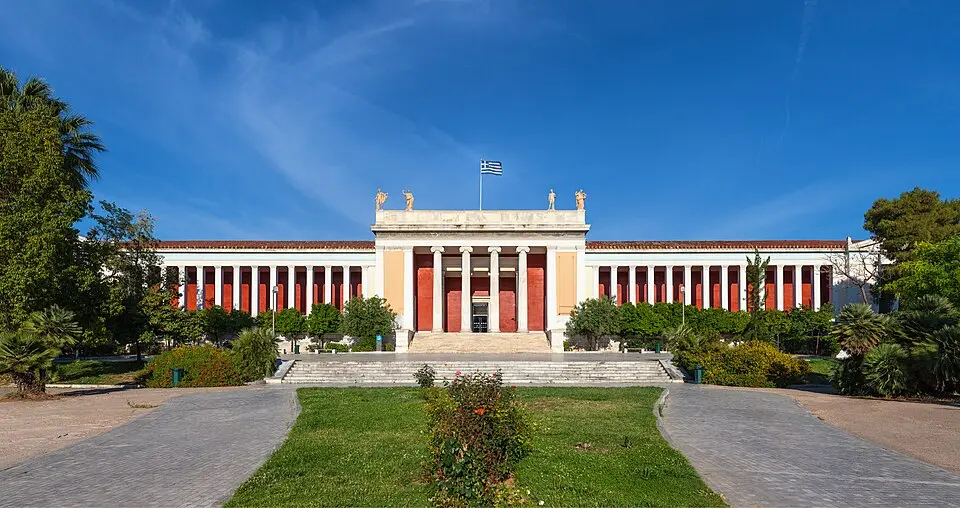
About Archäologisches Nationalmuseum
The National Archaeological Museum in Athens is the most important institution dedicated to ancient Greece and houses one of the most comprehensive collections of artworks and everyday objects from that era anywhere in the world. As the most visited museum in the city, it draws travelers who want a deep look at the cultural development of Greek civilization. The collection includes roughly eleven thousand exhibited objects from every region of Greece. This concentration of finds is a product of history: until the twentieth century, important archaeological discoveries were brought exclusively to this site. In addition to its focus on Greek history, the museum has its own department of Egyptian art, which broadens the cultural horizon of the exhibition.
The history of the museum building is closely tied to the founding of the modern Greek kingdom. Planning began as early as the 1850s, supported by state funds and generous private donations, including a significant gift from a Greek living in Saint Petersburg. After a public competition overseen by the academy in Munich, the architect Ludwig Lange was awarded the commission, but the project was put on hold because of excessive costs. Construction itself did not begin until 1866 under Panagiotis Kalkos. After his death, Ernst Ziller, a student of Lange's, took over the completion of the building, since Theophil von Hansen, who had originally been proposed, was unwilling to stick to Lange's plans. Ziller designed the striking neoclassical facade that still gives the building its distinctive look today. The main building was inaugurated in 1874, while the side wings were added in 1881 and 1885.
During World War II, the museum had to close in 1940. To protect the valuable exhibits from the turmoil of war, most of the collection was packed into crates and buried in secret locations, while the rest was stored in the basement. By 1945, the museum was able to reopen to the public. A major modernization followed at the end of February 2009, when the museum was expanded by roughly 24,000 square meters of exhibition space. This expansion, which is partly underground, made it possible to display more than two thousand additional ancient artifacts that had previously been kept in storage for lack of space. At a construction cost of about fifty million euros, it was the largest expansion in the museum's history.
The tour through the museum is divided into 52 rooms, 49 of which house the permanent exhibition and three of which are used for changing special exhibitions. The ground floor is almost entirely open for display, while on the upper floor only the rear section is accessible. Despite numerous renovations, the museum has kept its character as a nineteenth-century collection. The exhibits are not staged but presented plainly in display cases, so that the historicist building and the objects blend into a harmonious whole. The tour begins directly behind the entrance hall in the central wing, which connects the front of the building with the rear. Here you'll find the prehistoric collections, which include finds from the Neolithic, Cycladic, and Mycenaean cultures and span the period from the seventh millennium to around 1100 BC.
The sculpture collection deserves special mention; it is considered the most important and largest of its kind in the world. It comprises more than sixteen thousand inventory numbers, of which about nine hundred pieces are on display in thirty halls on the ground floor. These halls are arranged chronologically and lead you from the beginnings of large-scale sculpture in Greece to late antiquity. Most of the collection consists of stone sculptures, especially in marble, limestone, and other types of stone, supplemented by a few large bronze works. Because many visitors focus on this part of the tour, outstanding examples of the minor arts, especially ceramics, are integrated here as well. The exhibition begins with works in the so-called Daedalic style, including the statue of Nikandre, regarded as the earliest known life-size sculpture in Greece.
Archaic art is represented in several halls by the characteristic kouros and kore statues. The museum holds the largest number of these nude statues of youths, including famous works such as the Sounion Kouros and the Kroisos Kouros. These sculptures show the development of anatomy and artistic language, from rigid, blocklike figures to ever more detailed rendering of musculature and a more unified overall form. Alongside the statues, you'll see numerous reliefs, mostly grave stelae, which show a line of development going back to the Mycenaean period. Particularly fine is the fragment of a grave stele showing the head of a youth in front of a raised discus, as well as the relief of an armed runner, which masterfully captures the movement of the nude warrior.
The so-called Severe style, which emerged after the Persian Wars, is illustrated by heads and hands from the Temple of Aphaia on Aegina and by the larger-than-life bronze statue of Poseidon or Zeus from Cape Artemision. This statue, dated to around 460 BC, dominates the room and demonstrates the great mastery of Greek sculptors of the period. Next come Attic grave reliefs from the end of the fifth century BC, which regained their monumentality after the laws against lavish funerary monuments were lifted during the Peloponnesian War. These works are strongly influenced by the Parthenon frieze and often show the isolation of the deceased or a handshake between family members, as on the famous grave stele of Hegeso.
Finally, the museum offers a look at the monumental grave reliefs of the Rich style as well as marble copies of classical bronze works. Since only a few original bronzes have survived, these copies are especially important for reconstructing the appearance of famous works such as the Athena Parthenos or the Kassel Apollo. Other major exhibits include the frescoes from Akrotiri, the Mask of Agamemnon, the Marathon Boy, and the Antikythera Mechanism. This richly varied collection makes the National Archaeological Museum a must-see for any visitor to Athens who wants to experience the full breadth of the history and art of ancient Greece.
At a glance
- Category
- Museum › History museums
- Rating
- no reviews yet · write a review
- Address
- Odos Oktovriou Patissìon, Atene
Athens, Greece - Phone
- +302132144890
- Website
- www.namuseum.gr
- eam@culture.gr
- Coordinates
- 37.98917° N · 23.73250° E
- Data quality
- confidence 0.79
- Identifier
- ID a012762b-33e…
Location & surroundings
Toggle layersRatings & comments
none yetNear Archäologisches Nationalmuseum
closest 5 per category · 2 kmSights
Restaurants
Museums
Hotels
More:History museums in Athens (55)All museums in Athens (276)
300 places within 2 km loaded.
You need a free account to leave reviews and photos – that keeps comments genuine and lets you edit them later.
This is the largest and most popular of Athens' many museums, and is usually very crowded. Its vast collection includes treasures unearthed from Mycenae by Heinrich Schliemann; a staggering array of sculpture including the earliest known Greek figurines dating from around 2,000 BCE; frescoes from the volcanic island of Santorini; and remains of Antikythera mechanism, the oldest known mechanical computer. Plan to make several visits to absorb it all.
Source: Wikivoyage, „Athens“ · authors per page history · CC BY-SA 4.0 · as of 12/15/2025