About Vyšehradské casemates
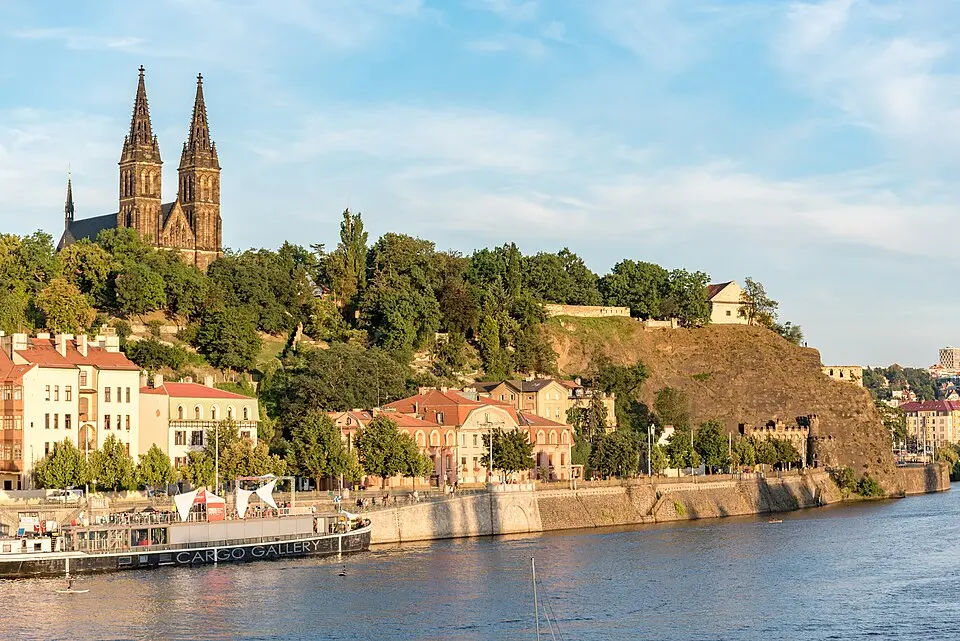
Vyšehrad, also known as the Prague stronghold, is one of the most important early medieval castle complexes in Bohemia. It rises on a steep hill south of Prague's New Town, right where the Botič River flows into the Vltava. Founded in the first half of the 10th century as the second residence of the Přemyslid dynasty, it is one of the oldest fortified sites in the region. The hill's present-day appearance is shaped largely by its conversion into a Baroque fortress in the 17th century, but its historical layers reach much further back. Inside the fortress walls today you will find the Basilica of St. Peter and St. Paul as well as the famous Vyšehrad Cemetery, which serves as the national burial ground for outstanding figures of Czech culture.
The history of Vyšehrad is closely tied to the legend of Princess Libuše, who is said to have had her seat here and to have foreseen the founding of Prague in a vision. Archaeological research has shown, however, that the complex is younger than Prague Castle on Hradčany Hill. A mint operated here from the 990s onward, and around 1070 King Vratislav II made Vyšehrad his main residence. The king founded the collegiate chapter of St. Peter and St. Paul here, which grew into an important center of learning. This period also saw the construction of the stone Romanesque palace as well as the Basilica of St. Lawrence and the Rotunda of St. Martin, considered the oldest rotunda in Prague.
A second major boom came under Emperor Charles IV in the second half of the 14th century. Motivated by his connection to his ancestor St. Wenceslas and by the memory of his late mother Elisabeth, Charles had the castle greatly expanded. New fortifications with square towers and battlements were built and linked to the wall of Prague's New Town. The main entrance was the so-called Pointed Gate, designed with nine small turrets. Charles IV also had a new royal palace built and the collegiate church converted into a three-aisled structure with side chapels. Vyšehrad became a fixed part of royal ceremony, as the coronation procession of the Bohemian kings traditionally led from here to Prague Castle.
After the death of Charles IV, the castle lost its political importance and became primarily a center of religious life. In the 15th century the complex suffered severe destruction during the Hussite Wars, after which it became a free town for small craftsmen. Only with the Counter-Reformation did the grounds revert to the chapter in 1620. Because the medieval fortifications had become militarily obsolete and were badly damaged in a Swedish attack in 1648, a complete rebuilding was decided upon. Between 1654 and 1680, Vyšehrad was transformed into a modern Baroque fortress.
Building this fortress required the demolition of many existing buildings and the removal of the local population. Massive brick ramparts and heavy corner bastions, named after saints, were erected. The fortress served its purpose until it was decommissioned in 1866. Soon afterward the area was incorporated into Prague as its sixth district. In the early 20th century, particularly in 1911, the fortifications were largely razed to make room for parks and green spaces. This transformation into a public space has largely shaped how the site is perceived today: a quiet, green place of reflection and remembrance.
Today you can visit the impressive remains of the Baroque fortifications, including the Empire-style Chotek Gate and the early Baroque Tábor Gate. The Pointed Gate still shows wall remnants of the Gothic main gate and a section of the medieval castle wall. Inside the fortress are casemates that illustrate the complex's former defensive purpose. Vyšehradské sady, a park on the site of the former Romanesque palace and Gothic royal court, offers a peaceful place to linger. Here you will find sculpture groups by Josef V. Myslbek, originally created for the Palacký Bridge, depicting figures from Czech legends.
A central attraction is the Basilica of St. Peter and St. Paul, founded in the 1070s and rebuilt several times. The current neo-Gothic façade with its two towers dates from the early 20th century, while the interior combines Baroque and Gothic elements. A particularly notable work of art is the so-called Vyšehrad Madonna, a Gothic panel painting from around 1360 showing the nursing Virgin Mary, which was venerated in processions during times of drought. Next to the church lies the Vyšehrad Cemetery, laid out as a national burial ground in the 1870s.
The cemetery is the final resting place of notable figures such as the composers Antonín Dvořák and Bedřich Smetana, the poet Jan Neruda, and the painter Alfons Mucha. At the center of the cemetery stands the Slavín, a shared tomb of honor for distinguished figures of the Czech nation. The Rotunda of St. Martin, one of the oldest buildings in Prague, was renovated in the 19th century and decorated with wall paintings showing motifs from the Vyšehrad Coronation Codex. The Basilica of St. Lawrence, an 11th-century Romanesque rotunda, is also part of the ensemble today and preserves remains of the original parish church.
Vyšehrad is not only a historic landmark but also a place of cultural identity. Bedřich Smetana dedicated the first symphonic poem of his cycle Má vlast (My Country) to it. The combination of medieval history, Baroque fortress architecture, and the tranquil atmosphere of the park and cemetery makes Vyšehrad a must-see for visitors to Prague. It offers impressive views of the city and the Vltava and invites you to explore the many layers of Bohemian history.
At a glance
- Category
- Sight › Historic sites
- Rating
- no reviews yet · write a review
- Address
- V Pevnosti 46
128 00 Prague, Czechia - District
- Praha 2
- Phone
- +420241410348
- Website
- www.praha-vysehrad.cz
- —
- Coordinates
- 50.06522° N · 14.41932° E
- Data quality
- confidence 0.99
- Identifier
- ID bfb10b1e-a3d…
Part of the tour
Prague for Food Lovers: From Brunch to Cocktails →Location & surroundings
Toggle layersRatings & comments
none yetNear Vyšehradské casemates
closest 5 per category · 2 kmSights
Restaurants
Museums
Hotels
More:Historic sites in Prague (736)Sights in Praha 2 (77)All sights in Prague (834)
291 places within 2 km loaded.
Don't miss in Prague
All sights Historic sites01
Pražský hrad
Pražský hrad, 119 08 · Prague● Website● Phone Historic sites02
Prague Astronomical Clock
Staroměstské nám. 1 · Prague● Website● Phone Historic sites03
Prasna brana
náměstí Republiky 1090/5 · Prague● Website● Phone Historic sites04
You need a free account to leave reviews and photos – that keeps comments genuine and lets you edit them later.