About Graz Museum Schlossberg
Graz's Schloßberg (Castle Hill) is a striking outcrop of dolomite rock that forms the heart of the historic old town of Graz, the capital of Styria. It rises directly from the left bank of the Mur River and towers 123 meters above the city's main square. As the northeasternmost and mostly green part of the old town, the hill is part of the UNESCO World Heritage Site "City of Graz – Historic Centre and Schloss Eggenberg." The rock is not only a scenic highlight but also a place of great historical and cultural significance, offering visitors a unique blend of nature, history, and architecture.
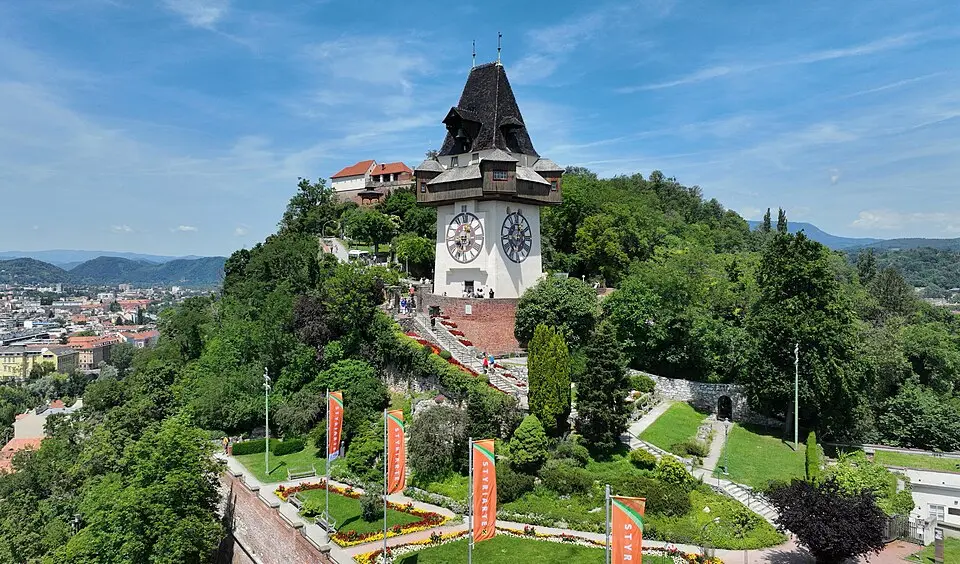
The history of the Schloßberg reaches far back into the past. Finds show that the site was settled as early as the 8th century B.C. Around 1125, a Romanesque castle was built on what was then a bare rock, giving the city its name, since "gradec" means "little castle" in Slovene. Over the centuries the complex was expanded in the Gothic style, and from 1544 it was developed into a mighty Renaissance fortress based on plans by Domenico dell'Allio. This fortress is considered one of the strongest of its kind and even withstood Napoleon's attacks in the early 19th century. It was not until 1809, when Napoleon threatened to destroy Vienna, that the city surrendered. Almost all of the fortifications were then razed, and only the Bell Tower and the Clock Tower were saved from destruction when the townspeople bought them back.
After the fortifications were dismantled, the character of the hill changed fundamentally. In 1839, Ludwig Freiherr von Welden began transforming the former fortress hill into a romantic garden. He laid out numerous walking paths and planted a number of Mediterranean plants that thrive thanks to Graz's mild climate. This design shaped the present-day appearance of the Schloßberg as a recreation area. In memory of Welden, a monument with a bronze statue was erected in 1859. The hill also served as the site of one of the first broadcasting stations outside Vienna, built in the early 1920s before being replaced by more modern facilities.
During World War II, the Schloßberg took on a new military function. An extensive tunnel system was dug inside the rock and served as a command center, air-raid shelter, and field hospital. Today, parts of these underground passages are in civilian use. They house, among other things, the Schloßberg Lift, the Schloßberg Slide, an event space called the "Dom im Berg" (Cathedral in the Mountain), and a footpath through the hill. The tunnel system also connects to natural stalactite caves that have been opened to visitors and offer a fascinating glimpse into the geological history of the rock.
On the summit plateau and along the slopes you'll find numerous historic structures and sights. The Clock Tower, the emblem of Graz, is one of the oldest buildings in the city and houses three historic bells. Not far away stands the Bell Tower, home to the great bell "Liesl," which is rung daily at set times. The Schloßberg casemates, former cellar vaults of the castle, have been converted into an open-air stage used for cultural events. You can also see the remains of the medieval castle and various smaller works of art on the hill.
A particular highlight is the new Schloßberg Museum, which opened in September 2020 in the rooms of the former Cannon Hut and the Stable Bastion. Designed by an architecture firm, the museum presents the history of the Schloßberg and the city of Graz. It offers an outdoor area with interactive stations and a viewing balcony with sweeping views over the city. Admission to these areas is free, which makes the museum a popular destination for families and tourists.
Getting up the Schloßberg is easy for visitors. You can ride to the top on the historic Schloßberg Railway, a funicular, or on the modern Schloßberg Lift. Alternatively, a footpath with 260 steps, known as the Kriegssteig, leads up to the Clock Tower. Adventurers can also try the Schloßberg Slide, which winds around the elevator shaft inside the rock and is considered the tallest indoor slide in the world. These different ways up make the Schloßberg accessible to a wide audience and offer different experiences, from a relaxed ride on the railway to a sporty challenge.
The nature on the Schloßberg is rich and diverse. The hill is covered by a mixed deciduous forest of European beech, hornbeam, ash, and elm. In sunny spots you'll also find introduced species such as black locust and tree of heaven. The lush ivy cover gives the woods a natural, untamed character. In the landscaped areas, Japanese ornamental cherries, broom shrubs, and a foxglove tree are in bloom. The Schloßberg is also an important habitat for various animals, including around 50 bird species, badgers, and the occasional fox.
Culturally, the Schloßberg is a place of encounter and remembrance. Here you'll find monuments commemorating historical events and figures, such as the Major Hackher Monument, which honors the defense of the hill against Napoleonic troops. The Herberstein Garden, a terraced complex with Mediterranean plantings, is among the finest examples of interwar garden architecture and offers a beautiful view over the city. The Chinese Pavilion and the Bishop's Chair are further historic sites that reflect the rich history of the place.
The Schloßberg is not only a historic monument but also a living part of everyday life in Graz. The roads on the hill are car-free, which adds to its peace and recreational value. Numerous trails invite you to hike, trail run, and mountain bike. The restaurants near the Bell Tower and the casemates are easily reached via the Schloßberg Railway. The Schloßberg is a place where history, nature, and culture blend in a unique way, offering visitors an unforgettable experience.
In short, the Graz Schloßberg is a treasure of the city that goes far beyond its function as a fortress hill. It is a place of history, nature, and culture that gives visitors from around the world the chance to experience the history and beauty of Graz in a special way. Whether you're visiting the historic structures, enjoying nature, or exploring modern attractions like the slide and the museum, the Schloßberg has something for everyone. It is an essential part of the UNESCO World Heritage Site and a symbol of the rich history and vibrant culture of the Styrian capital.
At a glance
- Category
- Museum › History museums
- Rating
- no reviews yet · write a review
- Address
- Schloßberg 5
8010 Graz, Austria - District
- Innere Stadt
- Phone
- +433168727630
- Website
- —
- —
- Coordinates
- 47.07497° N · 15.43675° E
- Data quality
- confidence 0.86
- Identifier
- ID a11f3586-0fd…
Location & surroundings
Toggle layersRatings & comments
none yetNear Graz Museum Schlossberg
closest 5 per category · 2 kmRestaurants
Museums
More:Museums in Innere Stadt (17)All museums in Graz (40)
223 places within 2 km loaded.
You need a free account to leave reviews and photos – that keeps comments genuine and lets you edit them later.