Cà Mau: Mangrove Forests at the End of Vietnam
Travel guide · editorialAt Cape Cà Mau, Vietnam ends in a tangle of mangroves and mudflats that grow a little farther into the sea every year. The province at the very southern tip has been merged with Bạc Liêu since 2025. A trip to Cà Mau leads to forests that stand in water, wind turbines rising from the tidal flats, and places closely tied to southern Vietnamese folk music.
Where the Land Grows into the Sea
The Cà Mau Peninsula is the southernmost part of the Mekong Delta and juts out between the South China Sea and the Gulf of Thailand. The land is flat, crisscrossed by canals, and lined with mangroves along the coasts. To the west lies the U Minh Hạ peat forest, a melaleuca swamp forest, and to the south the mangroves of Mũi Cà Mau National Park, a UNESCO biosphere reserve. The administrative seat is the city of Cà Mau; the second city is Bạc Liêu to the east. Shrimp farming and fishing shape the economy, along with rice in the less salty areas. Many Khmer and ethnic Chinese people live in the region.
Sights in Cà Mau
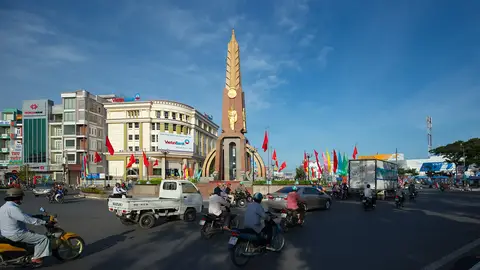
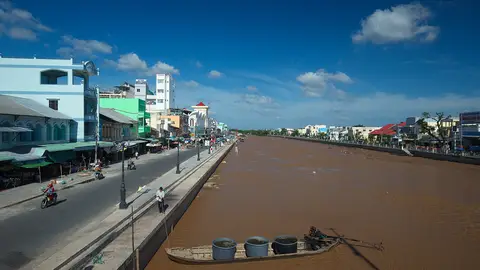
The goal of every trip is Cape Cà Mau, the southernmost point of the mainland, marked by a monument shaped like a ship's bow and a coordinates marker. From the city of Cà Mau, speedboats take several hours to get there through canals and mangroves; along the way you pass fishing villages on stilts and barges loaded with charcoal made from mangrove wood. In U Minh Hạ National Park, boat tours and wooden boardwalks lead through the forest, where bees gather wild honey and herons nest. The city of Cà Mau has a floating market and several Chinese and Khmer temples. Off the southern tip lies the small Hòn Khoai island group with an old lighthouse.
Bạc Liêu and the Coast
Bạc Liêu is famous for the story of the "Prince of Bạc Liêu," Trần Trinh Huy, a wealthy heir who spent money lavishly in the 1930s. His colonial-era house is now a museum. The city was also home to Cao Văn Lầu, the composer of the song "Dạ cổ hoài lang," which helped make cải lương, southern Vietnam's reformed theater, popular; a large square with statues of musical instruments commemorates him. Along the coast, dozens of wind turbines turn right out on the tidal flats, a popular photo spot. The Bạc Liêu Bird Sanctuary is home to herons and storks, and sea salt is harvested in the salt fields.
Food and Drink
The cuisine lives off the sea: crabs from Năm Căn, shrimp in every variety, and mudskippers, cá thòi lòi, which hop across the mud and are served grilled. Bánh tằm cay, thick rice noodles with coconut milk and chili, is typical of Bạc Liêu. Wild melaleuca honey comes from U Minh, and the markets pile up dried fish and shrimp in big heaps.
Getting There and Best Time to Visit
Cà Mau Airport (CAH) has flights from Ho Chi Minh City. By bus, the trip from Saigon takes about eight hours, and the expressway is being extended step by step. The best time to visit is the dry season from December to April. During the rainy season it is muggy, and many paths in the forest can only be reached by boat.