




Minnesota: Land of 10,000 Lakes
Travel guide · editorialThe license plates read "Land of 10,000 Lakes," but the real number is even higher, with more than 11,000 lakes. A vacation in Minnesota therefore often takes place on the water: paddling a canoe through the Boundary Waters, along the bluffs of Lake Superior, or on the shores of the Minneapolis city lakes, where locals jog in summer and ice-skate in winter.
Water, Forest, and Prairie
Minnesota sits at the very top of the Midwest, bordering Canada. The glaciers of the Ice Age shaped the land and left behind countless basins that filled with water. In Itasca State Park, the Mississippi begins as a narrow stream that you can cross on stepping stones. The northeast is defined by evergreen forests and Lake Superior; the North Shore between Duluth and Grand Portage offers cliffs, waterfalls, and lighthouses such as Split Rock Lighthouse. In the west and south, the landscape gives way to open prairie and farmland. The Boundary Waters Canoe Area Wilderness on the Canadian border is a motor-free labyrinth of more than 1,000 lakes that can be explored only by canoe and on foot. Together with Voyageurs National Park, it is one of the best regions in the U.S. for seeing the northern lights and wolves.
The Twin Cities
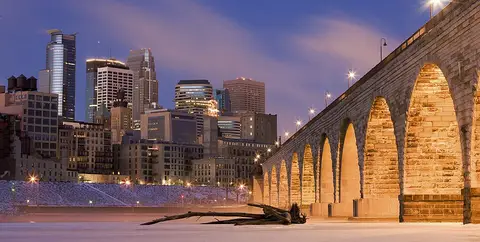
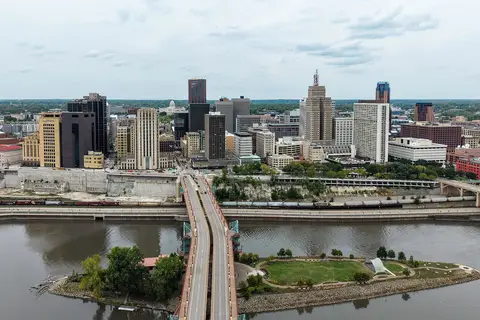
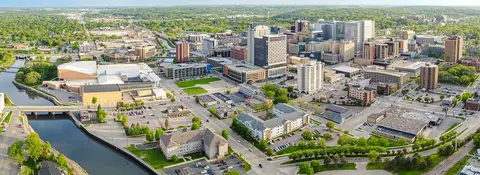
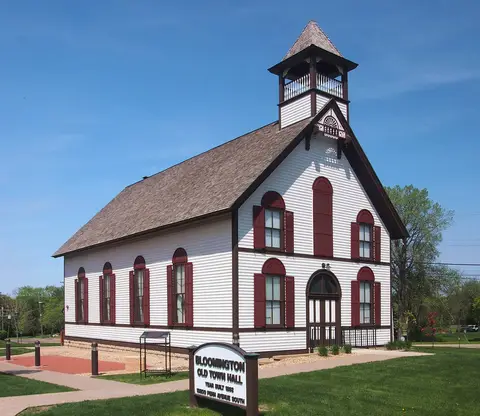
Minneapolis and Saint Paul lie on opposite sides of the Mississippi and are known together as the Twin Cities. Minneapolis is the larger and more modern of the two: the Stone Arch Bridge, a former railroad bridge, leads past St. Anthony Falls, where grain mills once stood; the Mill City Museum tells that story inside a ruined mill. The Walker Art Center, with its sculpture garden and the landmark "Spoonbridge and Cherry," and the Guthrie Theater showcase the city's strong arts scene. The chain of lakes, including Bde Maka Ska and Lake Harriet, is the city's favorite spot for outdoor recreation. Saint Paul, the state capital, feels older and more dignified, with an imposing cathedral, Victorian mansions on Summit Avenue, where F. Scott Fitzgerald grew up, and the Winter Carnival in January. In the suburb of Bloomington stands the Mall of America, the largest shopping center in the U.S., with an amusement park inside. Eagan is another large suburb.
Sights in Minnesota Beyond the Metro Area
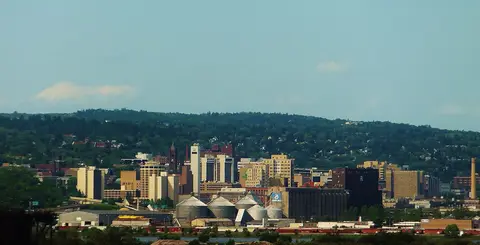
Duluth, the port city at the western tip of Lake Superior, has a lift bridge that large freighters pass beneath, and a scenic waterfront promenade, the Lakewalk. Rochester in the south is world-famous for the Mayo Clinic, one of the most renowned medical centers in the world. Saint Cloud and Mankato are college towns. In the southeast, the Mississippi flows through the hilly Bluff Country, with towns such as Red Wing, where the boots of the same name are made. If you want to see the state's mining heritage, head to the Iron Range around Hibbing, where Bob Dylan grew up and where you can tour a huge open-pit mine.
Culture and History
The Dakota and Ojibwe lived here long before Europeans arrived. In the 19th century, mainly Germans, Swedes, Norwegians, and Finns immigrated; Lutheran churches, lutefisk dinners, and the Swedish American Institute are reminders of that era. Minnesota became a state in 1858. Today, the Twin Cities are home to large Hmong and Somali communities. Musically, Minneapolis is synonymous with Prince, whose studio, Paisley Park, in Chanhassen, is open for tours. The Minnesota State Fair at the end of August draws nearly two million visitors every year.
Food and Drink
Typical dishes include "hotdish," a casserole of ground beef, vegetables, and tater tots, and the Juicy Lucy, a burger with molten cheese inside, whose invention two Minneapolis bars still dispute. Wild rice is traditionally harvested by the Ojibwe from canoes. Lake Superior supplies whitefish and lake trout, often smoked.
Best Time to Visit and Getting There
The best time to visit the lakes and forests is from June to September; at the end of September, the North Shore turns a brilliant red. Winters are extremely cold, with temperatures well below minus 20 degrees, but ice fishing and cross-country skiing have their fans. Minneapolis–Saint Paul International Airport (MSP) is a major hub with direct flights from Europe; light rail connects it to both downtowns and the Mall of America.