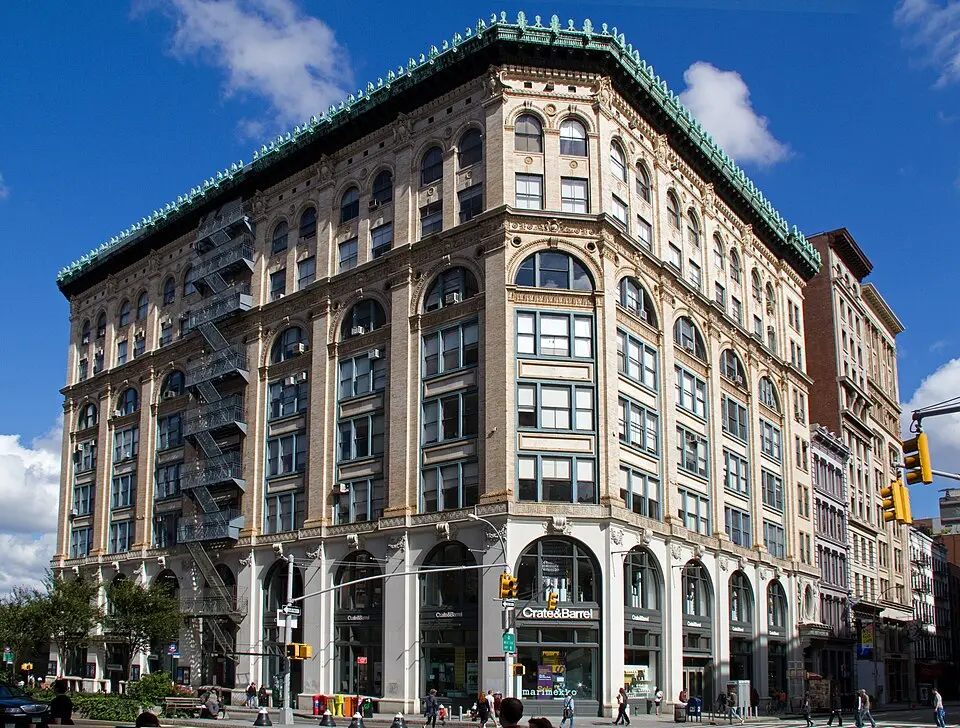
About The Cable Building
The Cable Building stands at the corner of Broadway and Houston Street in New York's NoHo neighborhood and is a striking example of late-19th-century Beaux-Arts architecture. Designed by the renowned architect Stanford White of the firm McKim, Mead & White, the building was constructed between 1892 and 1894. It is a nine-story structure with a steel and iron frame, clad in brick, stone, and terra-cotta. The facade stands out for its limestone base with a two-story arcade, whose display windows are framed by iron spandrels and elegant keystones. A prominent copper cornice with lion heads and acanthus ornaments crowns the building. The main entrance on Broadway in particular was originally flanked by two 11-foot-tall figures created by the Scottish-American sculptor J. Massey Rhind. As the only building of its kind in the NoHo Historic District designed by such a significant architectural firm, it embodies the principles of the so-called American Renaissance.
The building originally served as the headquarters and power station of the Metropolitan Traction Company, one of the city's leading cable car companies. In the basement, located deep below street level, were large winding wheels and powerful steam engines that drove the cables pulling the streetcars along Broadway. This technology proved short-lived, however, as mechanical problems with the steel cables created safety hazards. As early as 1901, the system was replaced by electric drives, with the last cable car retired on May 21 of that year. Despite the technological shift, the building kept its name. Over the decades, its use changed several times: after it was sold in 1925, it initially housed small businesses and later mostly clothing manufacturers.
Today the Cable Building is a protected historic landmark that serves a variety of functions. Since 1989, the former engine room in the lower level has been home to the Angelika Film Center, a movie theater specializing in arthouse films. Part of the ground floor and the entire second floor are occupied by a large home furnishings store, while the remaining floors are used as office space. The building also gained special cultural significance through its use for a time as the studio of pop artist Keith Haring in the early 1980s. The building's historic fabric, which stands on the former site of St. Thomas Church, has been safeguarded since 1999 by its inclusion in the NoHo Historic District.
At a glance
- Category
- Sight › Historic sites
- Rating
- no reviews yet · write a review
- Address
- 611 Broadway
10012 New York, USA - District
- Manhattan
- Phone
- —
- Website
- 611broadway.com
- —
- Coordinates
- 40.72588° N · -73.99707° E
- Data quality
- confidence 0.92
- Identifier
- ID ef26bafd-608…
Location & surroundings
Toggle layersFAQ about The Cable Building
quick answersWhat is the Cable Building in New York?
The Cable Building is a landmarked Beaux-Arts office building at 611 Broadway in Manhattan, New York. It stands at the corner of Broadway and Houston Street in the NoHo neighborhood and was built between 1892 and 1894. Since 1999 it has been part of the NoHo Historic District, which protects its historic fabric.
Who designed the Cable Building in New York, and what is special about its architecture?
The Cable Building in New York was designed by Stanford White for the architecture firm McKim, Mead & White and is considered an example of the so-called American Renaissance. The nine-story building has a steel and iron frame clad in brick, stone, and terra-cotta. Highlights include the limestone base with a two-story arcade and the copper cornice with lion heads and acanthus ornaments. The main entrance on Broadway was originally flanked by two 11-foot-tall figures by the sculptor J. Massey Rhind.
What was the Cable Building in New York originally used for?
The Cable Building in New York originally served as the headquarters and power plant of the Metropolitan Traction Company, a leading cable car company. In the deep basement, large winding wheels and steam engines drove the cables that pulled the streetcars along Broadway. Because of mechanical problems with the steel cables, the system was replaced with electric propulsion in 1901; the last cable car ran on May 21, 1901. The building kept its name anyway.
How is the Cable Building in New York used today?
Today the Cable Building in Manhattan combines a movie theater, retail, and offices. The former engine room in the lower level has housed the Angelika Film Center, which specializes in art-house films, since 1989. Part of the ground floor and the second floor are occupied by a large home furnishings store, and the remaining floors are office space. In the early 1980s, the pop artist Keith Haring briefly used the building as a studio.
What can you see around the Cable Building in New York?
Around the Cable Building at 611 Broadway in Manhattan, you'll find more historic buildings and art venues within walking distance. travelguide195 lists the Bayard Condict Building about 575 feet away and the Susan Sheehan Gallery about 385 feet away, among others. For a break, travelguide195 lists around 440 restaurants within 500 meters.
Ratings & comments
none yetNear The Cable Building
closest 5 per category · 2 kmSights
Restaurants
Museums
More:Historic sites in New York (3,728)Sights in Manhattan (2,358)All sights in New York (4,021)
300 places within 2 km loaded.
Don't miss in New York
All sights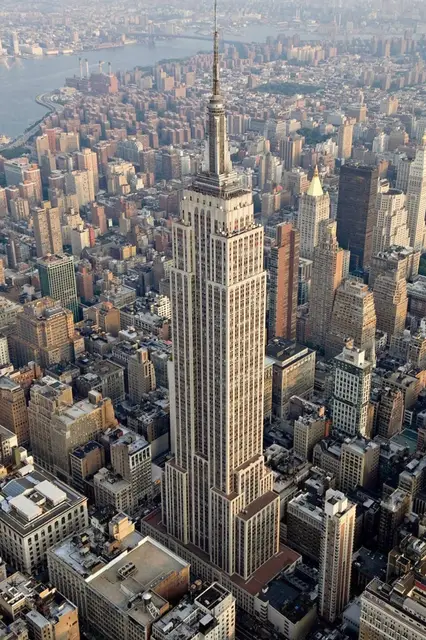 Historic sites01
Empire State Building
20 W 34th St · New York● Website○ Phone Monuments02
9/11 World Trade Center Memorial Monument
180 Greenwich St · New York○ Website● Phone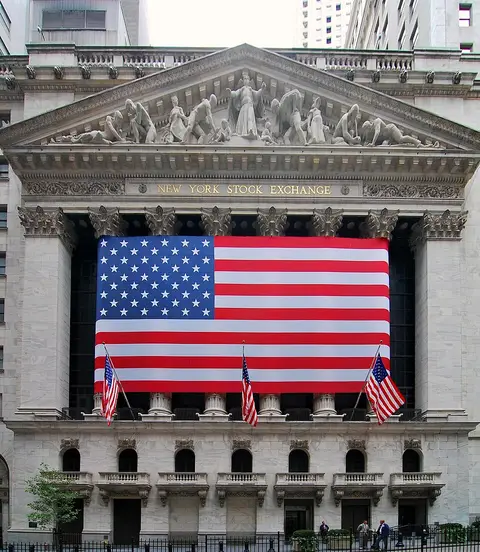 Historic sites03
New York Stock Exchange
11 Wall St · New York● Website● Phone Historic sites04
You need a free account to leave reviews and photos – that keeps comments genuine and lets you edit them later.
So-called because its top two floors were once occupied by the Metropolitan Traction Company, which made cable cars, this beautiful, block-long building that extends to Mercer Street to the west has a striking copper cornice and ornate decorations on its facade. It was built between 1892 and 1894. The Angelika Film Center , one of New York's most famous independent cinemas, is on the Mercer St. side, on the corner of Houston.
Source: Wikivoyage, „Broadway“ · authors per page history · CC BY-SA 4.0 · as of 11/9/2021