About Quartiere francese
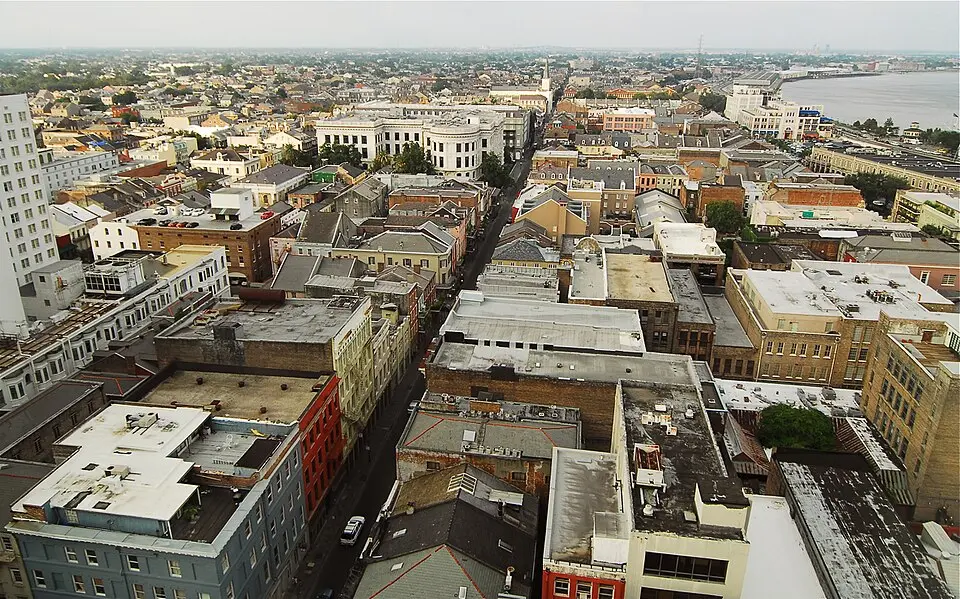
The French Quarter, known in French as the Vieux Carré, is considered the historic heart and oldest neighborhood of New Orleans. The area's settlement history reaches back to 1718, when Jean-Baptiste Le Moyne de Bienville founded the city. Since then, the neighborhood has grown up around its central square, which was originally known as the old square. While the name French Quarter is common in English today, a result of the influx of American settlers after the Louisiana Purchase in the early 19th century, the architecture and urban layout reflect the area's complex colonial past. Most of the historic buildings that survive today date either from the late 18th century, when the city was part of the Viceroyalty of New Spain, or from the first half of the 19th century, after Louisiana had become part of the United States.
The neighborhood's development was shaped decisively by two devastating fires, in 1788 and 1794, which destroyed most of the original French colonial architecture. The new Spanish colonial rulers used the destruction to rebuild the city in the style of the day. A strict fire code required all buildings to abut one another and stand close to the curb, forming a continuous firewall. The old wooden cladding was also replaced with fire-resistant stucco, painted in the pastel colors fashionable at the time, and roofs were covered with tiles. This combination of colorful facades, tile roofs, and elaborately decorated wrought-iron balconies still defines the neighborhood's distinctive streetscape today.
Geographically, by the most common definition, the French Quarter covers the area along the Mississippi from Canal Street to Esplanade Avenue and inland to Rampart Street. It spans 78 city blocks and is bounded by Esplanade Avenue to the north, the Mississippi to the east, Canal Street, Decatur Street, and Iberville Street to the south, and Basin Street, St. Louis Street, and North Rampart Street to the west. Any alteration to buildings in this area is subject to strict review by the Vieux Carré Commission, which ensures that new construction and renovations fit the district's historic character. This tight regulation has helped preserve the neighborhood's unique charm over the centuries.
A focal point of the neighborhood is Jackson Square, originally known to the French as the Place d'Armes and later to the Spanish as the Plaza de Armas. In the 19th century the square was renamed for the seventh U.S. president, Andrew Jackson, who won a victory over the British at the Battle of New Orleans. At the center of the square stands an equestrian statue of Jackson, created by sculptor Clark Mills in 1856. In the past the square also served as a military parade ground and execution site, underscoring the darker side of the neighborhood's history. Today it is a public park flanked by three historic 18th-century buildings that formed the heart of the city during the colonial era.
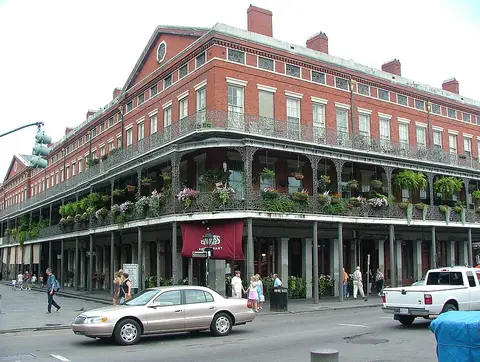
These three buildings include St. Louis Cathedral, which was elevated to a minor basilica by Pope Paul VI. To the left of the cathedral is the Cabildo, the former city hall, which now houses a museum. The final transfer documents for the Louisiana Purchase were signed here. To the right stands the Presbytère, which was originally planned as a residence for priests, later served as a courthouse, and is now also used as a museum. On either side of Jackson Square rise the Pontalba Buildings, four-story red-brick buildings erected between 1849 and 1851 by Baroness Micaela Almonester Pontalba. Their ground floors hold shops and restaurants, while the upper floors serve as apartments.
Bourbon Street is probably the best-known street in the French Quarter and, with its many bars and restaurants, draws millions of tourists every year. Although many of the bars popular with visitors are new, the neighborhood also has historic establishments with fascinating stories. The Old Absinthe House has kept its name even though absinthe was banned in the United States for a long time. Pat O'Brien's Bar on St. Peter Street is famous for inventing the red Hurricane cocktail. On the same street is Preservation Hall, which has been an important venue for New Orleans jazz since 1961. Another historic highlight is Lafitte's Blacksmith Shop, built before 1772 and considered the oldest bar still in operation in all of America.
The dining scene in the French Quarter is as varied as its history. You'll find restaurants that have been around since the 19th century, such as Antoine's and Tujague's, which are among the city's best-known landmarks. Arnaud's, Galatoire's, and Broussard's are also esteemed addresses for food lovers. Brennan's, which has been in business since 1946, is known for its elegant dining rooms and excellent cuisine. Alongside these historic establishments are modern restaurants from renowned chefs such as Paul Prudhomme, Emeril Lagasse, and John Besh. Café du Monde on Jackson Square is especially known for its café au lait and beignets, which have been made there continuously since the Civil War era.
Lodging in the French Quarter ranges from large international hotel chains to small guesthouses with just a few rooms. Traditional hotels such as the Bourbon Orleans, the Hotel Monteleone, and the Royal Sonesta are fixtures of the cityscape. Some properties, such as the Audubon Cottages, consist of luxurious Creole cottages, two of which were used in the 19th century by the naturalist John James Audubon. The Hotel St. Pierre and the Hotel Mazarin also offer historic atmosphere with stylish courtyards. This variety of accommodations reflects the broad appeal of the neighborhood, which is an important center of life for tourists and locals alike.
Hurricane Katrina in 2005 had only a limited impact on the French Quarter compared with other parts of the city. Because the neighborhood sits on higher ground in front of the levee systems and is protected from the Mississippi by solid, high embankments, flood damage was relatively light. Some streets were flooded and buildings suffered wind damage, but most attractions and businesses sustained only minor damage. The neighborhood was largely spared the looting and violence that broke out in other areas after the storm. Within a few weeks, most businesses were able to reopen, underscoring the neighborhood's resilience.
The French Quarter is not just a historic district but also a vibrant center of culture and nightlife. Live music has been a fixture of the neighborhood for more than a century, and street musicians regularly perform on Jackson Square and other public spaces. The neighborhood is also home to a lively LGBTQ+ scene, with bars and clubs that sponsor the annual Southern Decadence festival, often called Gay Mardi Gras. The combination of historic architecture, cultural diversity, and lively nightlife makes the French Quarter a one-of-a-kind experience that attracts visitors from around the world and brings the history of New Orleans vividly to life.
At a glance
- Category
- Sight › Historic sites
- Rating
- no reviews yet · write a review
- Address
- —
New Orleans, USA - District
- French Quarter
- Phone
- +15043227030
- Website
- —
- —
- Coordinates
- 29.95861° N · -90.06500° E
- Data quality
- confidence 0.72
- Identifier
- ID b196341a-c0a…
Location & surroundings
Toggle layersRatings & comments
none yetNear Quartiere francese
closest 5 per category · 2 kmSights
Restaurants
Museums
Hotels
More:Historic sites in New Orleans (408)Sights in French Quarter (38)All sights in New Orleans (450)
300 places within 2 km loaded.
You need a free account to leave reviews and photos – that keeps comments genuine and lets you edit them later.