About Westminster Bridge
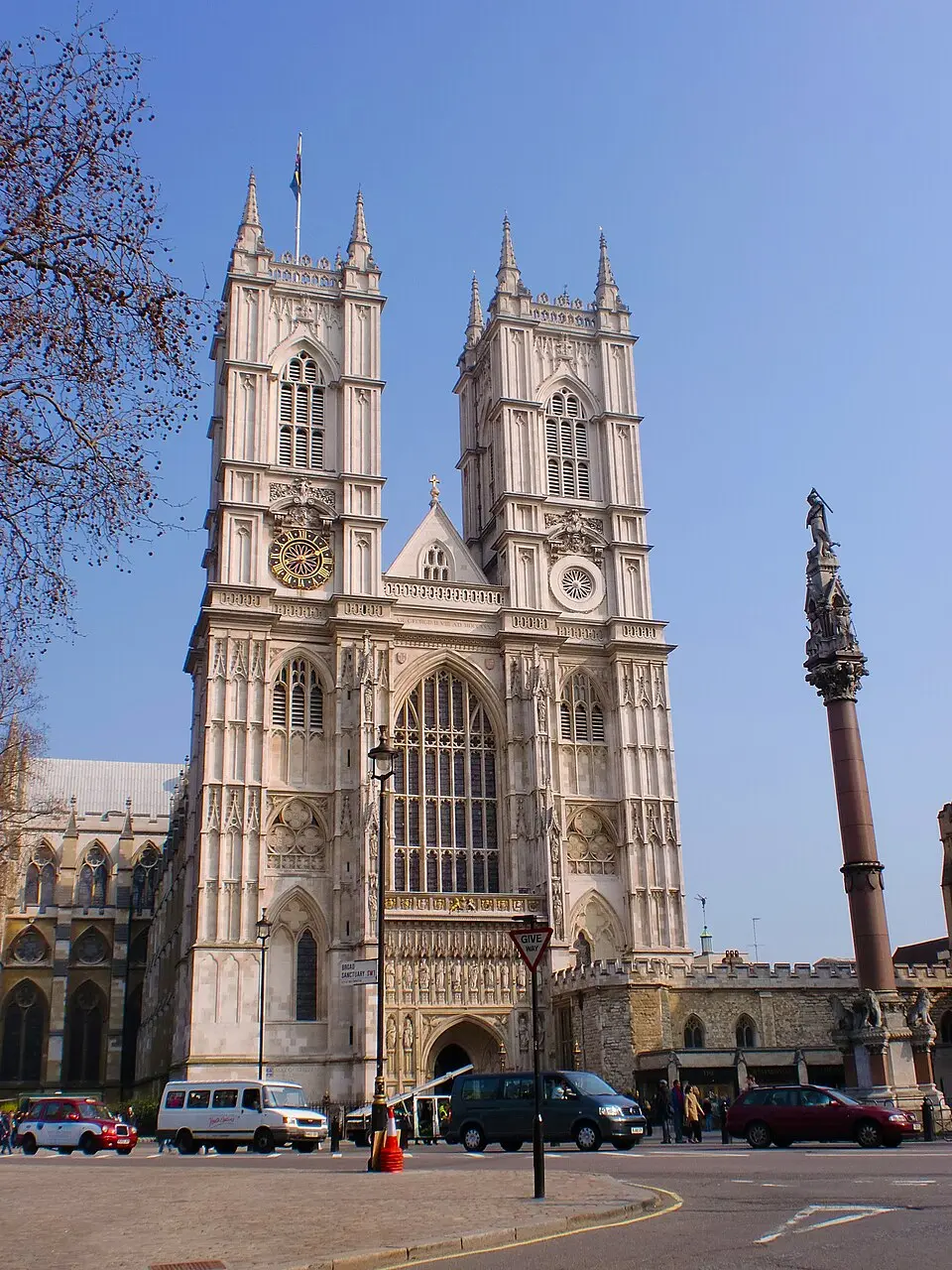
Westminster Abbey is one of the most important and best-known churches in the British capital, London. The Gothic church stands in the City of Westminster, directly west of the Palace of Westminster, home of Parliament. As the collegiate church of the Collegiate Church of St Peter at Westminster, it belongs to the Church of England, but because of its special historical role it is not assigned to any diocese. Instead, it is a so-called Royal Peculiar, a church under the direct authority of the British monarchy, which means that its senior cleric, the Dean of Westminster, is appointed directly by the reigning monarch. This unique status underscores the deep connection between the church and the country's royal history. Each year, around 1.6 million people visit this historic landmark to experience its architecture, its tombs, and its cultural significance.
The history of the site goes back to the 10th century, when King Edgar and Dunstan of Canterbury founded a Benedictine abbey here. The name West Minster derives from the Latin term for a minster, in the same way as St Paul's Cathedral, which was known as East Minster. In the 11th century, Edward the Confessor had the monastery expanded into an imposing Romanesque abbey, which was consecrated in 1065. After his death, the king was buried here, marking the beginning of a long tradition of royal burials. The only surviving depiction of this early abbey appears on the famous Bayeux Tapestry.
The present building was begun in 1245 on the orders of King Henry III in the style of French High Gothic. By 1269, the choir, transept, and eastern part of the nave were complete, with the architect Henry of Reyns, who came from Reims Cathedral, playing a key role in the design. The nave was not built until a century later, between 1376 and 1506, with the original design vocabulary retained. The two striking western towers were added only in the 18th century by Christopher Wren, Nicholas Hawksmoor, and John James, who took up the Gothic style. Westminster Abbey is therefore regarded as the most French of English Gothic churches.
The building materials came from a variety of sources: most of the stone was obtained from Caen in France, the Isle of Portland, and the Pays de la Loire region. Purbeck marble was used for masonry and floors, while the roof timbers were made from the wood of the great Irish oak forests near Finglas. A particular jewel of the abbey is the Lady Chapel of Henry VII, built between 1503 and 1519 in the rich Perpendicular style and counted among the finest late Gothic works in Europe.
During the English Reformation, Henry VIII dissolved the Benedictine abbey in 1540 and gave the church the status of a cathedral. After a brief return of the Benedictines under Mary I, Elizabeth I established the Anglican Collegiate Church of St Peter in 1560, which still exists today. Since the coronation of William the Conqueror, all kings of England and, later, of the United Kingdom have been crowned in Westminster Abbey, traditionally by the Archbishop of Canterbury. Until the reign of George II in 1760, nearly all kings were also buried here, making the church a central burial place of British monarchs.
The main entrance is on the west side. The portal, redesigned in 1998, is framed by depictions of the four Christian virtues of Truth, Justice, Mercy, and Peace, as well as ten martyrs of the 20th century. In the center of the nave lies the Tomb of the Unknown Warrior, an unidentified soldier killed in World War I, who rests in soil from French battlefields. An inscription on black marble records that he was buried "among the kings" because he had done good toward God and country. The St George's Chapel is also worth noting, where the fallen of both World Wars are honored.
In the south transept is the famous Poets' Corner. Here you will find monuments and burial places of important writers and poets such as William Shakespeare, Geoffrey Chaucer, Alfred Tennyson, Robert Browning, Charles Dickens, and George Frideric Handel. In the north transept, numerous famous British statesmen are buried, including William Pitt the Elder, Palmerston, Disraeli, and Gladstone. These graves underscore the abbey's role as a place of national remembrance for outstanding figures in British history.
Behind the high altar lies the Chapel of Edward the Confessor, which houses the Coronation Chair. Until 1996, this chair held the Stone of Scone, the stone on which Scottish kings were crowned for centuries. The stone was taken from the Scots by Edward I in 1297, stolen in 1950, and finally officially returned to Scotland in 1996, where it is now kept in Edinburgh Castle. This chapel also holds the tombs of several important kings, including Henry III, Edward I, Edward III, Richard II, and Henry V.
The organ of Westminster Abbey is another highlight of the interior. The instrument was built in 1937 by Harrison & Harrison for the coronation of George VI and has since been expanded and overhauled several times. It is located on the north and south sides of the western part of the choir and has a complex specification with several manuals and a pedalboard. The organ cases date originally from 1895 and were made for an earlier organ.
Since 2018, the abbey has housed a museum in the triforium, the Queen's Diamond Jubilee Galleries. The exhibition is divided into four thematic chapters: the building of the abbey, worship and daily life, the relationship with the monarchy, and national remembrance. Exhibits include royal funeral items such as the saddle, helm, and shield of Henry V, medieval glass, sculptural fragments, and the coronation chair of Queen Mary II. Replicas of the Crown Jewels and historic portraits of kings and queens are also on display. A particularly special piece is the Westminster Retable, England's oldest surviving altarpiece, dating from the late 13th century, which was made for the high altar and is now displayed after careful restoration.
Westminster Abbey is far more than a historic building; it is a living symbol of British history, culture, and spirituality. As you wander through its magnificent spaces and chapels, you can experience the connection between monarchy, nation, and church. The combination of architectural beauty, historic tombs, and museum exhibits makes it an essential destination for anyone who wants to understand the history of Britain.
At a glance
- Category
- Sight › Monuments
- Rating
- no reviews yet · write a review
- Address
- St. Margaret St, Westminster
SW1A 2JH London, United Kingdom - District
- City of Westminster
- Phone
- 020 7930 4097
- Website
- thames.me.uk
- —
- Coordinates
- 51.49991° N · -0.12622° E
- Data quality
- confidence 0.77
- Identifier
- ID c9753a86-497…
Location & surroundings
Toggle layersRatings & comments
none yetNear Westminster Bridge
closest 5 per category · 2 kmSights
Restaurants
Museums
Hotels
More:Monuments in London (301)Sights in City of Westminster (559)All sights in London (3,487)
300 places within 2 km loaded.
You need a free account to leave reviews and photos – that keeps comments genuine and lets you edit them later.