About Buckingham Palace
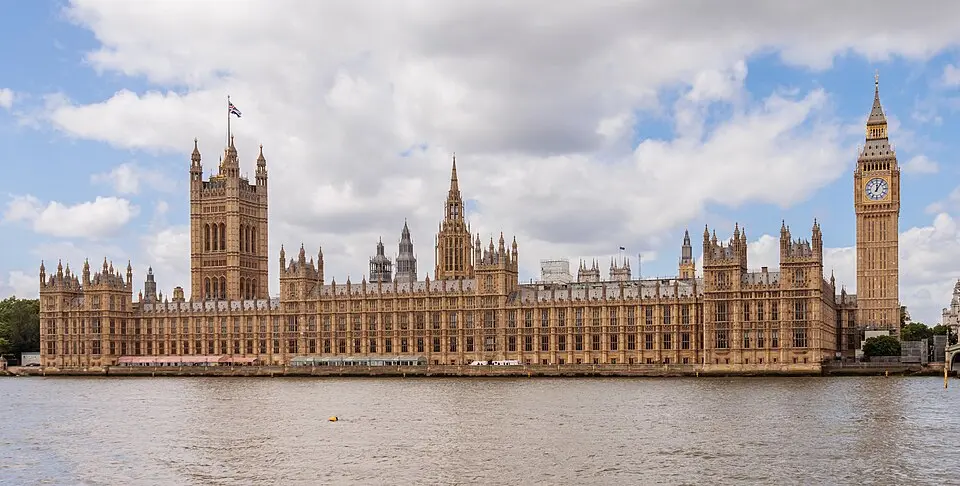
The Palace of Westminster, commonly known as the Houses of Parliament, is the historic and political heart of the British Parliament in London. This monumental complex of buildings on Parliament Square in the City of Westminster stands right next to the government buildings on Whitehall and, together with Westminster Abbey and St Margaret’s Church, has been designated a UNESCO World Heritage Site. The architecture of the complex, built mostly between 1840 and 1870 in the Gothic Revival style, leaves a lasting mark on the skyline of the British capital. Although the palace is best known today as the seat of lawmaking, it was originally the residence of the English kings. That role ended in 1529, when no monarch lived there anymore, but the site kept its central importance for the business of government.
The history of the site goes back to the early Middle Ages, when it was known as Thorney Island. Its strategic position on the Thames, which was shallower and wider then than it is today, attracted King Canute the Great, who had a small residence built here. Under Edward the Confessor, a palace was then built at the same time as neighboring Westminster Abbey. The name Westminster comes from the site's location west of the monastery. After the Norman Conquest of England, the site became the kings' main residence, and the most important institutions of government gathered here as a result. Westminster Hall, built in 1097, was the largest hall in Europe at the time and served as the meeting place of the royal council and, in 1295, of the first official parliament.
On October 16, 1834, a devastating fire destroyed most of the historic building. The blaze was started by the burning of surplus tally sticks in the Exchequer, leading to a disaster that only a few parts, such as Westminster Hall and the Jewel Tower, survived. The architects Charles Barry and Augustus Pugin were commissioned to rebuild the palace, and they chose the Gothic style after a heated debate between supporters of Classicism and Gothic. Barry designed the symmetrical floor plan, while Pugin created the detailed Gothic ornamentation. Construction began in 1840 and was largely complete by Barry's death in 1860, with final details worked out until 1870.
The exterior of the palace is defined by its imposing facade and several striking towers. The best known is the Elizabeth Tower, formerly called simply the Clock Tower and officially named after Queen Elizabeth II since 2012. It houses the famous bell Big Ben, which strikes on the hour, as well as the four large dials of the Great Clock of Westminster. The tower is 96.32 meters (316 ft) tall and a symbol of London. At the southwest corner rises the Victoria Tower, which at 98.45 meters (323 ft) is the tallest tower of the complex and now houses the Parliamentary Archives. The Central Tower in the middle serves as a ventilation shaft and is crowned with a spire. The facade itself was originally built of Anston limestone, which deteriorated through air pollution and was replaced with Clipsham stone in the 1930s, a restoration that continued into the 1990s.
Inside, the palace spans five floors with around 1,100 rooms, 100 staircases, and corridors that together measure 4.8 kilometers (3 miles) in length. The most important rooms are on the first floor, known as the principal floor. Here the debating chambers of the House of Commons and the House of Lords lie in a straight line from south to north. The chamber of the upper house, the Lords Chamber, is lavishly decorated and done in shades of red. It holds the monarch's throne, used at the State Opening of Parliament, as well as the Woolsack, where the Lord Speaker sits. The members of the House of Lords sit on red benches, with the Lords Spiritual on one side of the chamber and the Lords Temporal on the other.
The chamber of the lower house, the Commons Chamber, is in the northern part of the building and is far more restrained in design. The furniture and benches are in shades of green, a color choice that has also been adopted in many other Commonwealth parliaments. The chamber is relatively small and has room for only some of the members, which is why people often stand at the ends of the room during important sessions. The Speaker's Chair, a gift from the Australian government, stands at the northern end. By tradition, the monarch never enters this room, a rule that goes back to a historic event in 1642, when King Charles I attempted to have members of Parliament arrested.
Westminster Hall, the oldest surviving part of the palace, sits slightly offset next to the Commons Chamber. It is one of the largest halls in Europe with an unsupported roof and historically served as a courtroom and a venue for coronation banquets. Today it is used for lying in state, when the bodies of monarchs and other high-ranking figures are laid out for public mourning. Queen Elizabeth II also lay in state here in 2022. Besides the hall, there are other important rooms such as the Royal Gallery, decorated with large paintings of historic battles, and the Central Lobby, which serves as a meeting place for members of Parliament and their constituents.
The Jewel Tower, a medieval tower dating from 1365, stands apart from the main building on the other side of Abingdon Street. It was originally built to store the royal jewels and robes and now houses a museum on the history of the palace. Several gardens surround the building, including the Victoria Tower Gardens on the banks of the Thames, which are open to the public and offer a view of the river. Other areas, such as Old Palace Yard, are closed off for security reasons and cannot be entered.
For visitors, the Palace of Westminster offers several ways to experience the building. The exterior is freely accessible and draws numerous tourists who marvel at the Elizabeth Tower and the facade. Access to the interior, however, is regulated. UK residents can obtain tickets to the visitor galleries of the House of Commons or House of Lords through their Members of Parliament in order to listen to the debates. International visitors can also line up at the entrance in the morning, though seats are limited. During Parliament's summer recess, guided tours of the palace are offered, giving an insight into the history and architecture of the building.
Security at the palace is an important consideration, ensured by specialized police units and strict checks. Visitors must pass through metal detectors, and there are exclusion zones on the water and on land. Historically, the palace has been the scene of various incidents, including the Gunpowder Plot of 1605, in which an assassination attempt on Parliament was planned, as well as several attacks in modern times. Despite these incidents, the Palace of Westminster remains a symbol of British democracy and a fascinating destination for anyone interested in history, politics, and architecture.
At a glance
- Category
- Museum › Museums (general)
- Rating
- no reviews yet · write a review
- Address
- 9748 Abingdon St
SW1P 3JY London, United Kingdom - District
- City of Westminster
- Phone
- —
- Website
- www.royal.gov.uk
- —
- Coordinates
- 51.49951° N · -0.12494° E
- Data quality
- confidence 0.68
- Identifier
- ID 13935c58-a1d…
Location & surroundings
Toggle layersRatings & comments
none yetNear Buckingham Palace
closest 5 per category · 2 kmSights
Restaurants
Museums
Hotels
More:Museums in City of Westminster (136)All museums in London (825)
300 places within 2 km loaded.
You need a free account to leave reviews and photos – that keeps comments genuine and lets you edit them later.