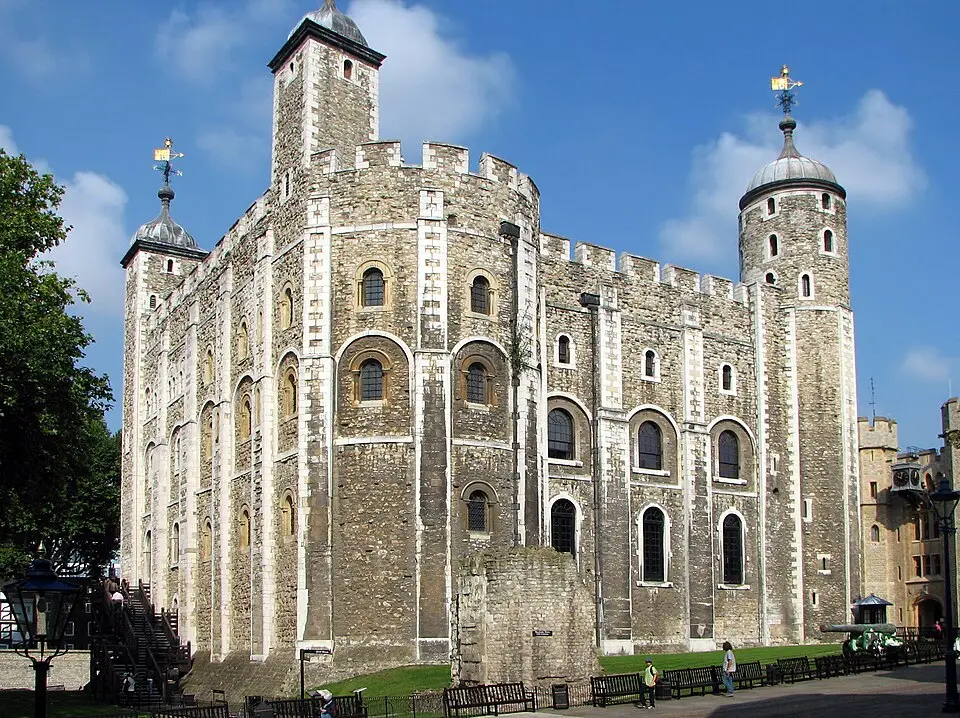
About The White Tower
The White Tower forms the historic heart of the Tower of London fortress and rises as the largest tower of the complex on rocky Tower Hill at the southeastern edge of the City of London. William the Conqueror ordered its construction around 1078 to secure the city against rebellious uprisings. The design followed Norman fortress-building techniques, but unusually, the typical elements such as the great hall, living quarters, and chapel were combined on several floors within a single building. This imposing design gave its name to the entire complex, which consists of numerous other walls and buildings. The tower itself has a nearly square floor plan with four projecting corner turrets and was originally built from hard limestone from Kent, which was later replaced by Portland stone.
Inside, the tower is divided into five floors. The entrance is on the second floor (the first floor in British usage) and is reached by a wooden staircase that recreates its medieval state. The thick walls house Norman fireplaces and latrines, while the ground floor originally served as a storage room with a deep well. Especially worth seeing is St. John's Chapel, whose interior ranks among the most remarkable examples of Norman architecture in the United Kingdom. The barrel vault of the nave is flanked by groin vaults in the side aisles and galleries. Over the centuries, the chapel served a variety of purposes, from royal worship and the safekeeping of state papers to the lying in state of the murdered King Henry VI.
Today the White Tower houses the Royal Armouries exhibition, which was reduced to a few but spectacular pieces after a separate museum opened in Leeds. Here you can admire, among other things, the armor of Henry VIII and other British monarchs. The display is complemented by information on the history of the fortress. Over the centuries, the tower also served as a prison, holding Walter Raleigh and participants in Thomas Wyatt's rebellion, among others, as well as an arsenal during the Great Fire of London.
At a glance
- Category
- Sight › Historic sites
- Rating
- no reviews yet · write a review
- Address
- London Tower
EC3N 4AB London, United Kingdom - District
- London Borough of Tower Hamlets
- Phone
- —
- Website
- www.hrp.org.uk
- —
- Coordinates
- 51.50810° N · -0.07607° E
- Data quality
- confidence 0.98
- Identifier
- ID ccdeec13-a46…
Location & surroundings
Toggle layersFAQ about The White Tower
quick answersWhat is the White Tower in London?
The White Tower is the largest tower and the historic heart of the Tower of London, located on Tower Hill at the southeastern edge of the City of London in the borough of Tower Hamlets. William the Conqueror commissioned its construction around 1078 to protect the city against uprisings. The tower has a nearly square floor plan with four projecting corner turrets and gave the entire fortress complex its name.
What can you see inside the White Tower in London?
Inside the White Tower in London, you can see an exhibition by the Royal Armouries today, including the suits of armor of Henry VIII and other British monarchs. After the opening of a dedicated museum in Leeds, the display was pared down to a few but spectacular pieces and supplemented with information about the history of the fortress. The entrance is on the second floor and is reached by a wooden staircase that mimics the medieval layout.
What is special about St. John's Chapel in the White Tower?
St. John's Chapel in the White Tower in London is one of the most remarkable examples of Norman architecture in the United Kingdom. Its nave has a barrel vault, while the aisles and galleries are topped with groin vaults. Over the centuries, the chapel served for royal worship, for the safekeeping of state papers, and as the place where the murdered King Henry VI lay in state.
What was the White Tower in London used for in the past?
Over the centuries, the White Tower in London served as a fortress, a prison, and an arsenal. Its prisoners included Walter Raleigh and participants in Thomas Wyatt's rebellion, and during the Great Fire of London the tower was used as an arsenal. Inside its five floors, Norman fireplaces, toilets built into the thick walls, and a deep well in the former storage room on the ground floor bear witness to its original use.
What can you see around the White Tower in London?
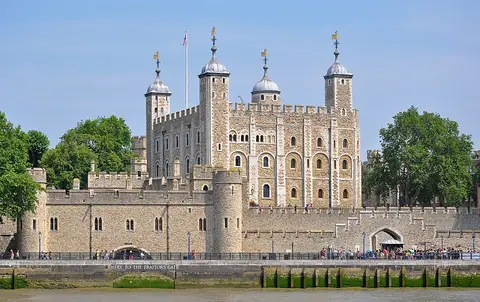
Around the White Tower in London, you'll find numerous other historic sites within the Tower fortress. travelguide195 lists, within less than 230 feet, the Wardrobe Tower, Tower Green, The Medieval Palace, the Bloody Tower, and the Wakefield Tower, as well as the Fusilier Museum London and the Torture Room. For a break, travelguide195 lists around 119 restaurants within 500 meters.
Ratings & comments
none yetNear The White Tower
closest 5 per category · 2 kmSights
Restaurants
Museums
Hotels
More:Historic sites in London (3,142)Sights in London Borough of Tower Hamlets (234)All sights in London (3,487)
300 places within 2 km loaded.
You need a free account to leave reviews and photos – that keeps comments genuine and lets you edit them later.