About Piccadilly Lights
Piccadilly Circus is one of the best-known and busiest spots in London's West End. As a central intersection and public square, it links major thoroughfares such as Regent Street, Piccadilly, Shaftesbury Avenue, and the Haymarket. Although the name points to a circular space at a junction in the architectural sense, the shape has changed considerably over time. Today the intersection has more of a triangular layout, since historic buildings were demolished and new streets were laid out. Its location amid numerous shopping and entertainment districts makes the Circus a lively meeting place, one that since the days of the British Empire has often been called the center of the world.
The history of the site goes back to 1811, when the future King George IV wanted a grand boulevard running from St. James's to Regent's Park. The famous architect John Nash was commissioned to plan it and completed the project in 1819. At that time Piccadilly Circus, then still called Regent Circus South, was a simple intersection where concave building façades formed a circle. The spot was a busy hub from early on, but the enclosed ring of buildings was broken up in 1886.
To build Shaftesbury Avenue, a memorial street for the 7th Earl of Shaftesbury, numerous houses in Soho had to be torn down, including a block of buildings right at the Circus. This intervention destroyed the original round shape and created today's more triangular appearance. At the same time, the London Pavilion was rebuilt, while the Criterion Theatre and the Swan & Edgar department store survived the restructuring. These changes laid the foundation for the square's modern form.
A central landmark of the square is the so-called Eros Fountain, officially known as the Shaftesbury Memorial Fountain. It was unveiled in 1893 to commemorate the Earl of Shaftesbury. The winged figure at the top does not depict the Greek god Eros but the Angel of Christian Charity. As the first monument in London cast entirely in aluminum, the almost naked figure was initially mocked by prudish Victorians. The fountain was originally surrounded by a wall that was later removed for aesthetic reasons, which made the square a popular gathering place for flower girls and shoeshine boys.
In the 1920s and 1930s, the Circus underwent a radical architectural transformation. The old, plain Regency-era buildings were demolished as outdated and replaced by much taller buildings in an eclectic style. These new buildings featured spacious commercial premises, large arched window fronts, and elaborate sculptural decoration. During this phase of construction, the Eros Fountain was temporarily removed and restored before being reinstalled in its old location with additional steps in 1932. Traffic management was modernized as well, when the first traffic lights replaced police officers at the entrances in 1937.
During World War II, the square had to take protective measures. The angel figure was moved to a bunker, the fountain was encased in iron plates, and the illuminated advertising signs were switched off. After the war, in 1947, the figure returned to its place, and in 1951 the fountain was filled with water again for the first time on the occasion of the Festival of Britain. In the 1950s, the last traditional traders left the square, marking its transformation into a modern traffic hub.
Because the square was considered too dangerous for pedestrians in the 1960s, as they had to cross the heavily trafficked intersection without safe crossings, the roundabout around the monument was abolished. Between 1961 and 1963, a paved area was created around the fountain, which served as a taxi stand and bus stop. This improved pedestrian safety but cut Shaftesbury Avenue off from Piccadilly. In 1973, a narrow bus lane was laid across the island to ease traffic flow again, which, however, broke up the square's sense of enclosure once more.
Starting in 1984, another comprehensive redesign began, as the area was considered run-down and traffic was badly congested. The London Pavilion was given additional floors and a slate roof. The Eros Fountain was taken to Edinburgh for restoration, as the aluminum figure had been badly damaged by exhaust fumes. Traffic routing was fundamentally changed: the old traffic island was removed, Shaftesbury Avenue was converted to a one-way street, and the roadways were widened. In 1986, the fountain found a new location east of the center of the intersection, set into a paved area in front of the Criterion Theatre that is reserved exclusively for pedestrians.
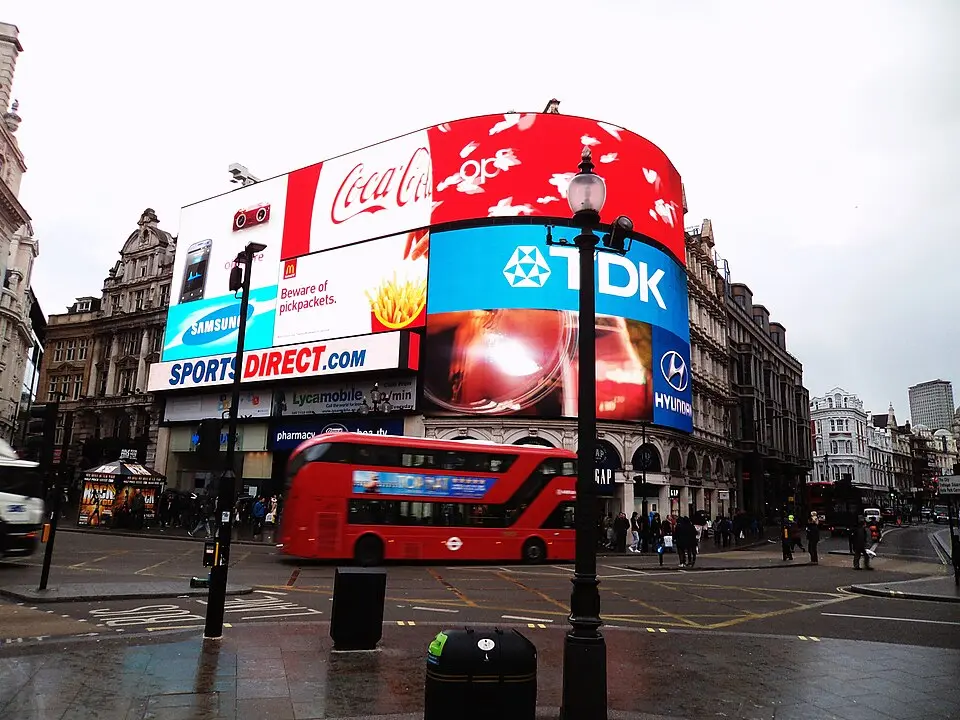
Another striking feature of Piccadilly Circus is its famous advertising displays. The first illuminated sign was installed on the London Pavilion in 1900. Over time, the white light bulbs evolved into colorful neon tubes and eventually into large digital displays. After the redesign in the 1980s, advertising boards were permitted only on one particular corner building. Well-known brands such as Coca-Cola, Hyundai, TDK, and McDonald's shaped the look of the square for decades. In 2017, the individual LED displays were replaced by a single curved video wall, which, with its size and resolution, ranks among the largest of its kind in Europe.
The architectural highlights include the London Pavilion and the Criterion Theatre. The Pavilion, originally a music hall dating from 1859, was rebuilt in 1886 and later converted into a shopping center connected to the Underground station. The Criterion Theatre, which opened in 1874, is located almost entirely underground and, with its 600 seats, offers an elegant setting for theater performances. Both buildings survived the square's various rebuilding phases and contribute to its historic atmosphere.
Today Piccadilly Circus is a modern traffic intersection with new pedestrian crossings and an optimized bus lane. The approach from Glasshouse Street has been converted into a pedestrian zone, and the one-way system on Piccadilly was lifted to keep traffic moving more smoothly. Visitors experience a mix of historic architecture, modern technology, and the pulsing activity of the metropolis. The square remains a central attraction that connects London's history with the dynamism of the 21st century.
At a glance
- Category
- Sight › Historic sites
- Rating
- no reviews yet · write a review
- Address
- Piccadilly Circus
W1D 7ET London, United Kingdom - District
- City of Westminster
- Phone
- +442072602700
- Website
- —
- —
- Coordinates
- 51.51024° N · -0.13455° E
- Data quality
- confidence 0.81
- Identifier
- ID 626fba71-de5…
Location & surroundings
Toggle layersRatings & comments
none yetNear Piccadilly Lights
closest 5 per category · 2 kmSights
Restaurants
Museums
Hotels
More:Historic sites in London (3,142)Sights in City of Westminster (559)All sights in London (3,487)
300 places within 2 km loaded.
You need a free account to leave reviews and photos – that keeps comments genuine and lets you edit them later.