About Piccadilly Circus
Piccadilly Circus is one of the best-known intersections and public squares in London's West End. Originally conceived as an architectural circus, it now connects some of the city's most important thoroughfares, including Regent Street, Piccadilly, Shaftesbury Avenue, and the Haymarket. In the days of the British Empire, this hub was often called the center of the world. The word "circus" comes from the Latin word for circle, a reference to the intersection's original round design, which has been greatly altered over the centuries by urban redevelopment. Today the spot is a lively meeting place surrounded by numerous shopping and entertainment districts and serves as a major transportation hub.
The history of the square began in 1811, when the future King George IV wanted a grand boulevard running from St. James's to Regent's Park. The architect John Nash designed this masterpiece, which was completed in 1819. At that time, Piccadilly Circus was still a simple intersection where the building façades were curved inward to form a closed circle. This unbroken ring of buildings was cut through in 1886 by the construction of Shaftesbury Avenue, which was built as a memorial street to the 7th Earl of Shaftesbury. Numerous buildings had to be demolished for the project, which produced the more triangular layout of the intersection you see today.
A central feature of the square is the so-called Eros Fountain, officially the Shaftesbury Memorial Fountain. It was unveiled in 1893 to commemorate the Earl, who had campaigned for social reform. The winged figure at the top actually represents the Angel of Christian Charity, but Victorian society mocked it for its near-nakedness. It was the first statue in London to be cast entirely in aluminum. The fountain originally stood on a small island in the middle of the intersection, surrounded by flower girls and shoeshiners who worked there until the 1940s.
In the 1920s and 1930s, the square underwent a radical architectural transformation. The old Regency-era buildings were considered outdated and were torn down. In their place rose taller buildings in an eclectic style, with spacious retail premises, arcades, and domes. During this time the fountain was temporarily removed and restored before being returned to the Circus in 1932. At the same time, the Underground station was expanded and modernized below ground to cope with growing traffic.
During World War II, Piccadilly Circus served as a strategic point. For safety reasons, the angel figure was moved to a bunker, and the fountain was protected with iron plates. The famous illuminated advertisements were switched off to camouflage the city from air raids. After the war, the lights returned, and in 1951 the fountain was filled with water again for the Festival of Britain. During this period, the last traditional street vendors left the square, marking its transformation into a modern traffic hub.
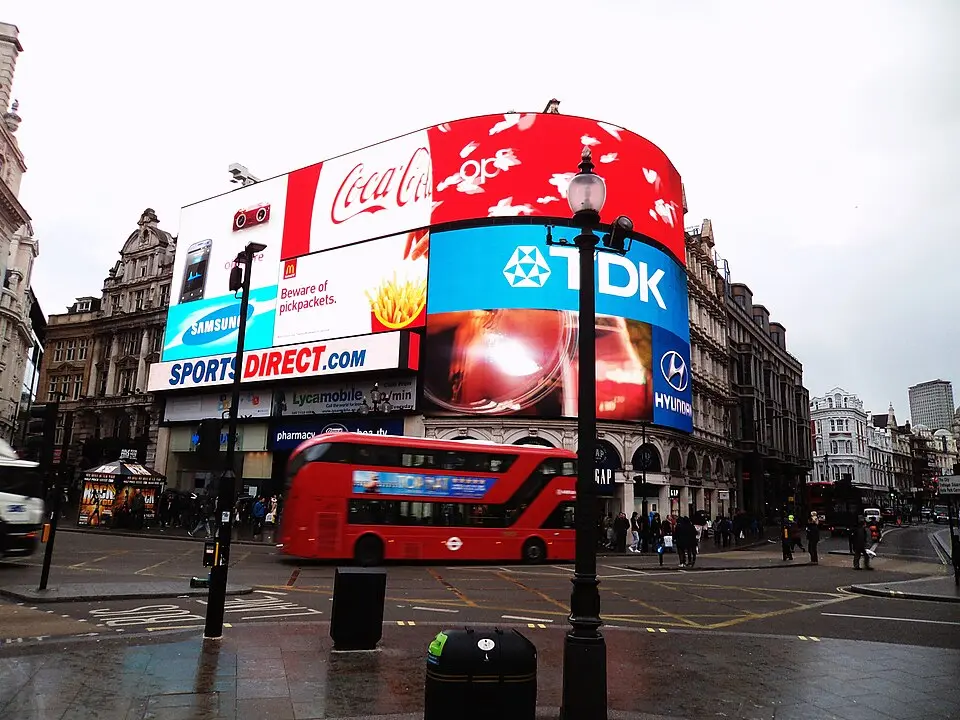
The advertising displays are another defining feature of Piccadilly Circus. The first billboard was installed on the roof of the London Pavilion as early as 1900. Over time, these simple illuminated letters evolved into elaborate light displays and large panels covering entire façades. After a period of scaling back in the 1970s and 1980s, when many advertising spaces were removed, a huge curved video screen now dominates the view. This LED display is one of the largest in Europe and shows changing advertisements from international brands, making the square a glowing symbol of the modern city.
The London Pavilion is a striking building on the northeast side of the square. Originally built as a music hall, it was remodeled several times in the 19th century and eventually converted into a shopping center. The building, in the Historicist style, now houses shops and is directly connected to the Underground station. Its façade was restored in the 1980s and decorated with Victorian figures that underscore the historic character of the site.
Opposite the London Pavilion is the Criterion Theatre, which opened in 1874. The theater lies almost entirely underground and is reached via an elegant staircase. It seats 600 and has undergone several renovations since it opened. The theater is an important part of cultural life in the West End and regularly draws visitors who want to see classic plays and modern productions.
Public transportation connections are excellent. Piccadilly Circus Underground station is served by the Bakerloo Line and the Piccadilly Line and has several entrances around the square. The typical red and blue London Underground signs are visible at every entrance. In addition, numerous bus lines stop at the square, making it a major transfer point in the city's transit network. The underground concourse also serves as a pedestrian underpass connecting different parts of the intersection.
In recent years, the square has been redesigned again to improve traffic flow and increase pedestrian safety. A new bus lane was created along Shaftesbury Avenue, and the one-way systems were adjusted to improve traffic flow toward Hyde Park Corner. The access from Glasshouse Street was converted into a pedestrian zone. These measures are intended to keep Piccadilly Circus the vibrant heart of London, offering locals and tourists alike a fascinating glimpse into the city's past and present.
At a glance
- Category
- Sight › Historic sites
- Rating
- no reviews yet · write a review
- Address
- Piccadilly
W1J 9HL London, United Kingdom - District
- City of Westminster
- Phone
- +442039323051
- Website
- www.english-heritage.org.uk
- contact@landmarks.org.uk
- Coordinates
- 51.50964° N · -0.13494° E
- Data quality
- confidence 0.98
- Identifier
- ID 5a78e063-727…
Location & surroundings
Toggle layersFAQ about Piccadilly Circus
quick answersWhat is Piccadilly Circus?
Piccadilly Circus is one of the best-known road junctions and public squares in London's West End, in the City of Westminster. Major thoroughfares such as Regent Street, Piccadilly, Shaftesbury Avenue, and the Haymarket meet here. The word "circus" comes from the Latin word for circle and recalls the junction's original round design. In the days of the British Empire, the square was often described as the center of the world.
How did Piccadilly Circus in London come about?
Piccadilly Circus in London goes back to a grand boulevard that the future King George IV envisioned in 1811, running from St. James's to Regent's Park. The architect John Nash designed the scheme, completed in 1819, with concave building facades that formed a closed circle. In 1886, the construction of Shaftesbury Avenue cut through this ring of buildings, creating today's more triangular layout. In the 1920s and 1930s, taller eclectic-style buildings with arched arcades and domes replaced the old Regency-era structures.
What is the Eros fountain at Piccadilly Circus?
The so-called Eros fountain at Piccadilly Circus in London is officially named the Shaftesbury Memorial Fountain. It was unveiled in 1893 in memory of the 7th Earl of Shaftesbury and his commitment to social reform. The winged figure at the top actually represents the Angel of Christian Charity and was the first statue in London cast entirely from aluminum. The fountain was restored during the redesign of the square and reinstalled in 1932. During World War II, the angel figure was moved to a bunker for protection.
What can you see around Piccadilly Circus?
Around Piccadilly Circus in London, you'll find several attractions and museums within close range. travelguide195 lists, among others, the museum Ripley's Believe It Or Not! London about 21 meters away, the historic Swan & Edgar about 31 meters away, and the Anteros monument about 42 meters away. Also very close are the Piccadilly Lights (about 72 meters), the science museum Body Worlds (about 88 meters), and the sculpture The Horses of Helios (about 120 meters).
What tours and restaurants are there at Piccadilly Circus?
Piccadilly Circus in London is a stop on several tours and is surrounded by a great many restaurants. travelguide195 lists the square in the tours "London Around Trafalgar Square: A Day of Eating and Drinking," "From Wellington Arch to the Thames: A Walk Through Westminster and St James's," and "West End by Night: Lights, Dinner, and Cocktails." Within 500 meters, travelguide195 lists about 833 restaurants.
Ratings & comments
none yetNear Piccadilly Circus
closest 5 per category · 2 kmSights
Restaurants
Museums
Hotels
More:Historic sites in London (3,142)Sights in City of Westminster (559)All sights in London (3,487)
300 places within 2 km loaded.
You need a free account to leave reviews and photos – that keeps comments genuine and lets you edit them later.
At the junction of five major roads, Piccadilly Circus is the home of the famous aluminum statue of Eros, which sits atop a fountain. The monument is officially known as Shaftesbury Memorial Fountain and initially wasn't supposed to depict Eros, but different god Anteros. The north side of Piccadilly Circus holds an enormous display board of electric advertisements, including Britain's biggest illuminated display (the widest in the world), advertising Coca-Cola.
Source: Wikivoyage, „London/Leicester Square“ · authors per page history · CC BY-SA 4.0