About The Rosetta Stone
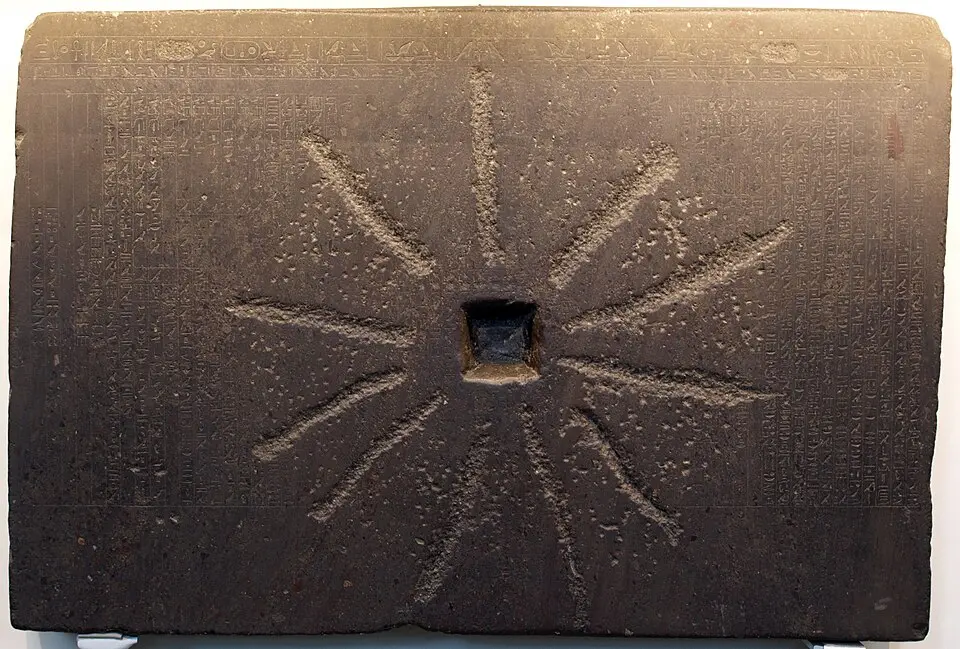
The British Museum in London displays the so-called Memphite Theology Monument, a rectangular block of black hard stone often referred to as the Shabaka Stone. The exact origin of the stone has not been fully established, but it entered the museum's collection in 1805 as a gift from the Earl of Spencer. The earl had brought the stone back from Alexandria together with other heavy objects that originally served as ballast to keep a ship steady on a calm voyage. Today the inscription is cataloged under inventory number EA 498. Mineralogically, the rock is classified as green breccia and probably comes from the Wadi Hammamat, where quarrying expeditions took place under the Kushite pharaoh Shabaka. The block may have come from the Temple of Ptah in Memphis, where, according to the inscription, a worm-eaten papyrus was found; Shabaka had its contents carved into the slab to preserve them for eternity.
The inscription consists of two horizontal lines and numerous vertical columns of ancient Egyptian hieroglyphs. The middle section of the stone, however, is badly damaged, because it was reused in later times as a column base or millstone. As a result, a large section is no longer legible, which makes scholarly analysis of the text considerably harder. In addition, certain names, including that of the god Seth and Shabaka's birth name, were already erased in ancient Egypt on the orders of Psamtik II. Despite this damage, the text is considered the most important source for Memphite theology, a creation myth developed in Memphis.
At the center of the account stands the god Ptah, who created the world through heart and tongue, that is, through thought and speech. This doctrine is regarded as the earliest known theology based on the principle of the Logos, and it recalls the opening of the Gospel of John. The text also deals with the myth of Horus and Seth, which is seen as a mythical depiction of the unification of Egypt. The dating of the original text is disputed among scholars and, depending on the interpretation, varies by more than two thousand years. While earlier researchers assumed it was composed in the Old Kingdom, the prevailing view today is that it was created in the 25th Dynasty or compiled from older elements, which Shabaka had presented as a "work of the ancestors" to lend the content greater weight.
At a glance
- Category
- Museum › Museums (general)
- Rating
- no reviews yet · write a review
- Address
- The British Museum
WC1B 3DG London, United Kingdom - District
- London Borough of Camden
- Phone
- +442073238000
- Website
- www.britishmuseum.org
- —
- Coordinates
- 51.51928° N · -0.12755° E
- Data quality
- confidence 0.98
- Identifier
- ID 0e5dde11-3a5…
Location & surroundings
Toggle layersRatings & comments
none yetNear The Rosetta Stone
closest 5 per category · 2 kmSights
Restaurants
Museums
Hotels
More:Museums in London Borough of Camden (90)All museums in London (825)
300 places within 2 km loaded.
You need a free account to leave reviews and photos – that keeps comments genuine and lets you edit them later.