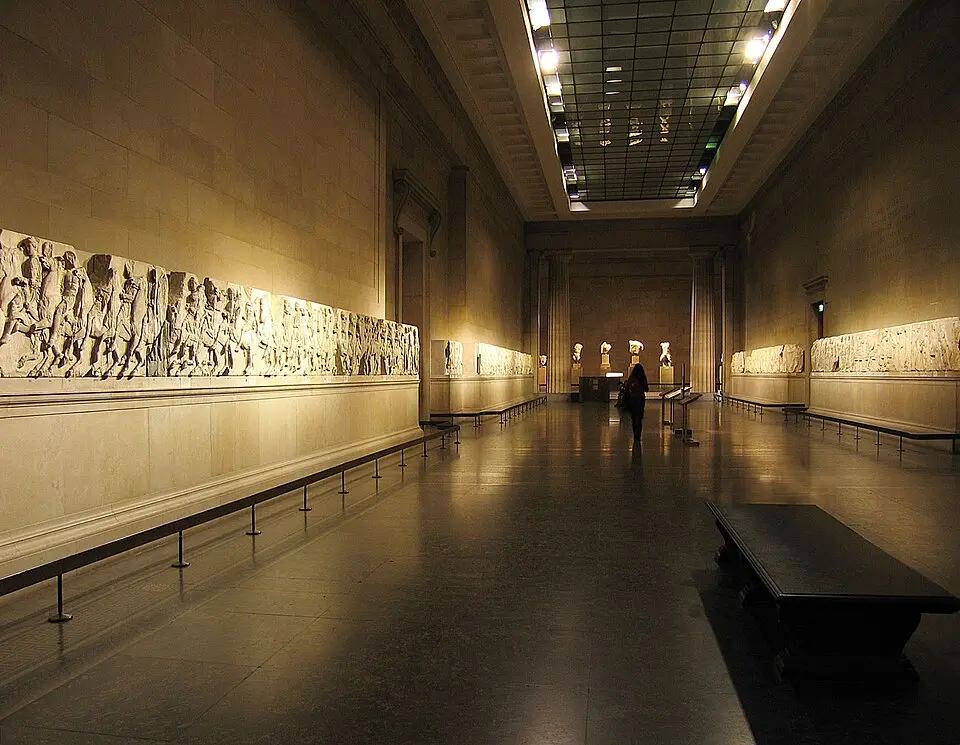
About Elgin Marbles
The Elgin Marbles, also known as the Parthenon Marbles, are one of the most famous collections of ancient sculpture and can now be admired at the British Museum in London. They include significant sections of the frieze, metopes, and fragments of the pediments of the Parthenon, the most important temple complex on the Athenian Acropolis. Added to these is one of the maiden figures from the Porch of the Caryatids of the Erechtheion. These marble sculptures and fragments were removed from the historic buildings in the early 19th century by Lord Elgin, then the British ambassador to the Ottoman Empire. After several years spent transporting them to Great Britain, he sold the collection in 1816 to the British government, which acquired it for the British Museum. Since then, the artifacts have been among the museum's central exhibits and are displayed in a gallery donated specifically for that purpose.
The history of their removal remains controversial to this day. Lord Elgin cited an official permit from the Ottoman sultan that allowed him to remove pieces of stone. Critics, however, accuse him of abusing the permit and violently wrenching the works of art from their context, which is interpreted as looting or desecration of the Parthenon. The transport to England was not without risks; in 1804, for example, a yacht carrying part of the cargo sank off the Greek island of Kythira, though the pieces were fortunately recovered. During World War II, the Marbles were stored in the Aldwych Underground station for safekeeping to protect them from air raids. The display in the museum in its present form was made possible only in the 1930s through a donation from the art dealer Joseph Duveen.
An important aspect of the research on the Marbles and their condition concerns their original appearance. For a long time, the sculptures were perceived as pure white marble. Only in 2009 were researchers able to use highly sensitive methods to detect traces of the pigment Egyptian blue, confirming the long-held assumption that the Parthenon was originally at least partly painted. In addition, the fragments were aggressively cleaned in 1937 and 1938 at the donor's request. Scrapers and abrasives were used to remove up to two millimeters of the ancient surface in order to strip away the patina of centuries. This intervention led to the loss of fine details and tool marks, causing lasting damage to the historic fabric of the objects.
The question of returning the Elgin Marbles to Greece is one of the oldest and most frequently debated issues in the field of cultural property restitution. The Greek state demands the permanent reunification of the fragments at the place of their creation, the Acropolis Museum in Athens, where space was deliberately left open for the missing pieces. The British Museum has traditionally argued that Athens lacked a suitable exhibition venue, an argument that has lost force with the construction of the new Acropolis Museum. While international legal experts and parts of the academic community increasingly support the Greek demand, the British government has so far resisted legal action. The debate remains politically and socially explosive, as various public disputes and the loan of individual pieces to other museums show.
At a glance
- Category
- Museum › History museums
- Rating
- no reviews yet · write a review
- Address
- The British Museum, Great Russell St
WC1E 7JW London, United Kingdom - District
- London Borough of Camden
- Phone
- +442073238000
- Website
- www.britishmuseum.org
- —
- Coordinates
- 51.51894° N · -0.12782° E
- Data quality
- confidence 0.97
- Identifier
- ID 28853c67-9d7…
Location & surroundings
Toggle layersRatings & comments
none yetNear Elgin Marbles
closest 5 per category · 2 kmSights
Restaurants
Museums
Hotels
More:History museums in London (155)Museums in London Borough of Camden (90)All museums in London (825)
300 places within 2 km loaded.
You need a free account to leave reviews and photos – that keeps comments genuine and lets you edit them later.