About Fossil Grove
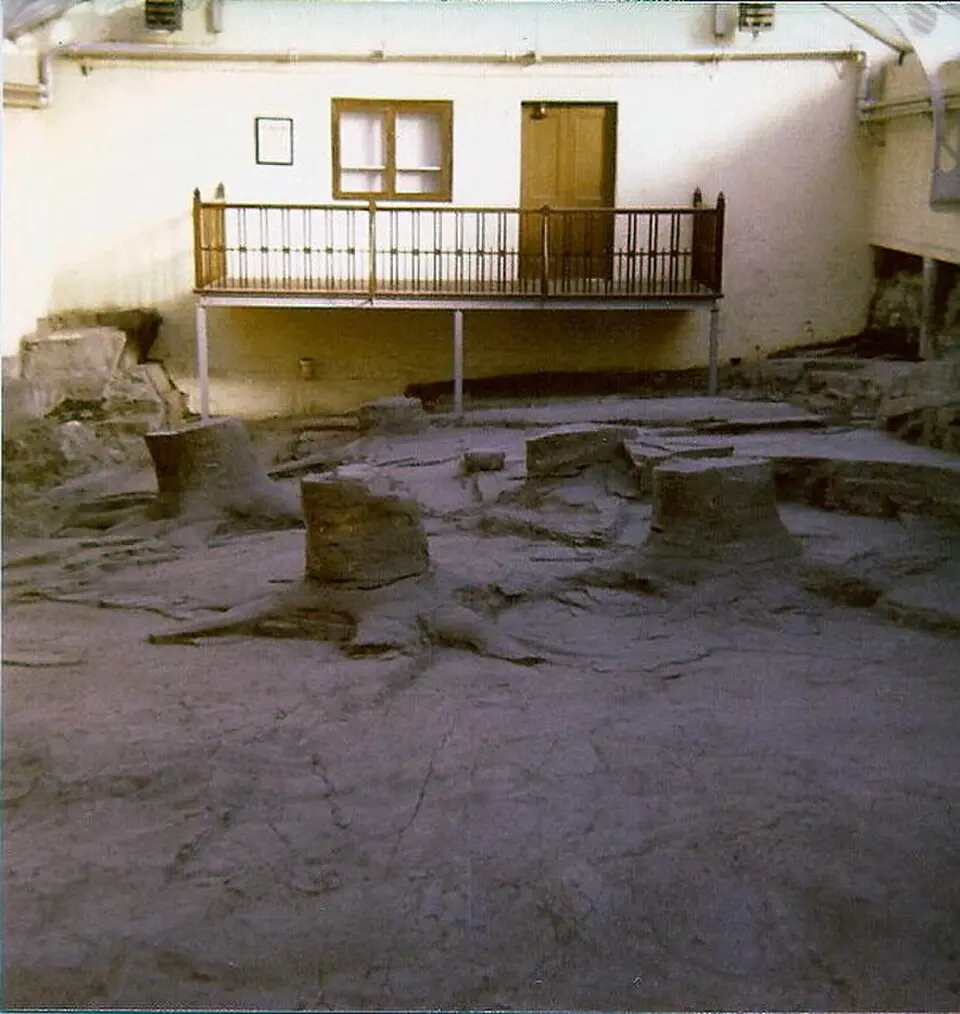
Fossil Grove in Glasgow's Victoria Park is one of the city's oldest attractions and preserves the fossilized stumps and root systems of eleven extinct Lepidodendron trees. These so-called giant club mosses, which are more closely related to today's quillworts, lived about 325 million years ago in the Carboniferous period, when the Glasgow region was a tropical, swampy area near the equator. The fossils were discovered in 1887 during construction work in an old quarry that was later turned into a park. Today the stumps remain in their original growth position and show just how dense the primeval forest vegetation was. Most of the stumps measure between 0.30 and 0.91 meters (1 to 3 feet) in diameter, while a single larger stump in the western part of the site reaches up to 1.22 meters (4 feet). The underground root systems, known as Stigmaria, extend several meters away from the trunks and are distinguished by their characteristic forking branches.
The fossils rest on a bed of shale and sandstone formed by a massive flood in the early Permian period around 290 million years ago. This flood toppled the plants, filled their hollow trunks with sand, and eventually buried them, turning them to stone. The fossils are made up of internal casts of the bark-forming tissue, since the soft interior rotted away and was replaced by sand. The rock layers are now tilted and cut through by faults, a sign of the region's geological activity. Besides the plant fossils, the sandstones also contain traces of Arenicola worms, the only other organic evidence of life in the strata.
You can view the fossils in a protective building that opened in 1890 and shields the finds from the elements. Over the years the building has been renovated several times, including a new roof and repairs to war damage. Admission is free, and the site is wheelchair accessible. Fossil Grove is designated a Site of Special Scientific Interest and is looked after jointly by the City of Glasgow and various associations. A fern house is also being built in the nearby quarry area, while an oak sculpture of a lycopod tree with a giant centipede commemorates the 2014 Commonwealth Games.
At a glance
- Category
- Sight › Historic sites
- Rating
- no reviews yet · write a review
- Address
- Victoria Park Dr S
G14 9QR Glasgow, United Kingdom - District
- Bearsden
- Phone
- +441412875918
- Website
- www.glasgowmuseums.com
- —
- Coordinates
- 55.87667° N · -4.33833° E
- Data quality
- confidence 0.91
- Identifier
- ID fe1c638a-8cf…
Location & surroundings
Toggle layersRatings & comments
none yetNear Fossil Grove
closest 5 per category · 2 kmSights
Restaurants
Hotels
Cocktail bars
More:Historic sites in Glasgow (203)All sights in Glasgow (257)
91 places within 2 km loaded.

You need a free account to leave reviews and photos – that keeps comments genuine and lets you edit them later.
The remains of an ancient forest of Lepidodendron , extinct giant quillworts. About 330 million years ago this area flooded with mud, which killed the trees but made casts of their trunks. They were discovered during quarrying in 1887, and enclosed by a building for protection. This is open at weekends, while the rest of Victoria Park is always open.
Source: Wikivoyage, „Glasgow“ · authors per page history · CC BY-SA 4.0 · as of 4/17/2023