About Cardiff Castle
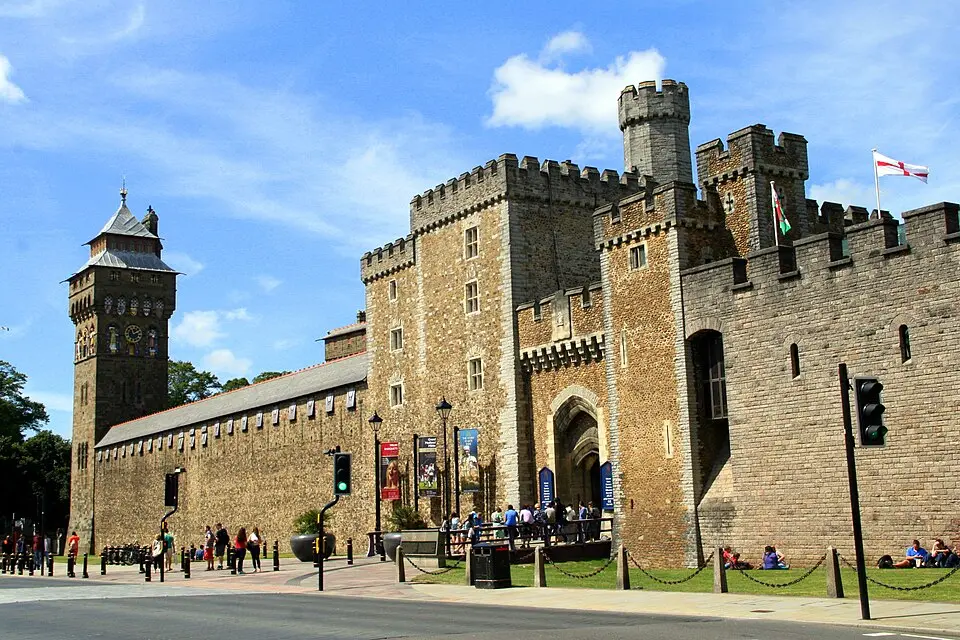
Cardiff Castle (Welsh: Castell Caerdydd) is a fascinating cultural site in the heart of the Welsh capital. The complex combines the history of a medieval fortress with the splendor of a Victorian Gothic Revival mansion. It lies east of the River Taff at the southeastern corner of Bute Park, and its location within the walls of a former Roman fort makes it especially remarkable. A top-category listed building and protected monument, the site reflects a broad cross-section of Wales's military and architectural development. Here you'll find a place where Roman, Norman, medieval, and Victorian eras meet in a very small space.
The history of the site begins in antiquity. Between A.D. 55 and 66, a Roman fort was built at a ford across the River Taff, serving as a base for campaigns against the Silures. This first fort was a rectangular earth-and-timber fortification, considerably larger than today's castle complex. After a brief period of abandonment, a smaller fort was built toward the end of the first century, followed by a third at the beginning of the second century. The fourth and last Roman fort was built around 276 to 285. It had stone fortifications and was used for about a century. The foundations of these Roman walls still form the foundation of the entire complex today.
With the Norman conquest in the 11th century, a new chapter began. In 1081, William the Conqueror had a motte with wooden fortifications built within the surviving Roman walls. This castle continued to secure the strategically important ford across the river and served as a starting point for the conquest of the Welsh kingdom of Morgannwg. During the 12th century, the wooden tower was replaced by a stone shell keep. The complex developed into an administrative center of Norman rule in Glamorgan. In the late Middle Ages, the castle was expanded into a comfortable residence, which was enlarged further in the 16th and 18th centuries.
The transition from pure fortress to stately residence happened gradually. After the death of the last Baron Despenser in 1400, the castle remained in his family's possession until it passed to Richard Beauchamp in 1423. He had the Octagon Tower built, along with a new residential building on the west side. In the 16th century, the complex came into the hands of the Herbert family, who further expanded the western living quarters. During the English Civil War, the castle served for a time as a base for Parliamentary forces. After the war it was not demolished, but it fell increasingly into disrepair in the 18th century as the Herbert family moved their residence to Wiltshire.
The site's rebirth began in 1766, when the castle passed to John Stuart, later the 1st Marquess of Bute. He began renovating the neglected complex and had the castle grounds redesigned to plans by Lancelot Brown. Henry Holland designed the west wing and a southern extension in the Gothic Revival style. This work was completed under the 2nd Marquess of Bute by 1818. The real transformation into a magnificent mansion, however, came only in the late 19th century. The 3rd Marquess commissioned the architect William Burges to convert the residential buildings on the west side, known as the Western Apartments, into a Gothic Revival fairy-tale castle.
William Burges designed the interiors with great imagination and elaborate craftsmanship. Seventeen rooms were decorated in different historical styles, including the Winter Smoking Room with its splendid rib vault and the Summer Smoking Room with a painted dome. The grand dining hall has a wooden vaulted ceiling, while the Arab Room, in an Orientalist style, impresses with its gilded vaulted ceiling. The library, with its marble shelving, and the Chaucer Room, with stained glass depicting the Canterbury Tales, are also striking. After Burges's death in 1881, the project was continued by his assistants and finally completed in the 1920s.
The castle's outward appearance is defined by the Roman walls, which enclose an area of 3.7 hectares (9 acres). These walls were up to three meters (10 feet) thick and were partly restored and rebuilt in the 19th century. The main entrance is the South Gate, flanked by two towers, the western one being the medieval Black Tower. On the west side rises the mansion with five differently designed towers. The tallest is the 40-meter (131-foot) Clock Tower at the southwestern corner, completed in 1875. Other prominent towers are the 15th-century Beauchamp Tower as well as the Herbert, Guest, and Bute Towers.
Inside the complex, in addition to the opulent state rooms, you'll find historic sites such as the Norman shell keep on the motte. This octagonal tower is built of light-colored masonry and surrounded by a reconstructed moat. In the castle grounds you can see the foundations of earlier buildings, while the remains of the Roman walls are clearly visible on the south side. The complex has been open to the public as a museum since 1974. Besides the historic rooms, you can also visit World War II air-raid shelters and the museum on the history of Welsh soldiers.
Today, Cardiff Castle is a central cultural landmark in Wales. The combination of Roman foundations, medieval fortifications, and Victorian splendor makes the complex a unique witness to history. Careful restoration has made it possible to bring the different eras into view without obscuring the medieval fabric. The site serves not only as a museum but also as a venue for major occasions, such as the gala banquet at the 2014 NATO summit. For visitors, Cardiff Castle offers an impressive glimpse into the military and cultural past of the Welsh capital.
At a glance
- Category
- Sight › Castles
- Rating
- no reviews yet · write a review
- Address
- Castle St
CF10 3RB Cardiff, United Kingdom - District
- Castle
- Phone
- +442920878100
- Website
- www.cardiffcastle.com
- cardiffcastle@cardiff.gov.uk
- Coordinates
- 51.48220° N · -3.18123° E
- Data quality
- confidence 0.97
- Identifier
- ID bb465bd2-0fa…
Part of the tour
Cardiff in One Day: Castle, Civic Centre and Bay →Location & surroundings
Toggle layersFAQ about Cardiff Castle
quick answersWhat is Cardiff Castle?
Cardiff Castle, known in Welsh as Castell Caerdydd, is a castle complex in the heart of Cardiff, the capital of Wales, that combines a medieval fortress with a Victorian Gothic Revival mansion. It stands on Castle St east of the River Taff, at the southeastern corner of Bute Park. A Grade I listed building and scheduled monument, Cardiff Castle brings together Roman, Norman, medieval, and Victorian eras in a very compact space.
How old is Cardiff Castle?
The history of Cardiff Castle goes back to Roman times: between A.D. 55 and 66, a first Roman fort was built on this site in Cardiff, at a ford across the River Taff. The fourth and final Roman fort, with stone fortifications, was built around 276 to 285, and its wall foundations still support the entire complex today. The castle proper began in 1081, when William the Conqueror had a motte with timber fortifications built within the Roman walls.
Who shaped Cardiff Castle over the course of its history?
Cardiff Castle was shaped in turn by the Normans, English noble families, and finally the Bute family. In the 12th century, a stone shell keep replaced the wooden tower, and from 1423 Richard Beauchamp had the Octagon Tower and a new residential building built on the west side. In the 16th century, the Herbert family expanded the western living quarters, before the castle passed in 1766 to John Stuart, later the 1st Marquess of Bute.
What can you see around Cardiff Castle?
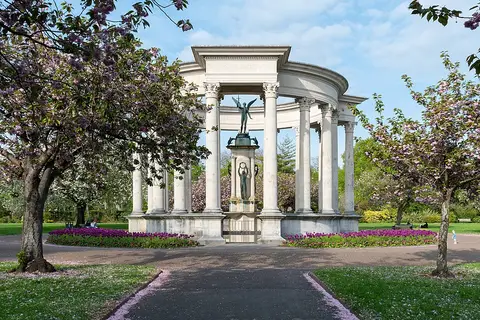
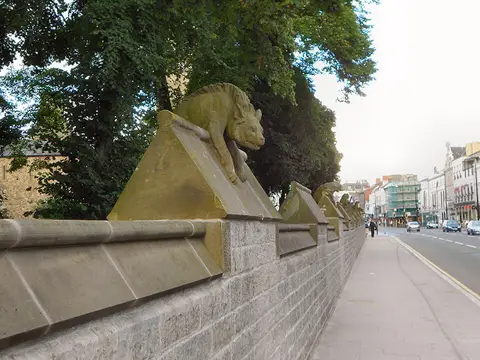
Around Cardiff Castle in Cardiff, you'll find several museums, monuments, and historic sites within walking distance. travelguide195 lists, among others, the Cardiff Roman Fort about 13 meters away, the Firing Line Cardiff Castle Museum of the Welsh Soldier, the Wartime Shelters, and the Queen's Dragoon Guards Museum. A bit farther away are the Duke St. Arcade, the Gorsedd Stone Circle, the Animal Wall, and the South African War Memorial, about 295 meters away.
Can you eat near Cardiff Castle?
Yes, there is a wide range of dining options around Cardiff Castle in Cardiff. travelguide195 lists about 93 restaurants within 500 meters of the castle. If you'd like to fit your visit into a city walk, you'll also find the castle on the tour "Cardiff in One Day: Castle, Civic Centre, and Bay."
Ratings & comments
none yetNear Cardiff Castle
closest 5 per category · 2 kmSights
Restaurants
Museums
Hotels
More:Sights in Castle (33)All sights in Cardiff (116)
228 places within 2 km loaded.
You need a free account to leave reviews and photos – that keeps comments genuine and lets you edit them later.
Castle St. Cardiff Castle is a large castle whose foundations are based upon a Roman fort. In the 19th century, it was one of the homes of the Marquis of Bute. The Norman fort in the centre, the Welsh regimental museum and excavated Roman ruins are open, and tours of the Bute household are available. The Bute part of the castle is quite amazing. The interior was all done in the early 1900s in a very idiosyncratic and interesting style. There is barely an inch that is not adorned with some sort of artistic work. Yet, it is not overwhelming. The craftsmanship is well worth a look.
Source: Wikivoyage, „Cardiff“ · authors per page history · CC BY-SA 4.0 · as of 1/29/2024