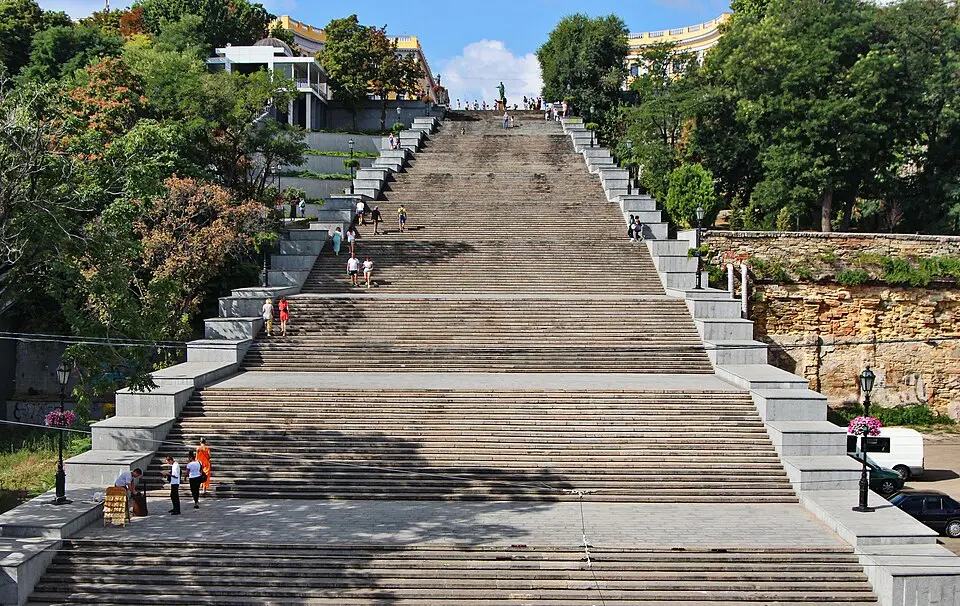
About Potemkin Stairs
The Potemkin Stairs are probably the best-known landmark of the Ukrainian port city of Odessa on the Black Sea. This monumental outdoor staircase connects the city center, set on a plateau, with the harbor basin below, bridging a difference in elevation of roughly thirty meters. At 142 meters long and with 192 steps, it has left a lasting mark on the cityscape since the 19th century. The architecture is defined by a distinctive taper toward the top, which gives the structure a special optical depth. Seen from below, the stairs therefore look even taller and more dramatic, since only a statue and open sky are visible at the top, creating the impression that the steps lead straight into the clouds.
The history of the structure goes back to 1826, when Governor Mikhail Vorontsov initiated the planning. The stairs were built between 1837 and 1841 to designs by the Ticino-born architect Francesco Boffa, although other engineers and architects also took part in the complex project. The original building material was sandstone from Trieste, which corroded over time. In the 1930s the stairs underwent a thorough restoration, and the weathered stone was replaced with marble from the Southern Bug. The construction was a masterpiece not only of architecture but also of engineering, as the stairs were founded on hundreds of timber piles to protect the unstable steep slope between city and harbor from landslides. Large vaults and retaining walls secure the ground and bear the enormous weight of the structure.
The stairs originally went by other names, such as the Boulevard Stairs or the Richelieu Stairs, after the adjoining boulevard and the city's first governor, Armand Emmanuel du Plessis, Duke of Richelieu. They received their present name only in 1955, on the 50th anniversary of the mutiny and in reference to the famous film Battleship Potemkin. Today the stairs lead at the top to a semicircular square on Primorsky Boulevard, enclosed by historic buildings. On the central axis of this square stands the statue of Richelieu, facing the harbor, whose open palm is regarded as a welcoming gesture to arriving visitors. Together with the square and the surrounding buildings, the stairs form a harmonious architectural ensemble.
The stairs gained worldwide fame above all through Sergei Eisenstein's 1925 silent film Battleship Potemkin. In this masterpiece of montage, the stairs become the setting for a dramatic scene in which a crowd is fired upon by Cossacks and a baby carriage rolls down the steps. This sequence turned the stairs into an icon of the 20th century and left a lasting imprint on the image of Odessa in international culture. The historical mutiny of 1905 alluded to in the film actually took place nearby, though the film stages the events dramatically. To this day the stairs remain a central motif in film history, and in 2015 they were added to the list of treasures of European film culture.
For visitors, the stairs are not only an architectural highlight but also a place of living culture and tradition. Alongside the stairs runs a funicular that covers the elevation difference mechanically and houses cabins originally from Paris. In summer, during the International Film Festival, the stairs turn into a huge open-air cinema where classic films are shown free of charge. The Odessa Classics music festival has also used the steps for concerts under the open sky. The stairs are also a stage for athletic feats, such as competitions in which runners race up the steps in record time or snowboarders ride down them on rare snowy days.
Perceptions of the stairs have changed over the centuries. While contemporary travelers in the 19th century initially criticized them as expensive and useless, today they are seen as a symbol of the city's beauty and self-confidence. The stairs link two different social worlds: the aristocratic city plateau with its palaces and shops and the lively, often chaotic harbor district below. Despite modern buildings that partly block the view, the Potemkin Stairs remain the unmistakable face of Odessa. They stand as a witness to the city's history and as a symbol of the link between past and present, between the sea and urban culture.
At a glance
- Category
- Sight › Historic sites
- Rating
- no reviews yet · write a review
- Address
65000 Odesa, Ukraine- District
- Prymorskyi Raion
- Phone
- —
- Website
- ru.wikipedia.org
- —
- Coordinates
- 46.48857° N · 30.74201° E
- Data quality
- confidence 0.52
- Identifier
- ID fbc32a05-dec…
Location & surroundings
Toggle layersFAQ about Potemkin Stairs
quick answersWhat is the Potemkin Stairs in Odessa?
The Potemkin Stairs is a monumental outdoor staircase and probably the best-known landmark of the Ukrainian port city of Odessa on the Black Sea. It connects the downtown area, which sits on a plateau in the Prymorskyi Raion district, with the harbor, descending roughly 30 meters (about 100 feet) in elevation. At 142 meters (466 feet) long with 192 steps, it narrows toward the top, so it looks taller from below, and from the top you see only the statue and the sky.
When and by whom were the Potemkin Stairs in Odessa built?
The Potemkin Stairs in Odessa were built between 1837 and 1841 to plans by the Ticino-born architect Francesco Boffa. The impetus for the project came in 1826 from Governor Mikhail Vorontsov. The original sandstone from Trieste corroded and was replaced with marble from the Southern Bug during a thorough restoration in the 1930s. Hundreds of timber piles, vaults, and retaining walls protect the unstable steep slope from landslides.
Why are the stairs in Odessa called the Potemkin Stairs?
The stairs in Odessa have only carried their current name since 1955, on the occasion of the 50th anniversary of the 1905 mutiny on the battleship Potemkin and in reference to the film of the same name. Before that, they were known as the Boulevard Stairs or the Richelieu Stairs, among other names, after the adjacent boulevard and the city's first governor, Armand Emmanuel du Plessis, Duc de Richelieu. They became world famous through Sergei Eisenstein's 1925 silent film "Battleship Potemkin," with its scene of a baby carriage rolling down the steps.
What can you see around the Potemkin Stairs in Odessa?
Around the Potemkin Stairs in Odessa, you'll find several monuments, historic buildings, and museums within walking distance. At the top of the stairs, about 70 to 85 meters (230 to 280 feet) away, stands the monument to the Duc de Richelieu, whose statue faces the harbor with an open hand, and about 134 meters (440 feet) away runs Primorsky Boulevard. travelguide195 also lists the wax museum (about 79 meters), the Palace of Sailors (about 169 meters), the Shidlovsky Palace (about 183 meters), an ancient settlement from the 5th to 3rd century B.C. (about 184 meters), and the Tolstoy Palace (about 194 meters).
Are there restaurants near the Potemkin Stairs in Odessa?
Yes, you'll find plenty of restaurants around the Potemkin Stairs in Odessa. travelguide195 lists about 39 restaurants within 500 meters (about 1,600 feet) of the stairs. That makes it easy to combine a visit to the stairs and Primorsky Boulevard with a meal.
Ratings & comments
none yetNear Potemkin Stairs
closest 5 per category · 2 kmSights
Museums
Hotels
More:Historic sites in Odesa (332)Sights in Prymorskyi Raion (228)All sights in Odesa (379)
233 places within 2 km loaded.
Don't miss in Odesa
All sights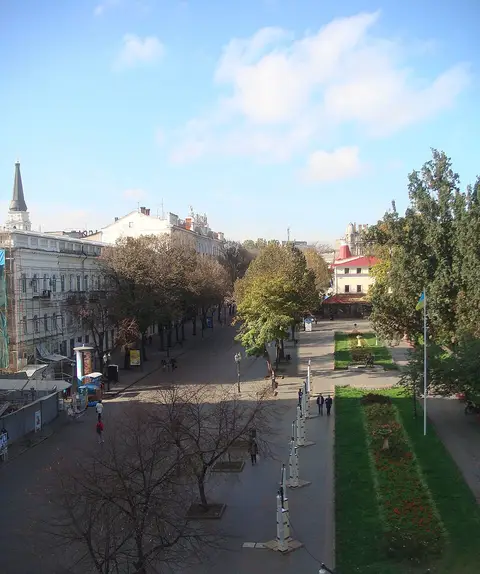 Historic sites01
Deribasivska Street
No address · Odesa○ Website○ Phone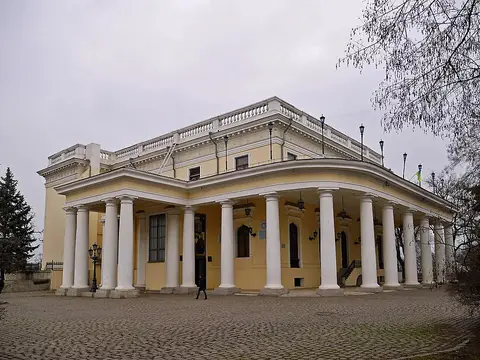 Historic sites02
Vorontsov Palace
Vorontsov Palace, Prymorskyi Blvd, 1 · Odesa○ Website○ Phone Historic sites03
Maraslis House
No address · Odesa○ Website○ Phone Monuments04
You need a free account to leave reviews and photos – that keeps comments genuine and lets you edit them later.