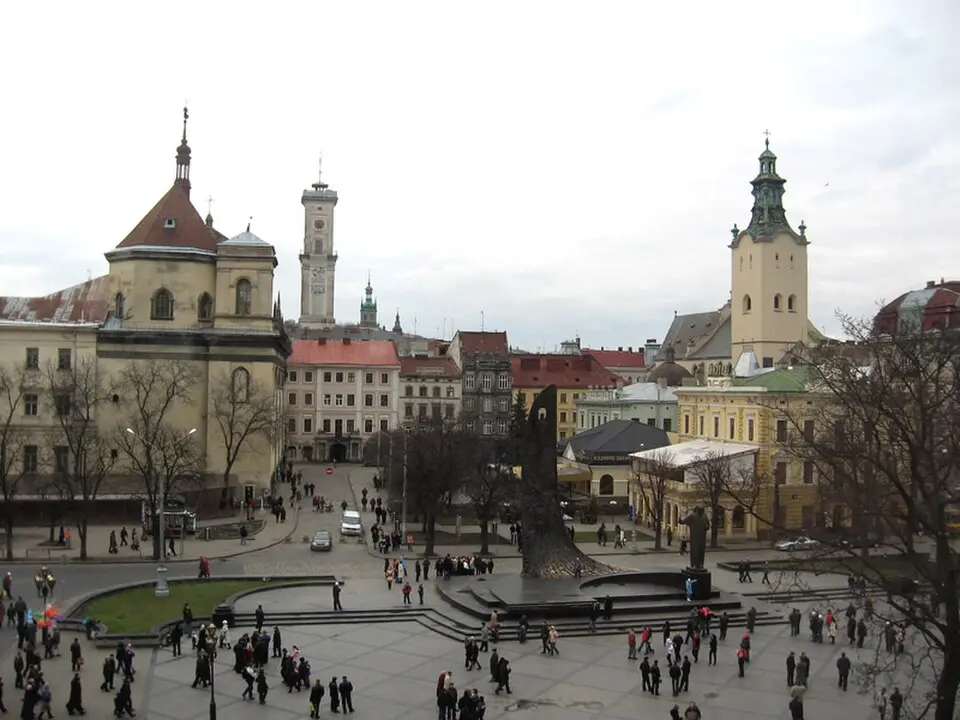
About Prospekt Svobody
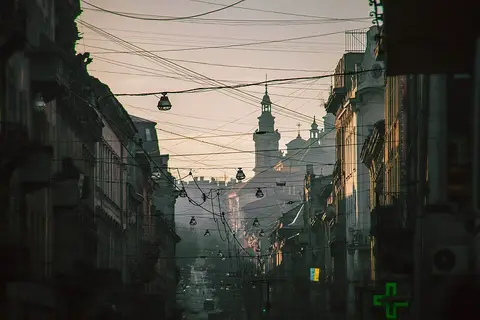
Prospekt Svobody is the central main axis of the Ukrainian city of Lviv and stretches from Mickiewicz Square in the south to the opera house in the north. The street came into being after the Austrian annexation in 1777, on the site of former Polish fortifications west of the Old Town that ran along the Poltva River. The avenue was originally laid out as a green boulevard divided by the river. During the second half of the 19th century, the Poltva was rerouted into an underground channel, which still runs beneath the street and the neighboring Shevchenko Avenue today. Under Austrian rule, the area traditionally served as a trading ground, and at the end of the 19th century an electric tramline was installed. The history of the avenue is closely tied to changing names that reflect political upheavals: from the Hetman Ramparts to Karl Ludwig Street and Legion Street, and on to Lenin Avenue in the Soviet era, it now bears the name Freedom.
Along the avenue, you can discover a number of important historic buildings and cultural institutions. Notable sights include the Grand Hotel, the Museum of Ethnography, the National Museum of the History of Lviv, the Maria Zankovetska Theater, and the Lviv Opera at the northern end. The street has also been the site of numerous monuments, many with a turbulent history. A monument to King Jan Sobieski, for example, was erected in 1898 and later moved to Warsaw and then to Gdańsk. A statue of the Archangel Michael and a monument to Stanisław Jabłonowski also once shaped the look of the avenue before they were removed or lost. More recently, a monument to the poet Taras Shevchenko was put up, while the Lenin statue, unveiled in 1952, was torn down in 1990.
The avenue holds great political and social significance for the city's history. In the Soviet era it served as the venue for annual May Day demonstrations, but in the late 1980s it became the scene of important political protests and concerts. Among other events, it hosted the first political demonstration in Soviet Ukraine as well as large marches calling for the legalization of the Ukrainian Greek Catholic Church. After Ukraine's independence, the street was renamed Freedom Avenue, and during the Euromaidan it once again became a central site for mass demonstrations supporting Ukraine's European integration. Today Prospekt Svobody is not only an important transportation hub but also a lively place where Lviv's rich and eventful history remains tangible.
At a glance
- Category
- Sight › Historic sites
- Rating
- no reviews yet · write a review
- Address
- —
Lviv, Ukraine - District
- Halytskyi District
- Phone
- —
- Website
- —
- —
- Coordinates
- 49.84267° N · 24.02699° E
- Data quality
- confidence 0.51
- Identifier
- ID fa83081e-be7…
Part of the tour
Lviv in One Day: Old Town, Rynok Square and High Castle →Location & surroundings
Toggle layersRatings & comments
none yetNear Prospekt Svobody
closest 5 per category · 2 kmSights
Museums
Hotels
More:Historic sites in Lviv (327)Sights in Halytskyi District (127)All sights in Lviv (377)
263 places within 2 km loaded.
You need a free account to leave reviews and photos – that keeps comments genuine and lets you edit them later.