Neuchâtel: Watchmaking Country Between Lake and Jura
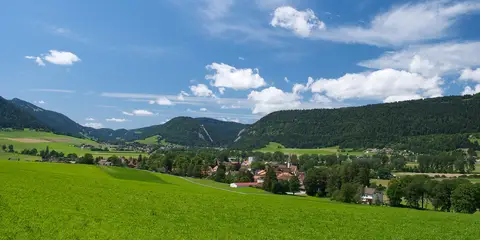
Travel guide · editorialThe canton of Neuchâtel rises steeply from the shore of Lake Neuchâtel into the Jura Mountains, the home of Swiss watchmaking. A trip to Neuchâtel combines a lakeside town of yellow limestone with high valleys, absinthe distilleries, and cities planned around the rhythm of watch movements.
Neuchâtel and the Lakeshore
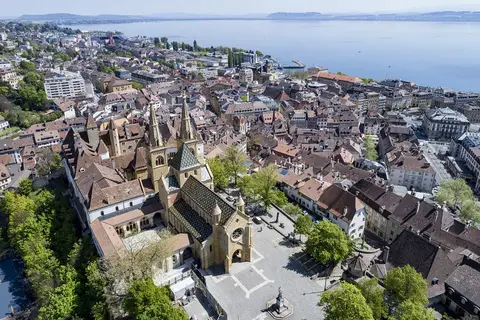
The town of Neuchâtel is dominated by its castle and collegiate church; its houses of ocher-yellow Hauterive stone led Alexandre Dumas to describe it as a town "made of butter." Until 1848, Neuchâtel was both a Swiss canton and a Prussian principality. Along the lakeshore, vineyards produce a light, sparkling Chasselas and the rosé Œil-de-Perdrix. In the municipality of Laténa near Marin, the archaeological site of La Tène gave its name to an entire era of Celtic history; the Laténium museum in Hauterive displays the finds.
La Chaux-de-Fonds and Le Locle
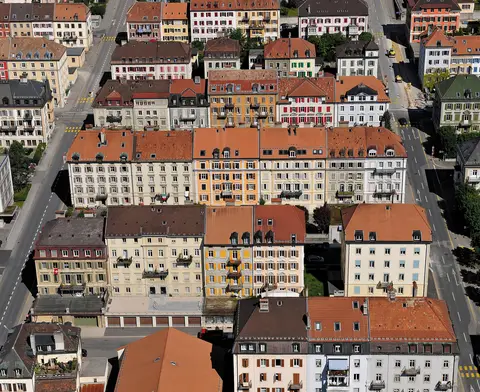
At an elevation of about 1,000 meters (3,300 feet) lie La Chaux-de-Fonds and Le Locle, whose grid-like layouts were rebuilt after fires in the 18th and 19th centuries entirely to suit the needs of watchmakers: long rows of buildings with wide windows for good light. Since 2009, they have been a UNESCO World Heritage Site. The International Watchmaking Museum in La Chaux-de-Fonds displays timepieces from several centuries, and Le Corbusier was born here – his Villa Turque and the Maison Blanche can be visited. In Le Locle, the underground mills at Col-des-Roches are worth a visit.
On Lake Neuchâtel, the lakeside path connects Neuchâtel with Auvernier, a winegrowing village with a history of pile dwellings, and with Saint-Blaise. In summer, boats cross the lake and travel through the Thielle Canal as far as Murten and Biel.
Val-de-Travers, Food, and Getting There
Absinthe was invented in the Val-de-Travers in the late 18th century; after a ban lasting nearly a hundred years, the "green fairy" has been legal again since 2005, and distilleries in Môtiers and Couvet open their cellars to visitors. The Creux du Van, a rocky natural amphitheater with 160-meter (525-foot) walls, is one of the most impressive natural spectacles in the Jura. On the menu you'll find saucisse aux choux, tripe, and fondue neuchâteloise. Neuchâtel lies on the Biel–Lausanne rail line, and a train climbs up to La Chaux-de-Fonds. The best time to visit is May through October; in winter, the Jura becomes a cross-country skiing area.