Fribourg: Bilingual Between Gruyère and Lake Murten
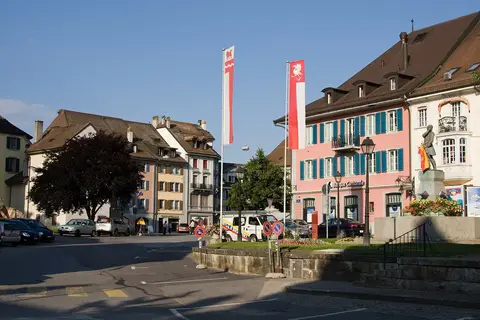
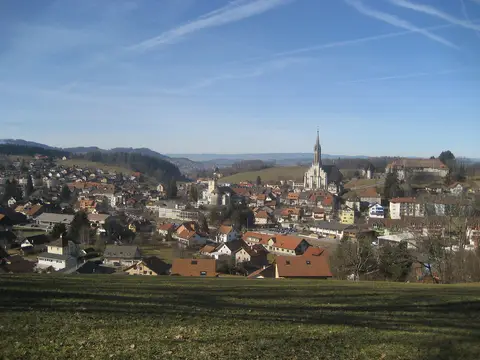
Travel guide · editorialThe canton of Fribourg (Freiburg in German) sits right on the language border and lives it every day. A trip to Fribourg takes you to a medieval city above the Sarine River, to the Gruyère region with its famous cheese, and to the shores of Lake Murten and Lake Neuchâtel.
Landscape and Language Border
About two-thirds of the population speak French and just under a third speak German, mainly in the Sense district and around Lake Murten. The south of the canton lies in the Alpine foothills: the Fribourg Prealps, with Moléson, the local mountain of the Gruyère region, and Lake Schwarzsee in the Sense Valley invite you to go hiking. To the north the land flattens out toward the Seeland, where vegetable fields and vineyards stretch along Mont Vully.
Around Lake Murten and Lake Neuchâtel you can discover prehistoric pile-dwelling sites that are part of the UNESCO World Heritage listing for prehistoric pile dwellings, as well as the Grande Cariçaie, Switzerland's largest lakeshore wetland, with reeds, floodplain forests, and bird-watching stations. Estavayer-le-Lac has a medieval castle and a small old town on the water.
Fribourg and the Towns
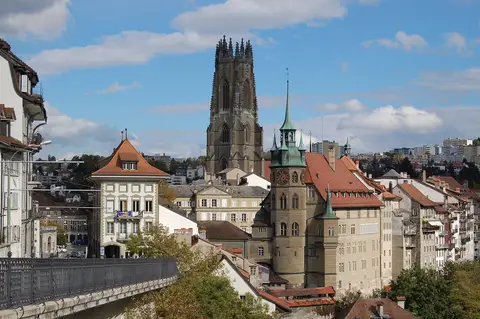
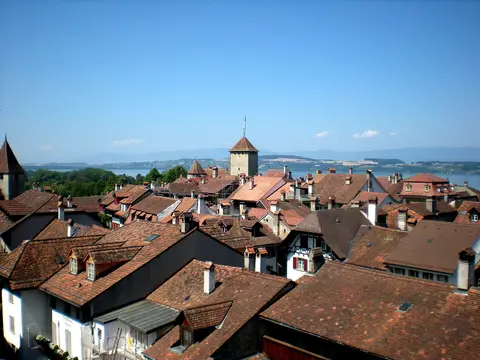
The city of Fribourg was founded in 1157 by the Zähringen dukes on a sandstone spur above the Sarine. With around 200 Gothic façades, its old town is one of the largest medieval city centers in Europe; St. Nicholas Cathedral has Art Nouveau stained-glass windows. Bridges from every era cross the Sarine, and a funicular runs on wastewater. Bulle is the market town of the Gruyère region and home to the Musée gruérien. Murten (Morat) has preserved a town wall that you can walk in its entirety and commemorates the 1476 battle in which the Swiss Confederates defeated Charles the Bold. Châtel-Saint-Denis lies in the south, at the border with Vaud.
Romont, on a hill above the Glâne Valley, houses the Vitromusée, a museum of stained glass, in its castle. Châtel-Saint-Denis is the starting point for Lac de Lussy and Moléson, and in the Sense district Lake Schwarzsee draws visitors with a cable car, a swimming beach, and an ice rink in winter.
Sights in the Canton of Fribourg
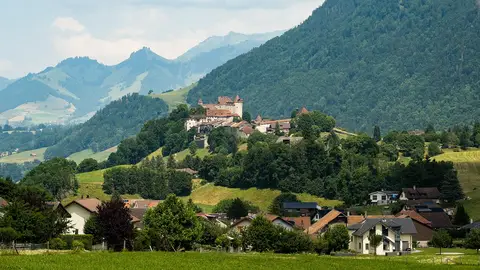
The little town of Gruyères, with its castle on a hilltop, is one of the most popular sights in the canton of Fribourg. Right next door, the show dairy La Maison du Gruyère explains how the cheese is made, and the HR Giger Museum displays the dark works of the creator of Alien. In Broc, the Cailler chocolate factory opens its doors. Near Lake Murten, the Roman town of Avenches, just across the canton line, is worth a visit, as is the Gotteron Gorge (Galternschlucht) in the Sense district.
The city of Fribourg itself deserves more than half a day: from the cathedral tower you look out over the loop of the Sarine, the Museum of Art and History displays late Gothic sculpture, and at the Espace Jean Tinguely – Niki de Saint Phalle the machines of the Fribourg-born artist are in motion.
Food and Drink
Gruyère AOP is the region's most famous cheese, and Vacherin fribourgeois is its creamy partner—together they make fondue moitié-moitié. The Bénichon, an autumn festival marking the descent of the herds from the Alpine pastures, is celebrated with a multicourse meal: lamb stew, tarts, cuchaule saffron bread with Bénichon mustard, and finally meringues with Gruyère double cream. Chasselas and Fribourg Pinot Noir grow on Mont Vully.
Getting There and Best Time to Visit
Fribourg is on the Bern–Lausanne rail line; it takes about 20 minutes from Bern. The best time to visit is May through October, especially September, with the descent from the Alpine pastures and the Bénichon.