Canton of Bern: Federal City, Lakes and the Bernese Oberland
Travel guide · editorialFew cantons span as wide an arc as Bern: from the Jura pastures around Biel, across the Mittelland with the federal city, to the glaciers of the Eiger, Mönch and Jungfrau. A vacation in Bern can therefore combine a stroll beneath arcades, a boat trip on Lake Thun and a high-alpine tour in a single day.
Landscapes from the Jura to the Alps
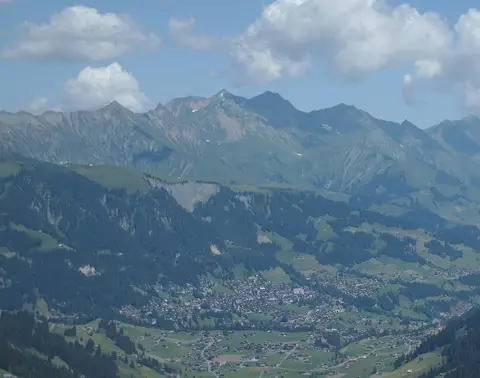
The bilingual canton stretches across three landscape zones. In the north lie the Bernese Jura and Lake Biel with St. Peter's Island, where Jean-Jacques Rousseau spent a few weeks. The Mittelland with the Emmental is gentle and rural: broad farmhouses with deeply pitched roofs dot the landscape, and the Seeland grows vegetables for half of Switzerland. In the south rises the Bernese Oberland, with Lake Thun and Lake Brienz, valleys such as the Haslital, the Simmental and the Saanenland, and the UNESCO World Heritage site Jungfrau-Aletsch, the largest glaciated area in the Alps.
Bern and the Canton's Towns
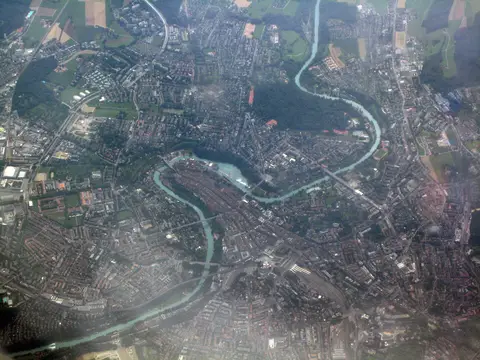
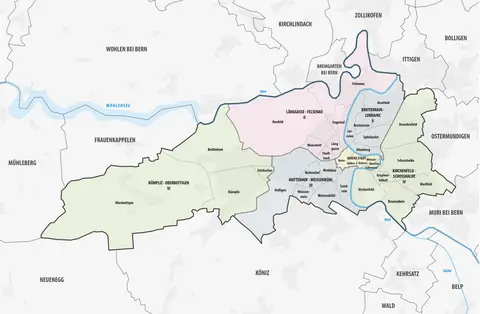
The city of Bern is the seat of the Federal Council and Parliament, yet feels more easygoing than capital-like. Its Old Town, on a peninsula in a loop of the Aare, is a UNESCO World Heritage site: roughly six kilometers of arcades, 16th-century figure fountains, the Zytglogge tower with its astronomical clock figures, and the Minster with the tallest church spire in Switzerland. In summer, locals float down the Aare and climb out again at the Marzili baths.
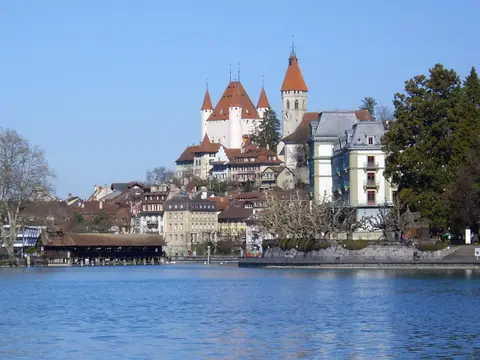
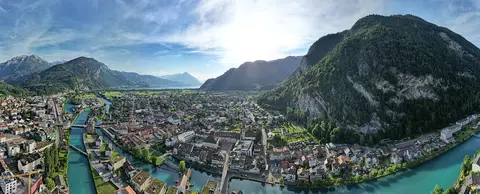
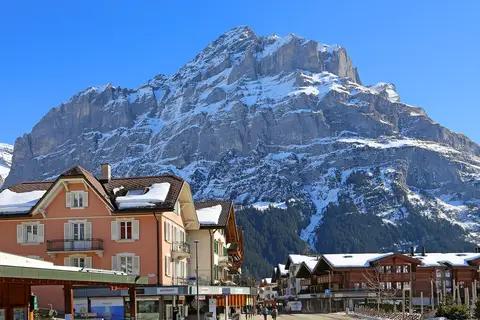
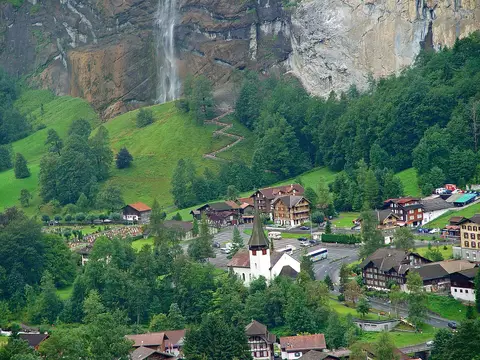
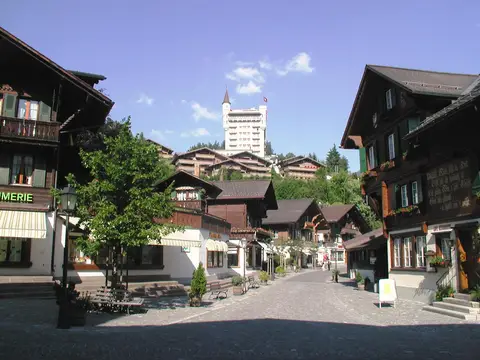
Biel/Bienne is the largest bilingual city in Switzerland and a center of the watch industry, home to the headquarters of Swatch and Omega. Thun welcomes visitors with a castle above the Old Town and the Aare, which flows out of the lake here. Interlaken lies between the two Oberland lakes and is the starting point for the mountain railways, while Grindelwald and Lauterbrunnen, with its 72 waterfalls, sit directly beneath the great peaks. In the west, Saanen and Gstaad are known for their chalets and winter guests, Adelboden for the World Cup giant slalom at the Chuenisbärgli.
Smaller but just as charming are Spiez, with its castle and vineyard bay on Lake Thun, Brienz, with its woodcarving school, and Meiringen at the foot of the Hasliberg. In the Emmental, Burgdorf with its castle complex and the show dairy in Affoltern are worth a detour.
Sights in Bern and the Oberland
Alongside the Old Town, the top sights in Bern include the Zentrum Paul Klee by Renzo Piano, the Einstein House on Kramgasse and the Bear Park on the banks of the Aare. In the Oberland, the Jungfrau Railway climbs to the Jungfraujoch at 3,454 meters, the highest railway station in Europe. From Mürren and the Schilthorn, a panorama opens up over the Lauterbrunnen Valley, while First above Grindelwald draws visitors with its cliff walk and zip line. Quieter spots include the Aare Gorge near Meiringen, the Giessbach Falls on Lake Brienz and the Ballenberg open-air museum, which gathers historic farmhouses from all over Switzerland.
Culture and History
Bern was founded by the Zähringen dukes in 1191 and rose in the late Middle Ages to become the largest city-state north of the Alps. It has been the federal city since 1848 – Switzerland has no official capital. The Zibelemärit, the onion market held on the fourth Monday in November, is the folk festival par excellence. In the Oberland, yodeling, Swiss wrestling festivals and alpine cattle processions are kept alive, and in the Emmental Jeremias Gotthelf captured 19th-century farm life in literature.
Food and Drink
The Berner Platte is a hearty dish of sausages, bacon, pork ribs, sauerkraut and beans, said to commemorate the victory at Neuenegg in 1798. The Emmental is where the cheese with the big holes is made, in Trubschachen Kambly bakes fine butter biscuits, and meringues are said to owe their name to Meiringen. Chasselas and Pinot Noir grow on Lake Biel, and you can taste them in wine villages such as Twann and Ligerz.
Getting There and Best Time to Visit
Bern is a central hub in the Swiss rail network: the trip takes about an hour from Zurich and Basel, and just under two hours from Geneva. The small Bern-Belp Airport (BRN) is served only seasonally, so most visitors arrive via Zurich or Geneva. In the Oberland, cog railways, postal buses and boats connect the towns. The best time for hiking is from June to September; skiers come to Grindelwald, Wengen or Adelboden between December and March. Fall brings golden larches and clear long-distance views, spring the cherry blossoms on Lake Thun.