About Münsterhügel
Basel's Münsterhügel (Cathedral Hill) is far more than the site of an important church. It is the historic heart of the city and a place where more than two thousand years of history have been compressed. The hill was already built on in the late Celtic period, and archaeological finds such as the so-called Murus Gallicus attest to early settlement. Later, the Romans built the fort of Basilia here, securing this strategically important point at the bend in the Rhine. This long prehistory makes the hill a place of special archaeological and cultural significance, one that still shapes the look of the city today.
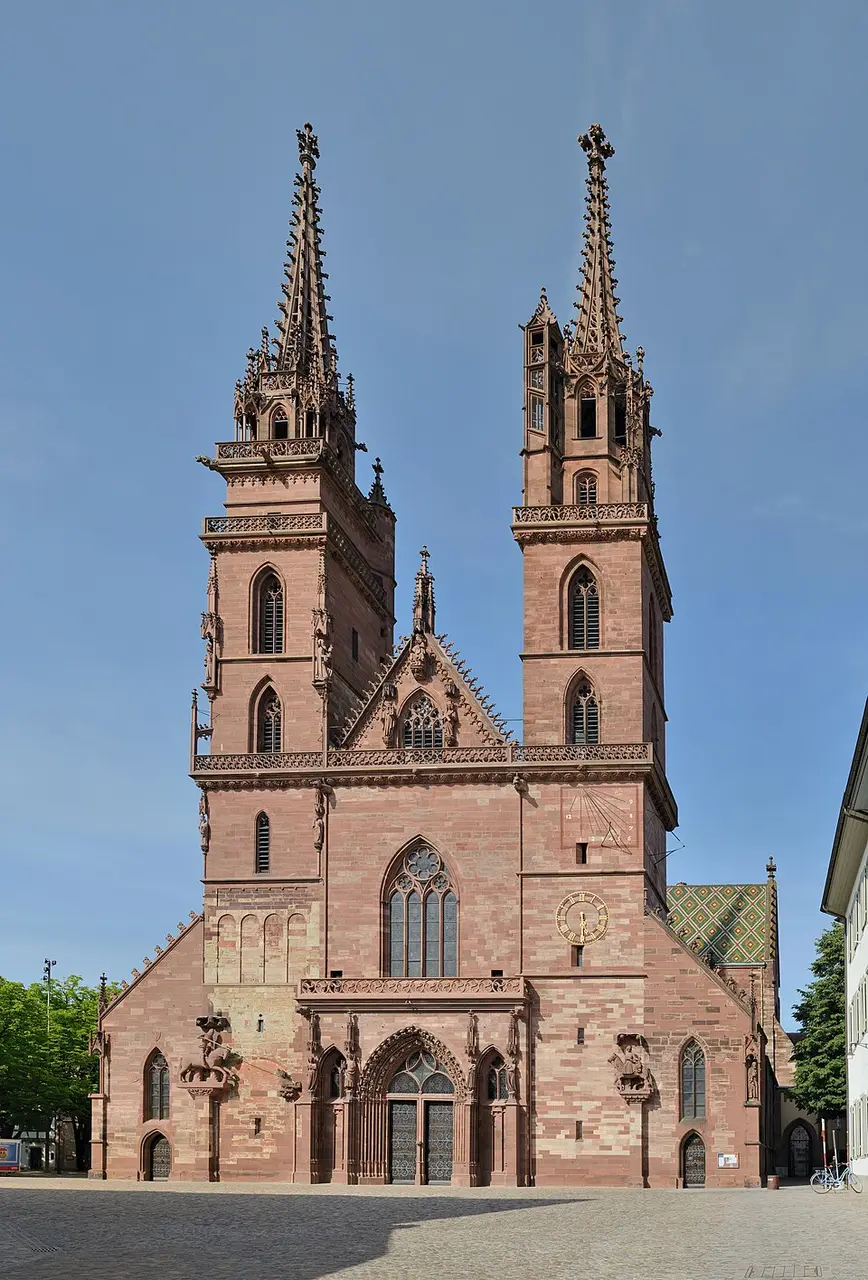
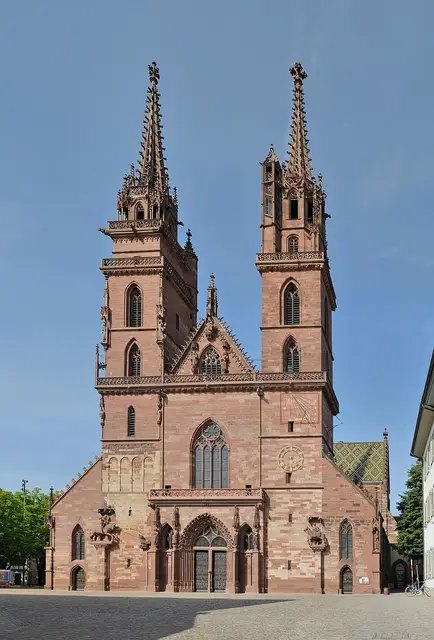
The dominant structure on the hill is Basel Cathedral (Basler Münster), a landmark of the city that immediately catches the eye with its red sandstone facades and colorful roof tiles. The two slender church towers and the main roofs, which intersect in a cross shape, give the building a unique silhouette. Today it serves as a Protestant Reformed church, but it was originally a bishop's church. Construction of the cathedral stretched over almost five centuries, from 1019 to 1500, and combines elements of Romanesque and Gothic architecture into a harmonious whole.
The building's history begins with the so-called Haito Cathedral, which was erected in the early 9th century as a Carolingian hall church. This early form gave way to the Heinrich Cathedral, a new Ottonian–early Romanesque building consecrated by Emperor Henry II in 1019. The present floor plan, however, goes back primarily to the late Romanesque reconstruction of the 12th century, which created a three-aisled gallery basilica. This building took over many elements of its predecessors but added new structures such as the transept and a crypt ambulatory. Construction proceeded from west to east, which can still be seen today in the building seams in the masonry.
A decisive event in the cathedral's history was the severe earthquake of 1356, which, together with a subsequent fire, caused great destruction. All the towers collapsed, and many vaults were damaged. The reconstruction, led by master builders such as Johann Parler and later Ulrich von Ensingen, produced the Gothic appearance seen today. The northern St. George's Tower was completed in 1428, while the southern St. Martin's Tower was not finished until 1500. These two towers, named after the knightly saints George and Martin of Tours, now dominate the west facade and, if you climb them, offer impressive views of the city, the Black Forest, and the Jura.
On the north side of the cathedral you will find the Gallus Portal, a masterpiece of Romanesque sculpture. One of the oldest Romanesque figure portals in the German-speaking world, it draws the eye with its archaic yet expressive figures. The portal resembles a triumphal arch and shows Christ as a merciful judge of the world in the tympanum. Below are scenes of the Last Judgment, along with angels and the dead. With their lively gestures and facial expressions, the figures seem unusually dynamic for their time. Above the portal sits a rose window in the form of a wheel of fortune, symbolizing the fickleness of earthly luck.
The interior of the cathedral is marked by the blending of Romanesque and Gothic style elements. The blocky capitals and round arches of the gallery arcades reflect its Romanesque origins, while the pointed-arch rib vaults of the side aisles and the nave show Gothic influences. This mixture makes the space architecturally fascinating. On the outside of the choir, which faces northeast for topographical reasons, you will find rich sculptures, including grotesque figures and elephants that reflect the imagination of medieval stonemasons. From the raised terrace behind the choir, known as the Pfalz, you have a wide view over the Rhine and the opposite bank.
Beneath the choir lies the crypt, which now serves as an archaeological showcase. It holds the graves of several Basel bishops from the 10th to 13th centuries. The oldest sarcophagus belongs to a Bishop Rudolf, who presumably lost his life during the Hungarian invasion of 917. On the crypt walls you can see important late Romanesque wall paintings depicting bishops such as Adalbero II and Lütold I. The vault of the crypt ambulatory also contains 14th-century frescoes with scenes from the lives of the saints. These underground rooms offer a fascinating glimpse into the religious and political history of the city.
A special highlight in the north aisle is the Vincentius Panel, a relief from around 1200. It tells the life and martyrdom of the deacon Vincent of Valencia in four scenes. The depiction shows his condemnation, his torture, and the attempt to defend his body from animals. The quality of the carving and the unknown artist's knowledge of ancient sculpture make this work a jewel of Romanesque sculpture. Also inside is the canons' choir stalls, of which 62 of the original 96 seats survive. The elaborately carved seats of oak and walnut are considered one of the most important medieval choir stalls of the 14th century.
The cathedral's history is also closely tied to the Reformation. In 1529 the church experienced the so-called iconoclasm, in which Reformed citizens destroyed many works of art. Despite this destruction, the cathedral treasure was saved. Today the epitaph of the humanist Erasmus of Rotterdam recalls his time in Basel. Erasmus died in the city in 1536 and was buried in the cathedral. His gravestone bears a Latin inscription honoring his achievements. That a Catholic cleric received such a place of honor in Reformed Basel shows the high respect he commanded across confessional lines.
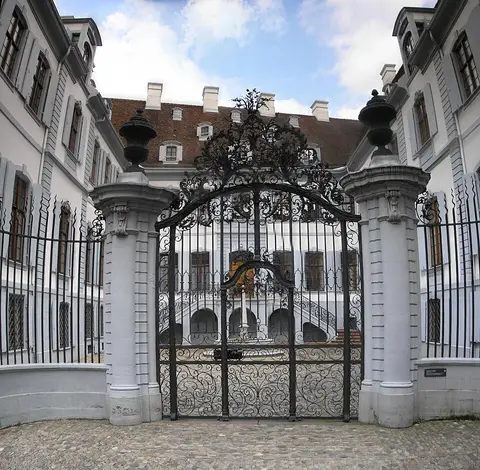
The Münsterplatz, which lies in front of the building, completes the picture of Cathedral Hill. It is lined with former canons' houses that underscore the historic importance of the place. The square is a popular meeting point for locals and tourists and offers an ideal setting for taking in the cathedral's architecture at leisure. The combination of the imposing church, the historic buildings, and the location on the Rhine makes Cathedral Hill an unforgettable experience. Here you can feel the layers of history, from the Roman roots through the medieval heyday to the modern city.
In summary, Cathedral Hill is a place that combines history, architecture, and spirituality in a unique way. Basel Cathedral, with its towers, crypt, and elaborate reliefs, invites you to explore the past. Whether you climb to the top of the towers, visit the crypt, or study the sculptures on the facade, every corner of the hill offers new impressions. It is a place that invites you to linger and brings Basel's rich history to life. The careful preservation and restoration of the building fabric, especially the red sandstone, ensures that this cultural heritage will be preserved for generations to come.
At a glance
- Category
- Sight › Historic sites
- Rating
- no reviews yet · write a review
- Address
- Münsterpl. 15
4051 Basel, Switzerland - District
- Altstadt Grossbasel
- Phone
- —
- Website
- —
- —
- Coordinates
- 47.55632° N · 7.59142° E
- Data quality
- confidence 0.88
- Identifier
- ID 93584f71-b00…
Part of the tour
Basel in One Day: Cathedral, Town Hall and the Rhine →Location & surroundings
Toggle layersRatings & comments
none yetNear Münsterhügel
closest 5 per category · 2 kmSights
Restaurants
Museums
Hotels
More:Historic sites in Basel (47)All sights in Basel (51)
233 places within 2 km loaded.
You need a free account to leave reviews and photos – that keeps comments genuine and lets you edit them later.