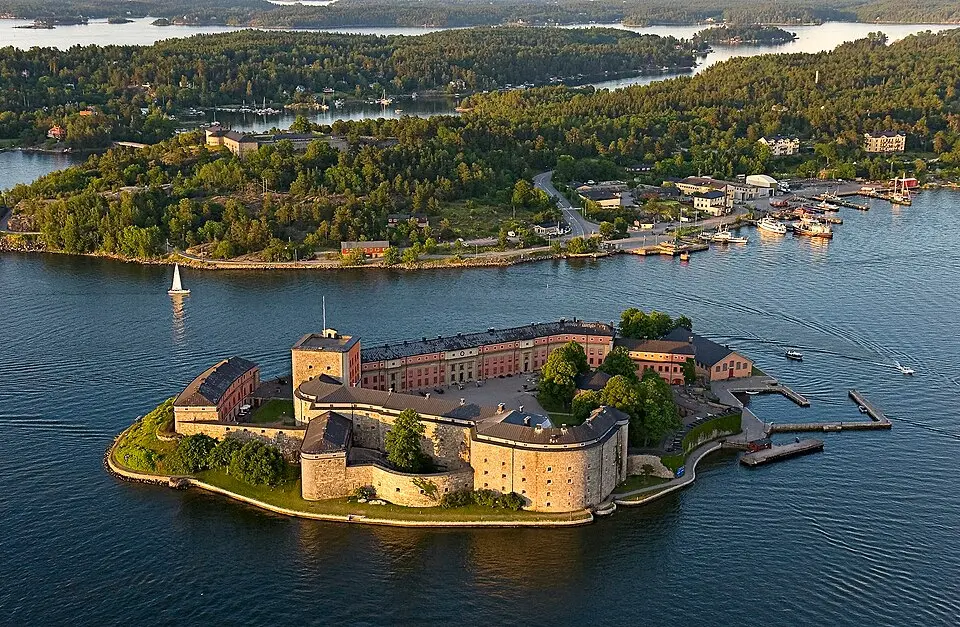
About Vaxholms Fästningsmuseum
Vaxholm Fortress sits on the island of Vaxholmen in the Stockholm archipelago and is open to visitors today as a museum. The strategic importance of this spot was recognized as early as the 16th century, as a way to protect the shipping route to the capital and to collect tolls. King Gustav Vasa chose the site himself, and in 1548 a simple wooden fort was first built there. Over the centuries the complex was expanded and reinforced several times, among other occasions after a Danish attack was repelled in 1612. During the Russian raids of 1719, Swedish warships helped defend the fortress against galleys. A complete rebuilding began in 1833 under the direction of the officer Carl Fredrik Meijer. The old fortification, including its tower, was torn down and replaced with a modern one inspired by French engineering ideas and by Karlsborg Fortress. The new structure consisted of a five-story central citadel, barracks for a garrison of about 1,200 men, and bombproof casemates for cannons. The thick walls and Neoclassical style define the look of the fortress, which has survived to this day.
Although the rebuilding was completed in 1863, advances in artillery technology and the growing size of ships soon robbed the fortress of its military relevance. New fortifications were built at other points along the approach, and Vaxholm lost its central role. In the meantime, the complex also served as a prison in the 18th and 19th centuries, holding, among others, the publicist Magnus Jacob Crusenstolpe and General Georg Carl von Döbeln. The fortress was also a station on an optical telegraph line connecting Söderarm with the Stockholm Palace. Today the building is a state-protected historic monument and houses the Vaxholm Fortress Museum.
In the exhibition rooms, you can gain insight into the history of Swedish coastal defense. Exhibits cover everyday life in the fortress in earlier times, its years as a prison, and military readiness in the archipelago during World War II. One highlight is the surviving part of the control mechanism for the optical telegraph, which was operated by Abraham Niclas Edelcrantz. A family lives in the complex today, which gives the place a special character. The name Vaxholm probably derives from the Swedish word for an island where a watch was kept.
At a glance
- Category
- Museum › Museums (general)
- Rating
- no reviews yet · write a review
- Address
- KASTELLET 1
185 99 Stockholm, Sweden - Phone
- +46812004870
- Website
- www.vaxholmsfastning.se
- info@vaxholmsfastning.se
- Coordinates
- 59.40289° N · 18.35852° E
- Data quality
- confidence 1.00
- Identifier
- ID 4aa7038d-9c9…
Location & surroundings
Toggle layersRatings & comments
none yetNear Vaxholms Fästningsmuseum
closest 5 per category · 2 kmSights
Restaurants
Museums
Hotels
Cocktail bars
None within 2 km.
More:All museums in Stockholm (219)
42 places within 2 km loaded.
You need a free account to leave reviews and photos – that keeps comments genuine and lets you edit them later.
A fortress which has guarded Stockholm's harbour since the 16th century, and famously resisted an attack by the Russian Empire in 1719. Over the centuries, an extensive coastal defense system was built across the archipelago, with Vaxholm as its headquarters. The fortress was also used as a prison. Some scenes of a 1970 Pippi Longstocking film was shot here. Since 2003, the fortress has a museum of its history, as well as hospitality venues.
Source: Wikivoyage, „Stockholm archipelago“ · authors per page history · CC BY-SA 4.0