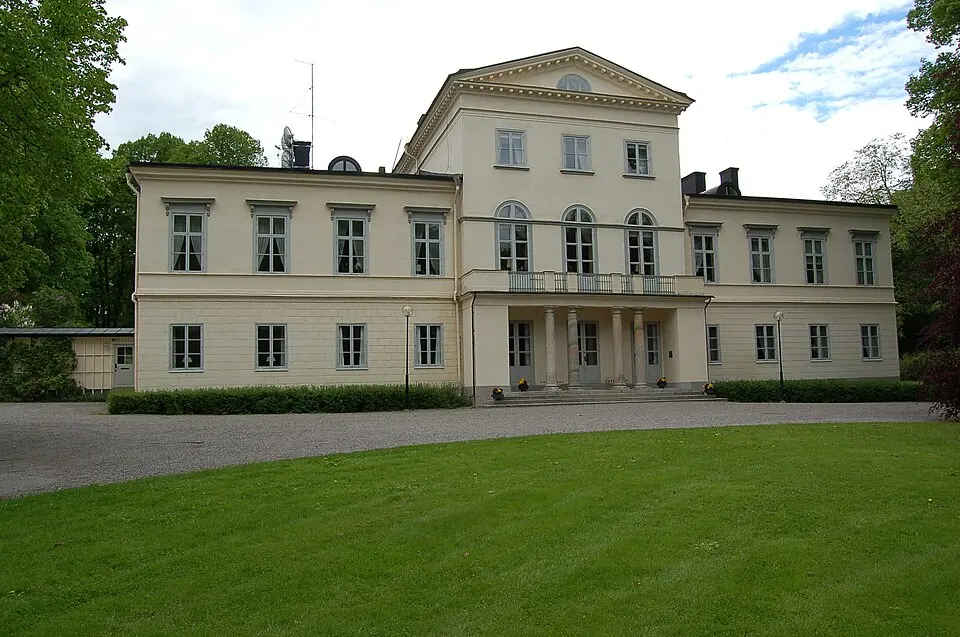
About Haga slott
Haga slott, also known as Haga Palace, is a historic ensemble of buildings in Haga Park in the Swedish municipality of Solna, right on the border with the capital, Stockholm. The park itself is considered one of the finest examples of an English landscape garden in Sweden and stretches along the western shore of Lake Brunnsviken. The palace, originally called Drottningens paviljong (the Queen's Pavilion), was built between 1802 and 1805 for King Gustav IV Adolf. The architect Christoffer Gjörwell designed the building in the Italian villa style. Today the palace is the residence of Crown Princess Victoria and her husband, Crown Prince Daniel, who have lived there since their wedding in 2010.
The history of the grounds goes back to 1771, when King Gustav III acquired the Haga estate in order to create a small English landscape park there. The king was a great patron of garden design and took a personal part in the planning, contributing numerous designs of his own for buildings and plantings. Between 1771 and 1780, three islands in Brunnsviken were connected by bridges and laid out with avenues and shoreline paths. The later purchase of the Brahelund estate more than doubled the size of the park. Gustav III liked to use the manor house as a retreat where he could work undisturbed on important decisions.
The park's present-day appearance took shape between 1780 and 1797 under the direction of park architect Fredrik Magnus Piper, who had trained in England. Other important designers included Louis Jean Desprez, Olof Tempelman, and Carl Christoffer Gjörwell. A central role was played by the sight lines Piper drew up, which determined the placement of buildings and trees. The Chinese Pavilion, for example, can be seen from the Turkish Kiosk. The grounds were reshaped to create gentle transitions between forest, pasture, and the large lawns sloping down to the lake, known as pelouses. By 1800, garden architect Johan Christian Ackermann had planted a total of 26,000 trees to achieve the desired landscape character.
Besides Haga Palace, the park is home to a number of other historic buildings that bear witness to the rich architectural history under Gustav III. Among the best known are the Copper Tents, a complex of three buildings whose facades, made of painted sheet copper, were modeled on Roman military tents. They originally served as guard and supply buildings for the mounted Life Guards. Today these buildings house cafés, restaurants, and the Park Museum. Also in the park is Övre Haga, which was originally conceived as an inn and later converted into an orangery. The eastern extension of this complex now houses a butterfly house, which opened in 1983 and is home to tropical butterflies and Asian gardens.
Another highlight is Gustav III's Pavilion, regarded as one of the most interesting examples of the Gustavian style in Sweden. Built from 1787 to designs by Olof Tempelman, it now holds much of the king's personal library. The interior decoration was designed by Louis Masreliez, and the original drawings were rediscovered and put to use in later restorations. Not far away stands the Turkish Kiosk, the first new building in the park, where Gustav III held counsel with his followers. The Chinese Pavilion, completed in 1787, is also a popular photo spot; its roof decorations originally carried small bells.
Particularly impressive are the ruins of the Great Palace, Stora Haga slott. Gustav III had planned to build a large pleasure palace here with a theater, ballrooms, and an art museum, inspired by his trip to Italy. After the ceremonial laying of the foundation stone in 1786, construction began, at times involving up to 800 people. After the king's assassination in 1792, however, work was halted, and only a huge, roofless basement structure was completed. Today the ruins are a popular backdrop for theater performances and film productions. A detailed model of the planned palace can be viewed in the Park Museum, located in the middle of the Copper Tents, which tells the story of the park through pictures and plans.
Haga Park has been open to the public since the mid-19th century and is a popular excursion destination for Stockholm residents. The large meadow, the Pelouse, is open to walkers and is used for barbecues in summer and sledding in winter. Since 1994, the park has been part of the Ecopark, Sweden's first National City Park. In the southwestern part of the park lies the Royal Cemetery at Haga, where numerous members of the ruling Bernadotte dynasty are buried. Since 1973, the monarchs have also been laid to rest here, after earlier burials took place in Riddarholm Church in Stockholm.
In the southernmost part of the park, right at the city limits, you'll find Stallmästaregården, the oldest surviving country inn in the Stockholm area. It has operated continuously since the mid-17th century and was originally built as the farm of a master of the horse. Queen Christina is said to have spontaneously celebrated Midsummer here in 1645, which led to the opening of an inn. Today Stallmästaregården is an upscale restaurant with a hotel. The park is managed by the Swedish National Property Board and maintained by the Royal Court administration, which ensures the preservation of this unique historic ensemble.
At a glance
- Category
- Sight › Historic sites
- Rating
- no reviews yet · write a review
- Address
- Hagaparken
169 70 Stockholm, Sweden - Phone
- +4684026000
- Website
- www.kungahuset.se
- —
- Coordinates
- 59.36362° N · 18.03947° E
- Data quality
- confidence 0.97
- Identifier
- ID 3d6fa022-ab7…
Location & surroundings
Toggle layersFAQ about Haga slott
quick answersWhat is Haga Palace in Stockholm?
Haga Palace (Haga slott) is a historic palace in Haga Park in the municipality of Solna, right on the border with Stockholm. It was built between 1802 and 1805 for King Gustav IV Adolf and was originally called Drottningens paviljong (the Queen's Pavilion). The architect Christoffer Gjörwell designed the building in the Italian villa style.
Who lives in Haga Palace near Stockholm today?
Today, Haga Palace near Stockholm is home to Crown Princess Victoria and her husband, Prince Daniel. The couple has lived there since their wedding in 2010.
What is special about Haga Park around Haga Palace?
Haga Park, surrounding Haga Palace in Stockholm, is considered one of the finest examples of an English landscape garden in Sweden and lies on the western shore of Lake Brunnsviken. King Gustav III acquired the Haga estate in 1771 and partly planned the park himself; it took its present form between 1780 and 1797 under the English-trained landscape architect Fredrik Magnus Piper. Piper's sight lines determine the placement of buildings and trees, so that from the Turkish Pavilion, for example, you can see the Chinese Pavilion. By 1800, the garden architect Johan Christian Ackermann had had a total of 26,000 trees planted.
Which buildings can you visit in Haga Park besides Haga Palace?
Haga Park, near Haga Palace in Stockholm, contains several historic buildings from the time of Gustav III. Best known are the Copper Tents, three buildings with facades of painted copper sheeting in the style of Roman military tents, which now house cafés, restaurants, and the Park Museum. Övre Haga, a former inn that later became an orangery, has a butterfly house in its eastern annex, opened in 1983, featuring tropical butterflies and Asian gardens.
What can you see near Haga Palace in Stockholm?
Near Haga Palace in Stockholm, travelguide195 lists several historic sites and museums within about one kilometer. Very close by are Gustav III's Pavilion (about 114 meters), the Temple of Echo (Ekotemplet, about 149 meters), and the Stora Haga palace ruins (about 252 meters). A bit farther away you'll find Wittrock's Tower, the Haga Park Museum, Villa Frescati, and the Chinese Pavilion; the Swedish Museum of Natural History is about 996 meters away.
Ratings & comments
none yetNear Haga slott
closest 5 per category · 2 kmSights
Restaurants
Museums
Hotels
Cocktail bars
More:Historic sites in Stockholm (747)All sights in Stockholm (854)
120 places within 2 km loaded.
You need a free account to leave reviews and photos – that keeps comments genuine and lets you edit them later.