
Extremadura: Romans, Conquistadors and Oak Groves
Travel guide · editorialBetween Madrid and the Portuguese border lies one of Spain's quietest regions, where storks nest on church towers and pigs forage for acorns under holm oaks. A vacation in Extremadura leads you to Roman theaters, medieval lanes and the hometowns of the conquistadors who conquered the Americas.
Landscape: Dehesa and River Valleys
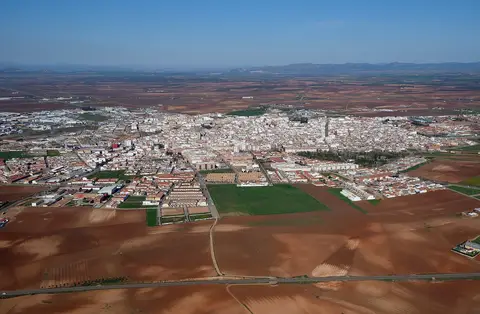
Extremadura consists of the provinces of Cáceres and Badajoz and is sparsely populated. Typical of the region is the dehesa, a pastoral landscape of open holm oak and cork oak groves where Iberian pigs, sheep and fighting bulls graze. In the north, the Valle del Jerte, famous for its cherry blossoms in March and April, and La Vera, with its pepper and tobacco fields, stretch all the way to the Sierra de Gredos. Monfragüe National Park on the Tagus is one of the most important breeding grounds in Europe for griffon vultures, Spanish imperial eagles and black storks. In the south, the Guadiana flows through broad plains where rice and tomatoes are grown.
Sights in Extremadura: Mérida and Cáceres
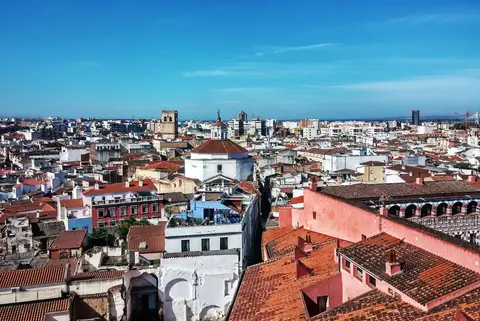
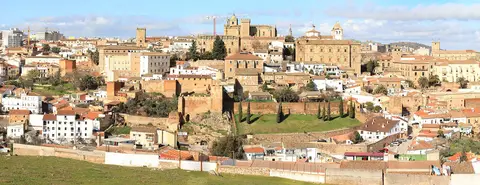
Mérida, the capital, was founded in 25 B.C. as Emerita Augusta and was the capital of the Roman province of Lusitania. The Roman theater, which hosts a classical theater festival every summer, the amphitheater, the long bridge over the Guadiana, the Temple of Diana and the Los Milagros aqueduct make up one of Spain's largest archaeological ensembles; the National Museum of Roman Art was designed by Rafael Moneo. Cáceres has a walled old town with noble palaces and defensive towers that is barely disturbed by modern buildings; it has often served as a film set, including for Game of Thrones. Both cities are UNESCO World Heritage Sites.
Trujillo, Plasencia and Guadalupe
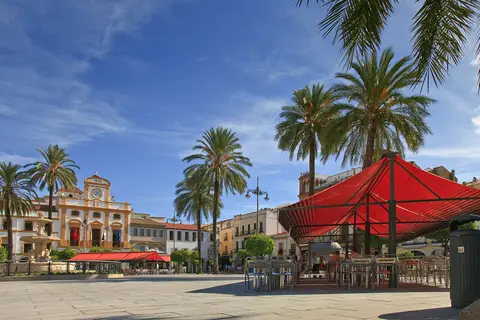
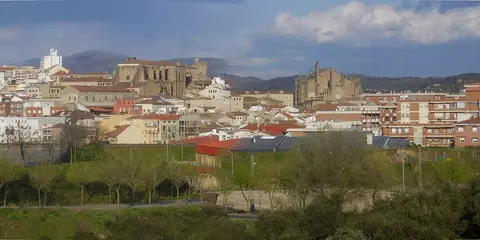
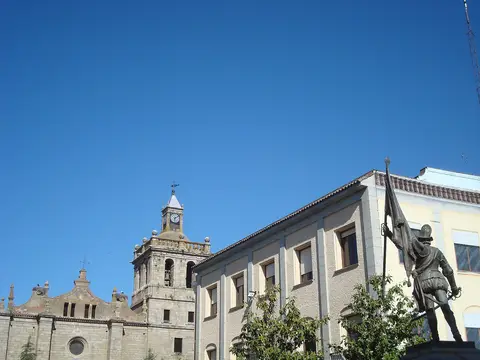
One of the best-known destinations in Extremadura is Trujillo, hometown of Francisco Pizarro, the conqueror of Peru. His equestrian statue stands on the Plaza Mayor, with a Moorish castle above it. The Guadalupe Monastery, with its famous Madonna, was one of Spain's most important pilgrimage sites and is also a World Heritage Site. Plasencia has two cathedrals built side by side and is the starting point for the Jerte Valley. Zafra in the south is often compared to Seville for its two plazas and white houses. Badajoz, the largest city, lies right on the border with Portugal and has a sprawling Moorish fortress, the Alcazaba. Don Benito and Almendralejo are agricultural centers; Almendralejo is the capital of the Ribera del Guadiana wine region, which also produces cava.
Jamón, Torta del Casar and Pimentón
The cuisine of Extremadura is rustic. Jamón ibérico de bellota from the dehesa, sold under the Dehesa de Extremadura designation of origin, is considered one of the best in Spain. Torta del Casar is a creamy sheep's-milk cheese; you cut off the top of the rind and spoon the soft interior onto bread. Smoked pimentón, a paprika powder that goes into chorizo and migas extremeñas, comes from La Vera. Caldereta de cordero, a lamb stew, and game dishes are widespread.
Getting There and Best Time to Visit
The small Badajoz airport has only a few domestic connections, so most visitors arrive via Madrid or Seville. A new rail line connects Badajoz, Mérida and Plasencia with faster trains, but for many destinations a car remains the most practical option. The best times to visit are spring and fall: in summer the region is one of the hottest in Spain, while in March and April the Jerte Valley is in bloom and the dehesa is green.