Discover Slovenia: Alps, Karst and the Adriatic
Travel guide · editorialIf you're planning a vacation in Slovenia, you can hike in the Julian Alps in the morning, walk through a stalactite cave at midday and eat fish at the harbor in Piran in the evening. The country is barely bigger than New Jersey, yet the Alps, the Karst, vineyard-covered hills and a short stretch of Adriatic coast all lie close together.
Ljubljana: A Capital on the Ljubljanica
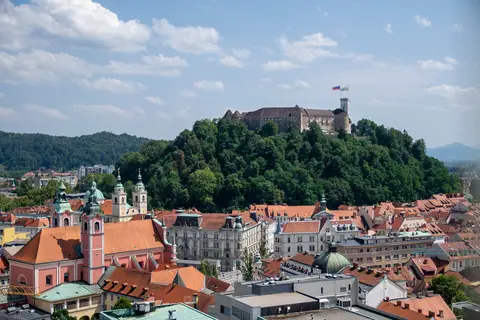
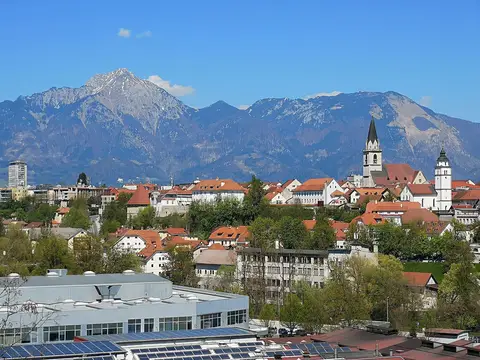
Ljubljana has just under 300,000 residents and feels more like a big small town. The old town is car-free, cafés line the Ljubljanica River, and from the castle on the hill you can see the peaks of the Kamnik–Savinja Alps on clear days. One man above all shaped the city: the architect Jože Plečnik, who between the 1920s and 1950s designed the Triple Bridge, the colonnades of the Central Market, the National and University Library and many riverside promenades. His works have been a UNESCO World Heritage Site since 2021. On the Dragon Bridge, green bronze dragons, the city's heraldic animal, stand guard. On Fridays in summer, the square next to the market turns into "Odprta kuhna" (Open Kitchen), with food stalls from all over the country. The alternative cultural center Metelkova, housed in a former barracks, shows the capital's other, nonconformist side.
Bled, Bohinj and the Julian Alps
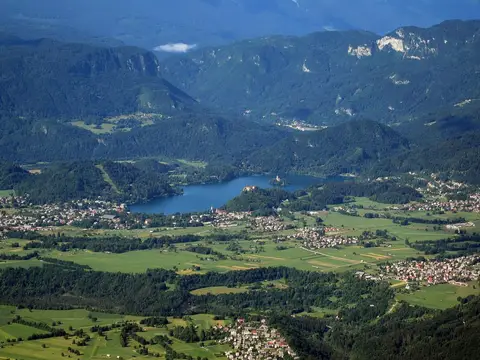
Lake Bled, with its little island, the Church of the Assumption and the castle on the cliff, is the country's best-known image. You reach the island by pletna, a wooden boat rowed by a standing oarsman; ring the bell there and you may make a wish. Afterward, a slice of Bled cream cake is a must. About 18 miles farther on lies Lake Bohinj, larger, quieter and without a hotel promenade, nestled in Triglav National Park. At 2,864 meters (9,396 ft), Triglav is Slovenia's highest mountain and appears on the national coat of arms; every Slovene, it is said, should climb it once in a lifetime. The Vršič Pass, the country's highest mountain pass road, leads from Kranjska Gora into the Soča Valley. The river glows emerald green there, and Bovec is a hub for rafting and kayaking. In World War I the Isonzo Front ran through here; the museum in Kobarid tells the story. Near Planica, close to Kranjska Gora, stand the large ski-flying hills where World Cup jumping events take place every spring.
Sights in Slovenia: Karst and Caves
The Karst, which gave its name to the geological phenomenon, is a landscape where rivers vanish underground and resurface miles away. You ride into the Postojna Cave on a small electric train, and about three miles of passages are open to visitors. Aquariums there house olms, blind amphibians known as "human fish" that can live for more than a hundred years. The Škocjan Caves are a UNESCO World Heritage Site: an underground canyon through which the Reka River roars, spanned by a bridge at a dizzying height. Nearby, Predjama Castle clings to a rock face. Lipica is the home of the Lipizzaner horses, the stud farm that once supplied the horses of the Spanish Riding School in Vienna.
Piran, Koper and the Coast
Slovenia's coastline is only about 29 miles long, but it is packed with towns. Piran sits on a narrow peninsula; the oval Tartini Square, named after the violinist born here, and the Venetian-influenced alleys rank among the most beautiful destinations in Slovenia. From the bell tower of St. George's Church you can see all the way to the Alps on a clear day. Portorož is the beach resort with hotels and a casino, Izola a small fishing town, and Koper the largest town on the coast, with the country's only commercial port and a small Venetian old town. Place names here are bilingual, and Italian is a minority language. In the Sečovlje Salt Pans, sea salt has been harvested using traditional methods for centuries.
Maribor, Wine Country and Slovenian Cuisine
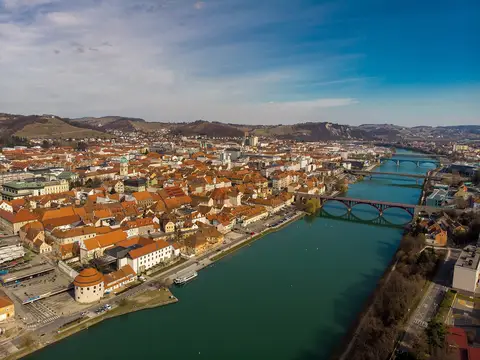
Maribor, the second-largest city, lies on the Drava River amid vineyards. At Lent grows the world's oldest grapevine, a Žametovka vine more than 400 years old. The region around Maribor and Ptuj, the country's oldest town, is white wine country; in Goriška Brda on the Italian border, Rebula and orange wines ripen, while the dark Teran comes from the Karst. Celje has a large castle ruin that once belonged to the Counts of Celje. The cuisine reflects the neighbors: Carniolan sausage with sauerkraut, štruklji (filled dough rolls), Idrija žlikrofi (small dumplings with a potato filling), the bean-and-sauerkraut soup jota, and on the coast, squid and polenta. For holidays, people bake potica, a yeast-dough roll with walnut filling, and from the east comes prekmurska gibanica, a layered pastry with poppy seeds, curd cheese, nuts and apples.
Getting There and Getting Around
Ljubljana Airport (LJU) is at Brnik, about 16 miles north of the capital, but it rarely has direct flights from Germany. Many travelers therefore land in Venice, Trieste, Klagenfurt, Graz or Zagreb. By car, you can reach Ljubljana from Munich in a good four hours via the Tauern or Karawanken motorway; you need an electronic vignette for the highways. Trains run from Villach and Graz, and buses supplement the network within the country. For the Alps and the Karst, a car or bicycle is more convenient.
Best Time to Visit Slovenia
The best time to visit Slovenia is from May to September. July and August bring temperatures of 82 to 86°F on the coast and water temperatures around 75°F, and the mountains are pleasant for hiking; the huts on Triglav are usually open from late June to September. May, June and September are quieter and ideal for Ljubljana, Bled and the Soča Valley. In October the vineyards change color, and in November people celebrate St. Martin's Day with young wine. In winter, you can ski in Kranjska Gora or on the Vogel plateau above Lake Bohinj.