Sibiu: Saxon Towns and the Făgăraș Peaks
Travel guide · editorialSibiu (German: Hermannstadt) was a European Capital of Culture in 2007, and the area has been one of Romania's best-known destinations ever since. A vacation in Sibiu combines a beautifully restored old town with fortified churches, shepherd villages, and one of the most spectacular mountain roads in Europe.
The Old Town of Sibiu
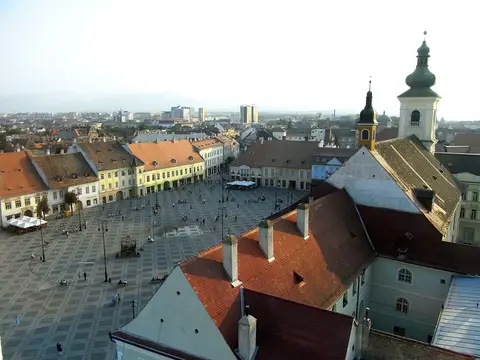
Transylvanian Saxons founded the city in the 12th century, and the Upper and Lower Towns still shape its character today. On the Large Square, the Brukenthal Museum, housed in the palace of the former Habsburg governor, holds one of the oldest art collections in southeastern Europe. The Small Square is linked to the Bridge of Lies, Romania's first cast-iron bridge, around which several legends have grown. Typical of the old town are the dormer windows that look out over the lanes like half-closed eyes. The Lutheran parish church with its tall tower recalls the city's Protestant tradition, and in June the International Theatre Festival fills squares and halls with performances.
Sights in and Around Sibiu
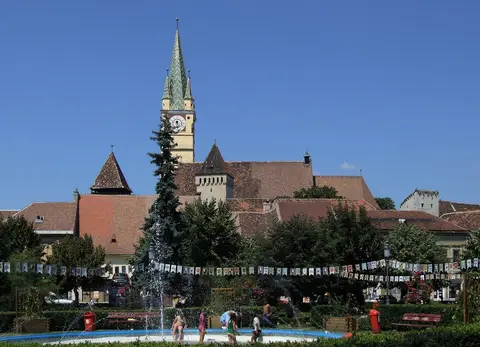
On the edge of town, in the Dumbrava Forest, the ASTRA Open-Air Museum displays hundreds of farmhouses, mills, and workshops from all over Romania. West of the city stretches the Mărginimea Sibiului, a chain of shepherd villages such as Sibiel, where a museum shows glass icons, and Rășinari, known for its sheep's cheese producers. To the north lies the gentle wine country around Mediaș: St. Margaret's Church, with its slightly tilted Trumpeter's Tower, stands inside a fortified church complex, and nearby Biertan, with its massive fortified church, is a UNESCO World Heritage Site. Cisnădie and Cisnădioara (Michelsberg) have more fortified churches, the latter on a hill above the village.
The Transfăgărășan and the Mountains
The Transfăgărășan high road winds up from the north in countless switchbacks to Bâlea Lake at about 6,500 feet. It is usually open all the way through only from early July into October, with the exact date depending on the snow. From Bâlea Lake, hikes lead into the Făgăraș Mountains and to Moldoveanu, Romania's highest peak. Closer to the city, the mountain resort of Păltiniș offers skiing in winter and forest walks in summer.
Sibiu Destinations in the Altland
In the east of the county, the Altland follows the Olt River, with Saxon villages and fortified churches that are far less visited than Biertan. Cârța Monastery, the ruins of a 13th-century Cistercian abbey, lies near the turnoff to the Transfăgărășan. To the south, the Olt cuts through the Carpathians at the Red Tower Pass, an old trade route into Wallachia. Many fortified churches are looked after by small congregations and associations, and you often have to pick up the key from a neighbor, an encounter that is part of the charm of this region.
Food, Getting There, and the Best Time to Visit
Salam de Sibiu, an air-dried premium salami, is famous across the country. In the shepherd villages, you'll find sheep's cheese, polenta, and lamb dishes on the table, while in the city, Saxon specialties such as Hanklich and chimney cake (Baumstriezel) are on offer. Sibiu has an airport with direct flights to Germany and Austria, and the A1 motorway leads west. The best time to visit the old town and fortified churches is between May and October, and for the high road between July and September. The Christmas market on the Large Square is among the loveliest in the country.