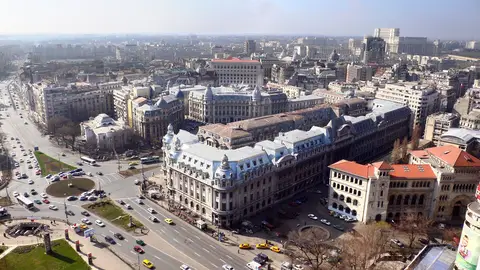
Bucharest: A Capital Between Belle Époque and Concrete
Travel guide · editorialIf you're planning a vacation in Bucharest, you'll find a capital that stubbornly resists snap judgments: Art Nouveau villas next to Communist-era apartment blocks, small Orthodox churches in the shadow of one of the largest administrative buildings in the world. Around 1.7 million people live here, and in recent years the city has become noticeably younger, greener, and more welcoming.
From "Little Paris" to Ceaușescu's Stage Set
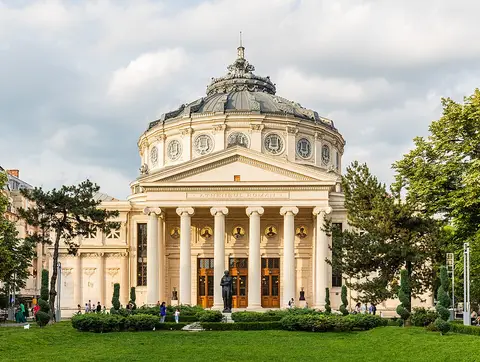
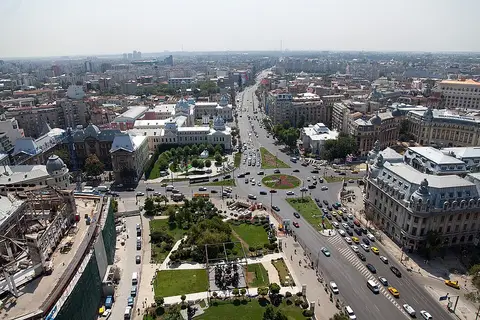
The city earned its nickname around 1900, when French architects and Romanian clients who had studied in Paris lined Calea Victoriei with palaces, banks, and cafés. The Romanian Athenaeum of 1888, a round concert hall with an Ionic colonnade, is still the finest example of that era. In the 1980s, Nicolae Ceaușescu then had entire neighborhoods demolished to build the Palace of the Parliament and the Boulevard of Unity. A tour of the colossus, with its marble halls and crystal chandeliers, is among the most striking sights in Bucharest, precisely because it shows what was lost to build it. On Revolution Square, the former Central Committee building and a memorial recall December 1989.
Old Town, Churches, and Parks
Around Strada Lipscani, bars, tea rooms, and restaurants crowd into buildings that once housed merchant guilds. Right in the middle stands Stavropoleos Church, built in 1724, a small masterpiece of the Brâncoveanu style with carved stone columns and a quiet courtyard. Next door, the beer hall Caru' cu Bere, with its neo-Gothic woodcarvings, is worth at least a look. Bucharest turns green in Cișmigiu Garden, where retirees play chess, and in the large park around Lake Herăstrău, now named after King Michael I. There, the open-air Village Museum displays farmhouses, windmills, and wooden churches from every part of the country, a good introduction before you travel on through Romania. Art lovers will find works by Brâncuși and Grigorescu in the National Museum of Art, housed in the former royal palace.
Eating, Drinking, and Nightlife
Bucharest's cuisine is hearty and honest: mici, grilled minced-meat rolls served with mustard, are on the menu at every beer garden. Add sarmale, cabbage rolls served with polenta and sour cream, the tangy tripe soup ciorbă de burtă, and, for dessert, papanași, fried cheese doughnuts with sour cream and jam. In recent years a lively scene has developed, with specialty coffee roasters, wine bars pouring Romanian grape varieties such as Fetească Neagră, and creative bistros, especially in the neighborhoods around Piața Romană and the Floreasca district. In summer, rooftop terraces and garden clubs open, and every two years the George Enescu Festival brings world-class orchestras to the city.
A Walk Along Calea Victoriei
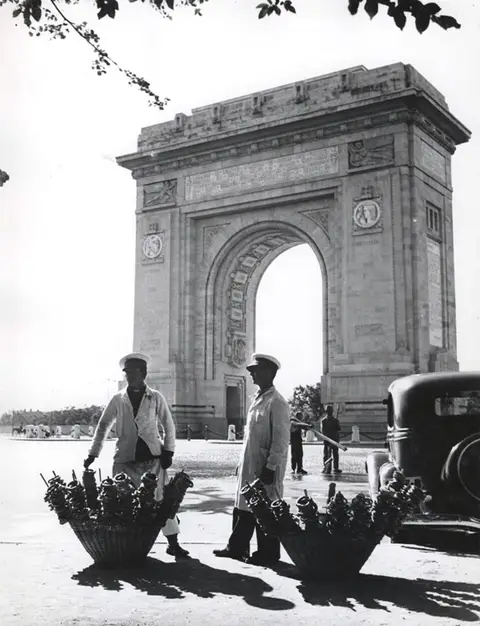
Calea Victoriei is the city's oldest grand boulevard and a great way to understand Bucharest on foot. From the National Museum of Romanian History, housed in the former Postal Palace, head north past the Military Club, the Athenaeum, and the Royal Palace to Piața Victoriei. Along the way you'll pass coffeehouses in Art Nouveau villas, antiquarian bookshops, and courtyards that have become home to galleries. At the end, it's worth a detour to the Arcul de Triumf on Kiseleff Road, built after World War I on the Parisian model, and to the Museum of the Romanian Peasant, whose costumes, icons, and ceramics make it one of the country's most original museums.
Getting Around and Best Time to Visit
Henri Coandă International Airport is in Otopeni, about 10.5 miles north of the city; trains and buses connect it to the Gara de Nord railway station. Within the city, the metro is the fastest way to get around, and taxis and ride-hailing services are inexpensive, though traffic on the boulevards is often sluggish. From Bucharest, you can easily reach the Prahova Valley with Sinaia, the Black Sea coast, or the monasteries on Lake Snagov by train or rental car. The best times to visit are May and June, when the linden trees bloom and the beer gardens open, as well as September and October. High summer is often oppressively hot, with temperatures above 95°F, and winter is cold but quite charming, with a Christmas market in front of the Palace of the Parliament.