Évora District: Heart of the Alentejo
Travel guide · editorialA vacation in the Évora District takes you into the wide, sunny landscape of the Alentejo, where cork oaks dot golden fields and white towns sit on hilltops. Évora with its Roman temple, the hilltop village of Monsaraz above the Alqueva Reservoir, and the marble towns around Estremoz are among the most beautiful destinations in southern Portugal.
The Alentejo Landscape
The district is one of the largest and most sparsely populated in Portugal. Gently rolling plains with wheat fields, olive groves, and montados, open woodlands of cork and holm oaks, shape the land. In the east, the Alqueva Dam holds back the Guadiana River to form the largest artificial lake in Western Europe, its shores branching into countless coves. The area around the lake is designated a dark-sky reserve because there is almost no light pollution. Summers are very hot and dry, and in spring the fields bloom in a riot of color.
Sights in Évora
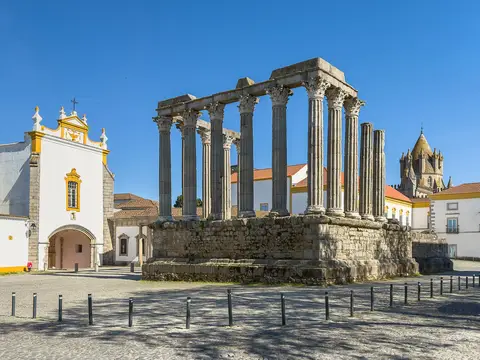
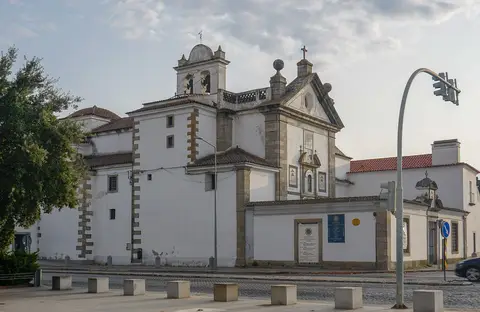
Évora's old town has been a UNESCO World Heritage Site since 1986. In the middle of the city stand the Corinthian columns of the Roman temple, often attributed to Diana. Next to it rises the cathedral, whose roof you can climb, and in the Church of São Francisco you'll find the Capela dos Ossos, a chapel lined with thousands of bones and bearing the inscription "We bones that are here await yours." The arcaded Praça do Giraldo is the center of city life, and the 16th-century university has lecture halls decorated with tile panels. West of the city lies the Cromeleque dos Almendres, a stone circle of almost a hundred menhirs, older than Stonehenge.
Monsaraz, Estremoz, and Other Towns
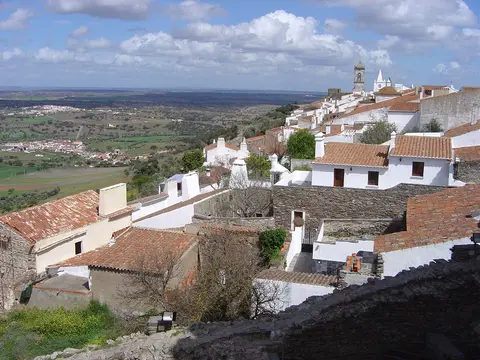
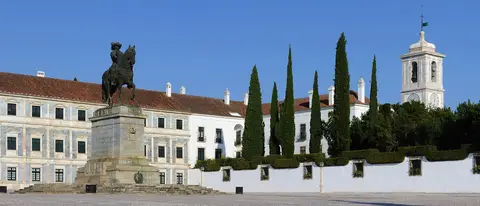
Monsaraz is a walled village on a hill, with a castle, whitewashed houses, and sweeping views over the Alqueva Reservoir and across to Spain. Below it lies Reguengos de Monsaraz, a wine-growing center with large estates such as Esporão. Estremoz is dominated by a castle with a tall tower, its Saturday market is famous, and the colorful clay figurines known as Bonecos de Estremoz are on UNESCO's list of intangible cultural heritage. Marble is quarried around Estremoz, Borba, and Vila Viçosa, and it gleams in churches and sidewalks. Vila Viçosa is home to the Palace of the Dukes of Braganza, and Arraiolos is known for its hand-embroidered rugs.
Food and Drink
Alentejo cuisine is simple and full of flavor. Carne de porco à alentejana combines pork with clams, migas are made of bread with garlic and olive oil, and açorda is a bread soup with cilantro and a poached egg. The black Iberian pig supplies ham and sausages. For dessert, there's sericaia, an egg-based pudding cake served with Elvas plums. The red wines from Reguengos, Borba, and Redondo are among the most popular in the country. The Alentejo is also home to Cante Alentejano, polyphonic male singing that has been on UNESCO's cultural heritage list since 2014.
Getting There and Best Time to Visit
Évora is about an hour and a half from Lisbon via the A6 highway, and trains and buses run several times a day. You'll need a car for Monsaraz and the marble towns. The best time to visit is from March to June and in September and October. In July and August, temperatures often climb above 95°F, and life shifts to the early morning and evening hours.