Castelo Branco District: Gardens, Cherries, Granite Villages
Travel guide · editorialA vacation in the Castelo Branco District takes you to the Beira Baixa, a quiet border region between the Serra da Estrela and the Tagus. Baroque gardens, cherry blossoms in spring, and villages built among enormous granite boulders define this little-known part of Portugal.
Landscape and Towns
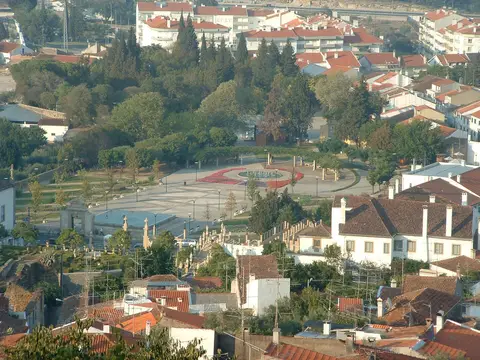
In the north, the district reaches the slopes of the Serra da Estrela, where Covilhã sits at around 700 meters (2,300 feet). For centuries, the town was the center of the wool industry; a museum in an old Royal Cloth Factory tells the story, and street art now decorates the facades. From here you can drive up to Penhas da Saúde and Portugal's only ski resort. To the south lies the fertile Cova da Beira valley with Fundão, famous for its cherries, whose blossoms turn the hillsides white in March and April. The district capital, Castelo Branco, is home to the Garden of the Episcopal Palace, one of the country's finest Baroque gardens, with staircases lined with stone statues of kings and apostles. The embroidered silk bedspreads known as Colchas de Castelo Branco are a well-known local craft.
Sights in the Castelo Branco District
Monsanto is considered one of Portugal's most unusual villages: the houses nestle against and beneath huge granite boulders, and above them stand the remains of a Templar castle with views stretching all the way to Spain. Just a few miles away lies Idanha-a-Velha, a tiny village with Roman walls and an early Christian cathedral. Both belong to the Naturtejo UNESCO Geopark, which offers quartzite rock formations, river gorges, and fossils. In the southwest, slate villages and river beaches around Oleiros and Sertã lead into the green hinterland, and on the Tagus near Vila Velha de Ródão, the rocky gateway of the Portas de Ródão rises up, where griffon vultures nest.
Food, Getting There, and Best Time to Visit
Local specialties include sheep's and goat's milk cheese from Castelo Branco, lamb dishes, maranhos (stuffed lamb stomach) from Sertã, and, of course, cherries in early summer. The region lies along the A23 motorway, about two and a half hours from Lisbon; a rail line runs via Castelo Branco to Covilhã. The best time to visit is spring, with the cherry blossoms, and fall; summers are hot, and in winter the mountains are often covered in snow.