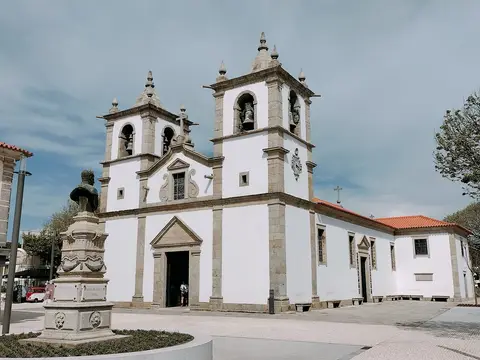
Braga District: The Cradle of Portugal in the Green Minho
Travel guide · editorialA vacation in the Braga District takes you to the green north of Portugal, where the country got its start. Churches and pilgrimage sites in Braga, the medieval old town of Guimarães, weekly markets in Barcelos, and the granite mountains of the Gerês are all close together here.
Landscape in the Minho
The district belongs to the historic province of Minho, a rainy, fertile region of cornfields, vine pergolas, and granite villages. The Cávado and Ave rivers flow from the mountains to the Atlantic, where flat beaches and dunes lie near Esposende and Apúlia. In Apúlia, farmers once gathered seaweed as fertilizer, a custom recalled by windmills and monuments. In the northeast, the land rises to Peneda-Gerês National Park, Portugal's only national park; in Vilar da Veiga lies the spa town of Gerês, with thermal springs, reservoirs, and waterfalls where you can swim in summer.
Sights in Braga and Guimarães
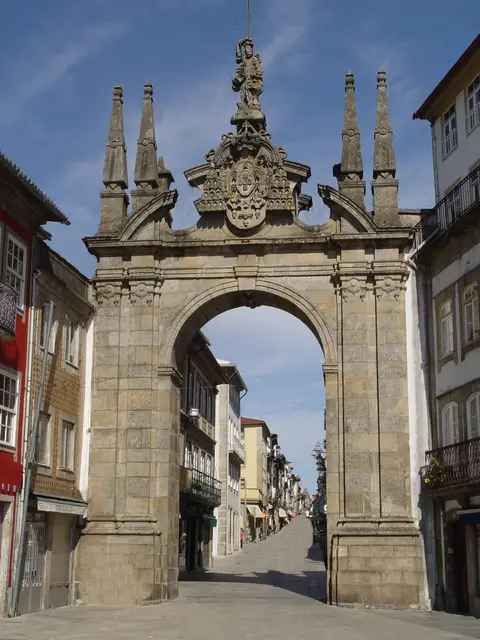
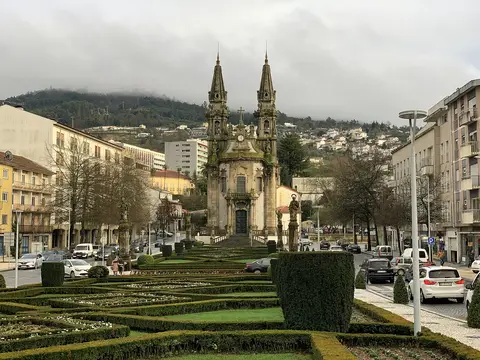
Braga is considered the religious center of the country. The cathedral is the oldest in Portugal, with origins reaching back to the 11th century. Above the city stands the sanctuary of Bom Jesus do Monte, reached by a Baroque staircase that zigzags up the hillside; it has been a UNESCO World Heritage Site since 2019, and a water-powered funicular from 1882 spares you the climb. The Holy Week processions and the Feast of St. John in June are the big festivals. Only about 25 kilometers away lies Guimarães, where the first king, Afonso Henriques, is said to have been born; a wall bears the words "Aqui nasceu Portugal" ("Portugal was born here"). The castle, the Ducal Palace, and the old town with its squares are World Heritage. Barcelos is known for the colorful rooster, a symbol of Portugal, and for its large Thursday market with pottery. In Vila Nova de Famalicão, a museum commemorates the writer Camilo Castelo Branco, and Fafe is known for its rally stage.
Festivals and Traditions
Hardly any region of Portugal celebrates as much as the Minho. In summer, almost every village holds romarias, pilgrimage festivals with processions, brass bands, fireworks, and folk dancing in embroidered costumes. The Semana Santa in Braga, with its nighttime parades and decorated altars in the streets, is among the most impressive Easter celebrations in the country, and Guimarães holds the Festas Gualterianas in early August. At the weekly markets, pottery, linen, and wickerwork are still traded.
Food and Drink
The Minho is the home of Vinho Verde, a young, lightly sparkling white wine. It pairs well with Bacalhau à Braga, fried salt cod with onions and potatoes, or rojões, braised cubes of pork. Caldo verde is eaten especially often here. The Pudim Abade de Priscos comes from monastery kitchens, a caramel pudding made with bacon and port wine, named after an abbot from the area.
Getting There and Best Time to Visit
The nearest airport is Porto, about 50 kilometers away. Braga can be reached via the A3 motorway and by train from Porto in about an hour; Guimarães is also served by regional trains. A car is recommended for the Gerês. The best time to visit is from April to October; in spring the hillsides bloom, and in summer it is warm but rarely hot. Winter brings a lot of rain, but the cities are quieter then.