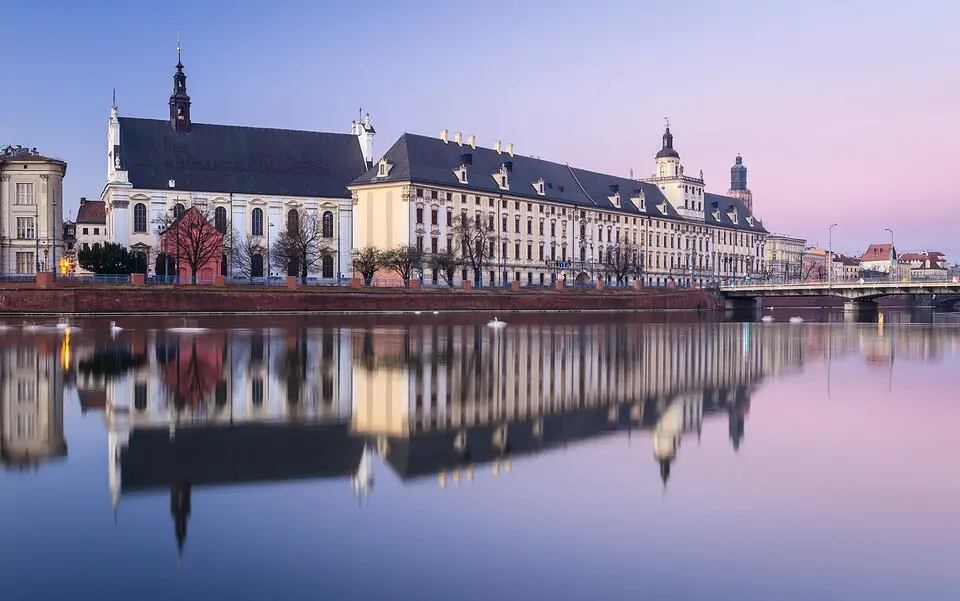
About Wrocław University Museum
The University of Wrocław (formerly Breslau) is one of the oldest and most important universities in the region, with a history reaching back to the 18th century. The institution was founded in 1702 as a Jesuit academy called Leopoldina, after Emperor Leopold I approved the endowment. Teaching began that same year, initially focusing on philosophy and Catholic theology. An architectural highlight of this early period is the Aula Leopoldina, built between 1728 and 1732. The building has survived almost entirely intact to this day and still serves the university as an impressive setting for official occasions and ceremonies.
After Breslau fell to Prussia in 1742, the academy lost its purely denominational character and continued to evolve. As part of the Prussian reforms of 1811, it was merged with the Brandenburg University of Frankfurt to form the Royal University of Breslau. This new foundation was historically significant, as it was the first German university to house both a Catholic and a Protestant theological faculty. It later bore the name Silesian Friedrich Wilhelm University. During this period the university grew into a major center of learning, home not only to the classical faculties but also to numerous institutes for the natural sciences, medicine, and the arts. Its facilities included a botanical garden, a zoological garden, several museums of natural history and Silesian antiquities, and an extensive university library with valuable incunabula and manuscripts.
The university's fate was fundamentally altered by World War II and the political upheavals that followed. After the destruction of the city and the dissolution of the German university in 1945, the institution was transformed into a Polish university, whose staff continued the tradition of the University of Lviv. Teaching resumed in 1945, and the new Polish university was officially opened in 1946. During the era of the Polish People's Republic, the university was for a time named after head of state Bolesław Bierut. Today the University of Wrocław is a modern institution with a broad range of faculties, from philology and history to law and economics, as well as physics, biotechnology, and computer science.
For visitors and interested travelers, the university offers a glimpse into the city's rich academic tradition. The well-preserved Aula Leopoldina bears witness to the history of Baroque architecture and is still used for ceremonial events. The university also maintains close international ties, particularly with German universities such as the University of Cologne and Ruhr University Bochum, in order to promote cultural and academic exchange. These partnerships underscore the institution's significance beyond the region and its role as a bridge between the cultures of Central and Eastern Europe.
At a glance
- Category
- Museum › History museums
- Rating
- no reviews yet · write a review
- Address
- plac Uniwersytecki 1
50-165 Wrocław, Poland - Phone
- —
- Website
- www.muzeum.uni.wroc.pl
- —
- Coordinates
- 51.11391° N · 17.03458° E
- Data quality
- confidence 0.96
- Identifier
- ID b8fe04db-c06…
Location & surroundings
Toggle layersRatings & comments
none yetNear Wrocław University Museum
closest 5 per category · 2 kmSights
Restaurants
Museums
Hotels
More:All museums in Wrocław (56)
243 places within 2 km loaded.
You need a free account to leave reviews and photos – that keeps comments genuine and lets you edit them later.
The four halls are: Aula Leopoldina, Oratorium Marianum, Mathematical Tower ( Wieża matematyczna ) and Exposition ( Wystawa ). The first two are still used by the university for events (so they can be closed at times). Audio guides are available.
Source: Wikivoyage, „Wrocław“ · authors per page history · CC BY-SA 4.0 · as of 5/22/2016