About National Museum in Wrocław
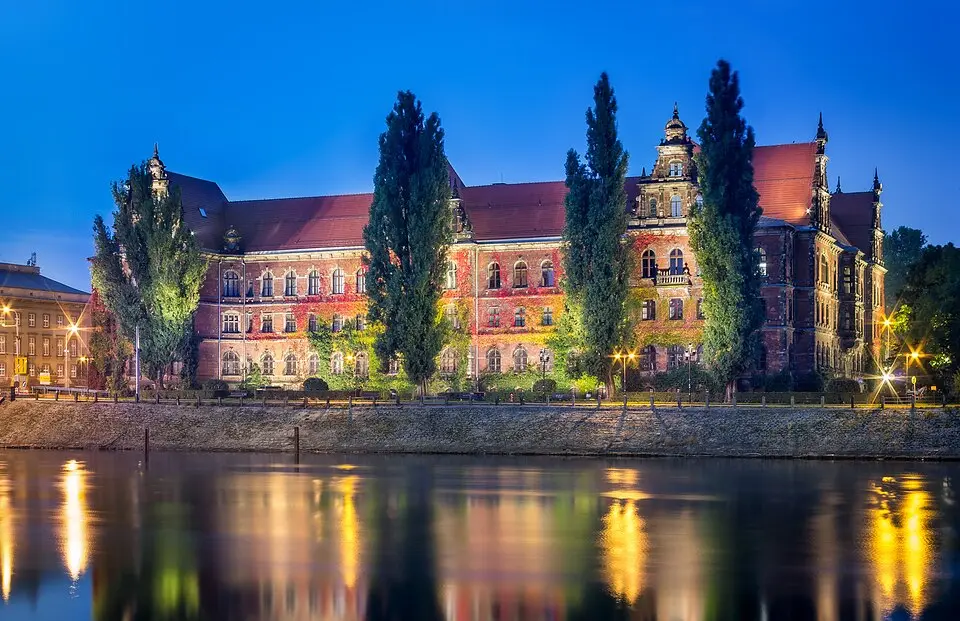
The National Museum in Wrocław is a major institution for the visual arts in the Polish city, with a eventful history that stretches from German foundations in the 19th century to Poland's postwar era. It originated in the Royal Museum of Art and Antiquities, which opened in 1815 and later became the Silesian Museum of Fine Arts, moving into a new Neoclassical building in 1880. After World War II, when the old buildings were destroyed and many collections were lost, the Polish authorities decided in 1947 to establish a new art museum. Its new home was the former Royal Government Building, an imposing Dutch Neo-Renaissance structure erected between 1883 and 1886. Since 1948, the building has housed the region's central art collection, which was granted the status of a national museum in 1970.
Today the collection comprises more than 120,000 objects spanning the Middle Ages to the present day, with a strong focus on the art history of Silesia and Poland. Among the oldest treasures are medieval stone sculptures, tomb slabs, and altar retables from Silesian churches, including the sarcophagus of Duke Henry IV from the Church of the Holy Cross. The department of 20th-century Polish painting is considered one of the most important of its kind. Here you can admire works by renowned artists such as Jan Matejko, Olga Boznańska, and Stanisław Wyspiański. Particularly noteworthy is the extensive holding of works by Magdalena Abakanowicz, as well as the presentation of various movements in modern and contemporary art, from Surrealist landscapes to geometric forms and figurative Expressionism.
Alongside Polish art, the museum also presents a selection of European and German masterpieces that reflect the region's international connections. The department of European painting reaches back to the Renaissance and Baroque, with works by artists such as Leonardo da Pistoia, Johann Michael Rottmayr, and Antoine Pesne. Romanticism and Impressionism are represented as well, for example by paintings by Andreas Achenbach, Ludwig Richter, and Lovis Corinth. Modern 20th-century tendencies are illustrated by works by Wassily Kandinsky and Kurt Schwitters. This collection was shaped in the postwar period by the distribution of holdings to other Polish museums and by later returns after 1989.
The museum is not limited to its main building but also includes important branches that complement the region's cultural heritage. These include the Racławice Panorama, the Ethnographic Museum, and the Four Domes Pavilion. These venues broaden the offering with historical depictions, ethnographic exhibits, and architectural highlights. For visitors, the National Museum thus offers a comprehensive look at the artistic development of Silesia and Poland, from medieval relics to current positions in contemporary art, set within the historic architecture of the former government building.
At a glance
- Category
- Museum › Art museums
- Rating
- no reviews yet · write a review
- Address
- plac Powstańców Warszawy 5
50-153 Wrocław, Poland - Phone
- +48713725150
- Website
- mnwr.pl
- stowarzyszenie@mnwr.pl
- Coordinates
- 51.11063° N · 17.04773° E
- Data quality
- confidence 0.94
- Identifier
- ID acc35bfc-de3…
Location & surroundings
Toggle layersRatings & comments
none yetNear National Museum in Wrocław
closest 5 per category · 2 kmSights
Restaurants
Museums
Hotels
More:All museums in Wrocław (56)
246 places within 2 km loaded.
You need a free account to leave reviews and photos – that keeps comments genuine and lets you edit them later.
Features a large collection of Polish art. The Gallery of Contemporary Art is in the attic.
Source: Wikivoyage, „Wrocław“ · authors per page history · CC BY-SA 4.0 · as of 8/31/2024