Limburg: Rolling Hills, Maastricht and the Meuse
Travel guide · editorialAnyone who thinks the Netherlands is flat everywhere will be proved wrong in Limburg. The southernmost province pushes like a narrow corridor along the Meuse between Belgium and Germany and ends in a hilly landscape of half-timbered farmsteads, orchards and the highest point in the European part of the country. A vacation in Limburg tastes of vlaai, beer and Burgundian conviviality.
Landscape and Location
The north of the province around Venlo and Venray is sandy, flat country with asparagus fields, greenhouses and De Maasduinen National Park, a long ridge of dunes along the Meuse. Farther south near Roermond, gravel and sand extraction left behind the Maasplassen, a chain of lakes that now attracts sailors and houseboaters. In the far south, in the Heuvelland between Maastricht, Valkenburg and Vaals, the terrain suddenly turns hilly: limestone, loess slopes, sunken lanes and valleys like that of the Geul recall the Eifel more than the Netherlands. At the Vaalserberg, the borders of the Netherlands, Belgium and Germany meet; at 322.4 meters, it is the highest point in the continental Netherlands.
Maastricht and the Other Cities
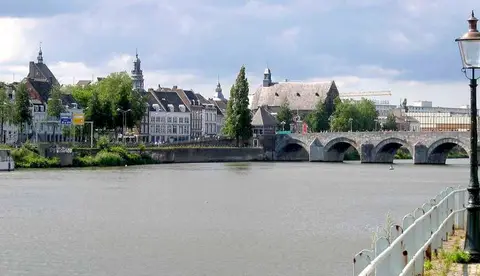
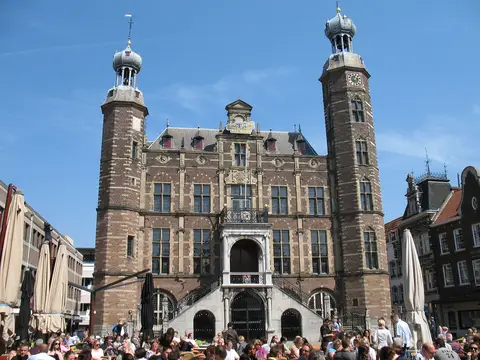
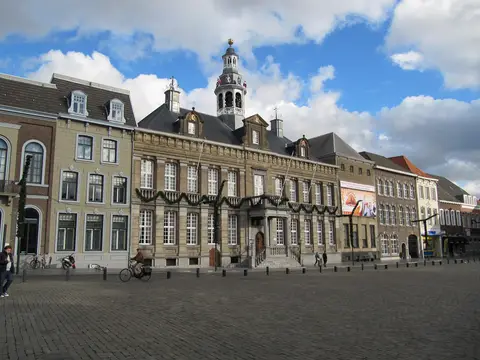
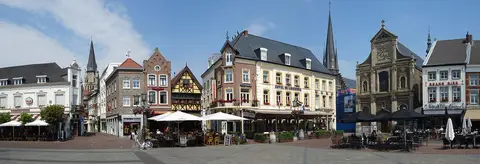
Maastricht is the capital and one of the oldest cities in the country, having grown up around a Roman bridge over the Meuse. The Basilica of Saint Servatius and the Basilica of Our Lady, the spacious Vrijthof square and the lanes of the Jekerkwartier give the city an almost Mediterranean flair. The Dominicanen bookstore, housed in a Gothic church, is among the best known in the world. The Maastricht Treaty, the foundation of the European Union, was signed here in 1992. Venlo in the north is a border and logistics city with a lively weekly market that many Germans visit. Roermond has a pretty old town with a cathedral and a large designer outlet. Heerlen and Kerkrade, in the former mining district, tell the story of industrial history in the Continium Museum and at Rolduc Abbey, while Sittard and Weert have well-kept market squares.
Sights in Limburg
Valkenburg aan de Geul is the tourist hub of the Heuvelland, with a ruined castle, caves in the marl rock and the region's biggest Christmas market, which takes place partly underground in the caverns. The cave passages of Sint-Pietersberg near Maastricht were excavated over centuries and served as shelter during the war. Thorn, the white town, owes its look to the whitewashed houses of a former convent for noblewomen. Hoensbroek Castle is one of the largest moated castles in the country. Cyclists love the routes of the Amstel Gold Race around the Cauberg.
Culture and History
Limburg did not finally become part of the Netherlands until 1839, and from 1839 to 1866 it also belonged to the German Confederation. The province is shaped by Catholicism, with wayside crosses, processions and marksmen's festivals, and carnival, known as Vastelaovend, is celebrated here at least as exuberantly as in the Rhineland. Many Limburgers speak their own dialect, which is recognized as a regional language. In the 20th century, coal mining shaped the south until the mines closed in the 1970s.
Food and Drink
Limburgse vlaai, a flat yeast-dough pie filled with cherries, apricots or rice pudding, is the culinary emblem of the region. Savory dishes include zoervleis, meat braised in vinegar and syrup. Breweries such as Gulpener and Brand in Wijlre maintain a long tradition, and wine grows on the slopes near Maastricht, for example at Apostelhoeve. Asparagus comes from Venlo and the north.
Getting There and Best Time to Visit
The small Maastricht Aachen Airport mainly handles charter and vacation flights, so most visitors arrive by car or train. Aachen is only half an hour from Maastricht, and trains run from Venlo to Düsseldorf. The best time for hiking in the Heuvelland is spring, when the orchards blossom, and golden autumn. In December the Christmas markets in Maastricht and Valkenburg draw crowds, and in February it's carnival. In March the TEFAF art fair brings collectors from around the world to Maastricht, and in summer André Rieu plays his hometown concerts on the Vrijthof. If you want to hike, follow the well-marked loop trails around Gulpen, Epen and Slenaken, where half-timbered farmsteads and chapels line the way and cafés serving vlaai invite you to stop in.