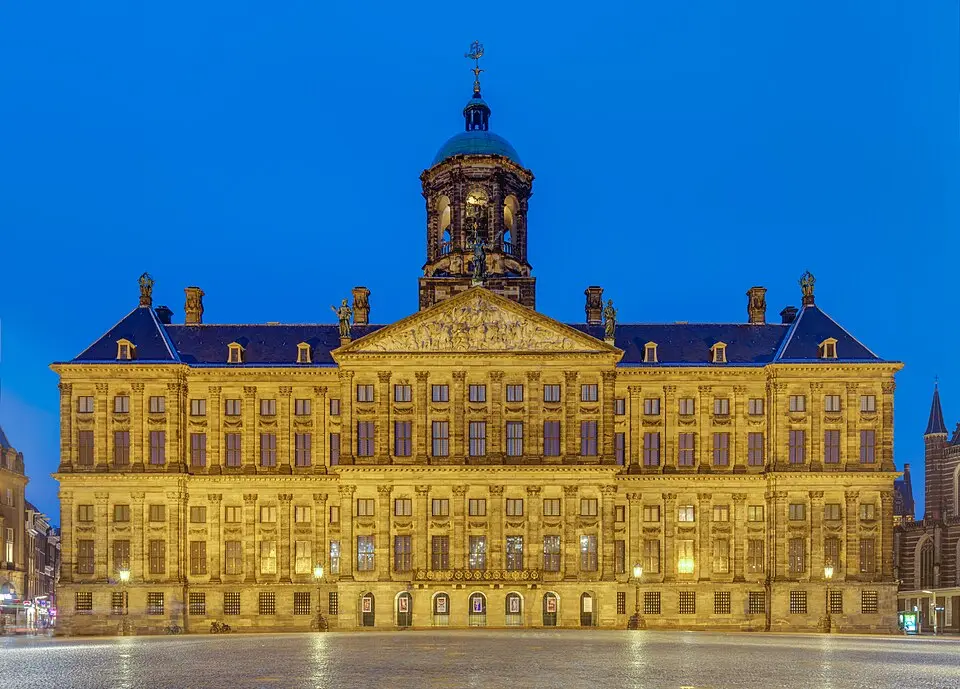
About Koninklijk Paleis Amsterdam
The Royal Palace, also known as the Palace on the Dam, towers over the west side of Dam Square in the heart of Amsterdam. This monumental 17th-century building is considered one of the most important historical and cultural landmarks of the Dutch Golden Age. It was originally designed not for kings but as the city hall, intended to underscore the wealth of the city and the dominance of the province of Holland. Today it serves the royal family of the House of Orange-Nassau mainly for ceremonial purposes and as a guest residence for visiting foreign heads of state, though it is not the monarchy's permanent home.
Construction began in 1648 and lasted until 1665, although the formal inauguration took place as early as 1655. The architect Jacob van Campen designed the Classicist showpiece, which draws on Roman administrative palaces and combines elements of French château architecture with Palladian accents. The elaborate pile foundation, for which more than 13,000 wooden piles were driven into the ground, was a technical masterpiece that poets of the time called the eighth wonder of the world. The sculptural work comes from the workshop of Artus Quellinus and shapes the building's appearance to this day.
Today you can tour the palace and get a sense of the splendor of the 17th century. The building is made entirely of Bentheim sandstone, which was originally almost white, the color of an eggshell, but darkened over time. The facade is richly decorated with statues, reliefs, and murals. The main pediment shows an allegory of the city of Amsterdam as ruler of the seas. Look for the seven plain arches at street level, which symbolize the seven provinces of the republic at the time. Despite the emphasis on the center, the actual entrance is deliberately hard to find, a feature originally meant to protect against attackers.
Inside, you'll find a series of impressive halls clad in marble and adorned with ceiling frescoes. The central Citizens' Hall is especially striking, spanning the full depth and height of the building. It represents the universe, with Amsterdam as its absolute center, an idea underscored by the depiction of the sun, moon, and planets in the surrounding gallery. The walls are hung with large allegorical paintings, many of them by students of Rembrandt such as Ferdinand Bol and Govaert Flinck. The great Council Chamber, one of the largest in Europe, also impresses with its size and its Empire-style furniture, a legacy of the time of Louis Bonaparte.
The history of the building is closely tied to the political development of the Netherlands. It was first used as a royal residence in 1808, when King Louis Bonaparte chose Amsterdam as his seat. During this period a royal museum was founded, which became the basis of today's Rijksmuseum. After the city government returned in 1813, the palace served as city hall again, before passing permanently into the possession of the royal house following the Congress of Vienna. In 1939 the Dutch government bought the building from the city of Amsterdam in order to use it permanently for ceremonial purposes.
In the 20th century the palace was restored several times, with the alterations from the time of Louis Bonaparte largely reversed to restore the original character. A comprehensive renovation, which also included the residential wing for state guests, closed the building temporarily from 2005 to 2009. Since reopening in 2009, the palace has been open to the public again and hosts cultural events and exhibitions in addition to the royal family's official receptions. Around 100,000 people visit the building every year to experience its historic splendor and the significance of this place for Dutch identity.
The Palace on the Dam is more than just a historic building; it is a symbol of Amsterdam's golden age and the political history of the Netherlands. From its original function as city hall to its present use as the monarchy's ceremonial seat, it reflects the transformations of the city and the country. The combination of architectural elegance, artful furnishings, and historical significance makes it a must-see for any visitor who wants to deepen their understanding of Amsterdam's culture and history.
At a glance
- Category
- Sight › Historic sites
- Rating
- no reviews yet · write a review
- Address
- Dam
1012 RJ Amsterdam, Netherlands - District
- Centrum
- Phone
- +31205226161
- Website
- www.paleisamsterdam.nl
- info@dkh.nl
- Coordinates
- 52.37313° N · 4.89174° E
- Data quality
- confidence 0.99
- Identifier
- ID c11226be-1ea…
Location & surroundings
Toggle layersRatings & comments
none yetNear Koninklijk Paleis Amsterdam
closest 5 per category · 2 kmSights
Restaurants
Museums
Hotels
More:Historic sites in Amsterdam (397)Sights in Centrum (132)All sights in Amsterdam (475)
300 places within 2 km loaded.

You need a free account to leave reviews and photos – that keeps comments genuine and lets you edit them later.