About Homomonument
The Homomonument in Amsterdam is a one-of-a-kind memorial that commemorates people persecuted because of their sexual orientation. It stands in the heart of the city on the Westermarkt, right next to the well-known Westerkerk. The work was designed by Dutch artist Karin Daan and erected in 1987. It is considered the first monument of its kind anywhere in the world, and it is dedicated both to those who were oppressed or murdered and to those who actively campaign for freedom and equality. The open design of the square underscores the timeless relevance of the subject for the present and the future.
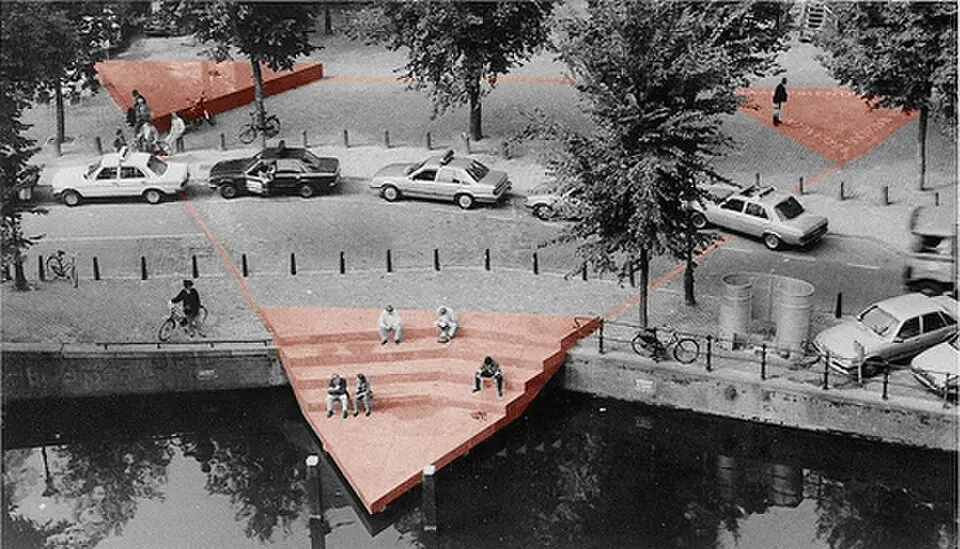
The design consists of three equilateral triangles of polished pink granite, each with sides of ten meters, arranged within a larger triangle with sides of 36 meters. Lines of paving stones connect the corners of these triangles. The pink color and the triangular shape deliberately refer to the so-called pink triangle that bisexual and gay prisoners were forced to wear in the Nazi concentration camps. During the German occupation of the Netherlands, homosexuality was criminalized again, although persecution there was less intense than in Germany itself. In the 1970s, the once stigmatizing symbol was reclaimed by the gay movement as a sign of emancipation and self-confidence.
Each of the three granite triangles has its own meaning and orientation. The first forms steps leading down to the Keizersgracht and symbolizes the present. It points toward the National Monument on Dam Square, the central place of remembrance for the victims of World War II. The second triangle is a platform about 60 centimeters (2 feet) high that represents the future and points toward the headquarters of the LGBT organization COC Nederland on Rozenstraat. The third triangle is set flush into the ground and stands for the past. One of its corners is aligned with the Anne Frank House, where a museum and documentation center now works against intolerance and racism. A line from a poem by Jacob Israël de Haan is engraved in this part; he was a writer who lived openly as a gay man and was murdered in 1924.
The history of the monument is closely tied to the political development of the LGBT movement in the Netherlands. The first ideas for such a memorial emerged shortly after the war, but concrete initiatives did not begin until the 1970s and 1980s. After a competition announced in 1980, the jury chose Karin Daan's design in 1981. Funding came mainly from individual donations and benefit events, as companies refused to be associated with the project. The foundation stone was laid in April 1987, and the official unveiling took place on September 5 of that year, one hundred years after the founding of the Scientific-Humanitarian Committee.
Today the square is a living place of remembrance and gathering. Flowers are regularly laid on the steps, while the platform is used as a meeting point or a stage for events. Every year on May 4, the national day of remembrance for the dead, representatives from politics, society, and the military gather to commemorate the gay victims of Nazism. By contrast, the square becomes a site of exuberant celebration on May 5, Liberation Day, and on April 27, King's Day. The Homomonument is known internationally and draws visitors from around the world, who come to lay flowers for departed friends and partners, dance, or have their photo taken. A multilingual information panel explains the meaning of the monument to international visitors.
At a glance
- Category
- Sight › Monuments
- Rating
- no reviews yet · write a review
- Address
- Westermarkt
1016 DW Amsterdam, Netherlands - District
- Centrum
- Phone
- +31204281070
- Website
- www.homomonument.nl
- info@homomonument.nl
- Coordinates
- 52.37442° N · 4.88482° E
- Data quality
- confidence 0.98
- Identifier
- ID 05e9b7f9-bc8…
Location & surroundings
Toggle layersFAQ about Homomonument
quick answersWhat is the Homomonument in Amsterdam?
The Homomonument in Amsterdam is a memorial to people who were persecuted, oppressed, or murdered because of their sexual orientation. It is considered the first monument of its kind in the world and also honors everyone who fights for freedom and equality. It was designed by Dutch artist Karin Daan.
What do the three pink triangles of the Homomonument mean?
The three triangles of polished pink granite stand for the present, the future, and the past, and refer to the pink triangle that bisexual and gay prisoners were forced to wear in Nazi concentration camps. Each triangle has sides of 10 meters, and together they form a larger triangle with 36-meter edges. The triangle of the present leads down steps to the Keizersgracht and points toward the National Monument on Dam Square, while the roughly 60-centimeter-high platform of the future points toward the headquarters of COC Nederland on Rozenstraat. The ground-level triangle of the past is aligned with the Anne Frank House and bears a line of poetry by Jacob Israël de Haan, who was murdered in 1924.
How did the Homomonument in Amsterdam come about?
The Homomonument in Amsterdam grew out of a competition announced in 1980; in 1981, the jury chose Karin Daan's design. It was funded mainly through individual donations and benefit events, because companies did not want to be associated with the project. After the cornerstone was laid in April 1987, the monument was unveiled on September 5, 1987, one hundred years after the founding of the Scientific-Humanitarian Committee.
Where is the Homomonument in Amsterdam located?
The Homomonument is located on Westermarkt in Amsterdam-Centrum, right next to the Westerkerk and on the Keizersgracht. The surrounding area is a good place for a break: travelguide195 lists around 229 restaurants within 500 meters. The Homomonument is also along the route of the tour "Amsterdam in One Day: Rijksmuseum, Canals, and Anne Frank House."
What can you see around the Homomonument in Amsterdam?
Around the Homomonument in Amsterdam, several attractions are just a few steps away. travelguide195 lists the Anne Frank Monument about 89 meters away, the Westertoren about 93 meters away, and the Anne Frank House about 96 meters away. You'll find the Museumhuis Bartolotti about 148 meters from the Homomonument.
Ratings & comments
none yetNear Homomonument
closest 5 per category · 2 kmRestaurants
Museums
Hotels
More:Monuments in Amsterdam (73)Sights in Centrum (132)All sights in Amsterdam (475)
300 places within 2 km loaded.
You need a free account to leave reviews and photos – that keeps comments genuine and lets you edit them later.
The Homomonument is a memorial to gays and lesbians murdered in World War II, a call for vigilance against homophobia, and an inspiration for gays and lesbians the world over. It consists of three equilateral triangles made of pink granite that are connected by an inlaid band of pink bricks. These three triangles represent the past, present and future.
Source: Wikivoyage, „Amsterdam/Canal District“ · authors per page history · CC BY-SA 4.0