Luxembourg Travel: Fortress City, Moselle, and Müllerthal
Travel guide · editorialLuxembourg is often reduced to banks and EU institutions, yet the Grand Duchy is full of castles, rocky gorges, and vineyards. A few days are enough for a vacation in Luxembourg to get to know the capital, the Moselle, and the Ardennes, and thanks to free public transportation, you can easily travel the whole country without a car.
The Capital on the Rock
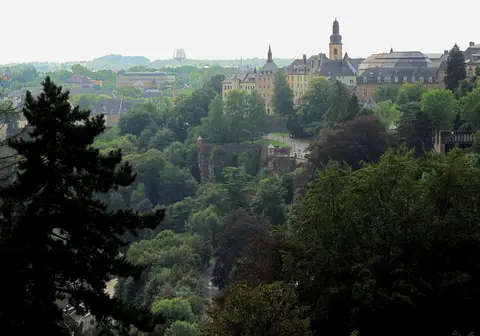
The city of Luxembourg sits on a sandstone plateau that drops steeply to the valleys of the Alzette and Pétrusse rivers. Thanks to its fortifications, it was once known as the "Gibraltar of the North," and the winding Old Town, together with the remains of the fortifications, is a UNESCO World Heritage Site. The Bock Casemates are carved into the rock, a labyrinth of passages and chambers that you can visit in summer. From the Chemin de la Corniche, often called the most beautiful balcony in Europe, you look down on the Grund district with its old houses, Neumünster Abbey, and the river. A glass elevator connects the upper and lower towns.
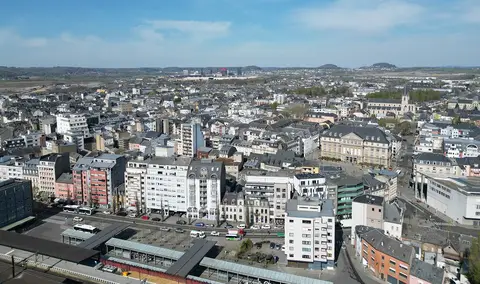
On the other side of the valley, the modern city comes into view. On the Kirchberg plateau stand the European Court of Justice, the Philharmonie with its facade of white steel columns, and the Mudam museum of modern art, designed by architect I. M. Pei. Other sights in Luxembourg include the Grand Ducal Palace, Notre-Dame Cathedral, and the Gëlle Fra, the monument with the gilded female figure.
Ardennes, Müllerthal, and Moselle
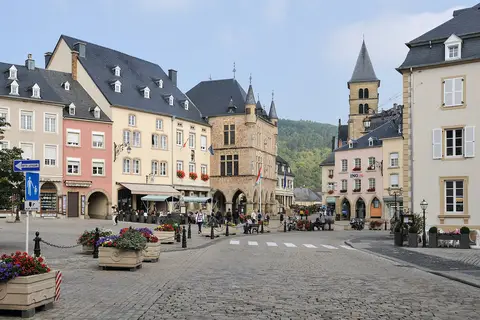
In the north, known as the Ösling, the country is part of the Ardennes. Wooded hills, river bends, and castles such as Vianden, Clervaux, and Bourscheid shape the region. In Clervaux, Edward Steichen's photo exhibition "The Family of Man" is on permanent display. To the east lies the Müllerthal, also called Little Switzerland of Luxembourg: bizarre sandstone cliffs, narrow gorges, cushions of moss, and small waterfalls such as the Schéissendëmpel make the Müllerthal Trail one of the region's most beautiful hiking routes. The small town of Echternach, with its abbey church, is the main town of the area.
Along the Moselle in the southeast, Rivaner, Riesling, Auxerrois, and Pinot Gris grow, and Crémant de Luxembourg makes an excellent sparkling wine. In the little village of Schengen, where the agreement of the same name was signed in 1985, Luxembourg, Germany, and France meet. In the south, in the Land of the Red Rocks around Esch-sur-Alzette, disused blast furnaces in Belval recall the steel industry that once made the country rich. Today a university and a new city district have sprung up there.
Culture, Language, and Cuisine
In everyday life, Luxembourgers switch effortlessly between Luxembourgish, French, and German; you also often hear Portuguese, as almost half of the residents do not hold a Luxembourgish passport. National Day on June 23 is celebrated with fireworks and a torchlight procession, and on Whit Tuesday the Echternach Dancing Procession draws thousands of participants who dance through the streets. It is part of UNESCO's intangible cultural heritage.
The cuisine combines German heartiness with French refinement. The national dish is Judd mat Gaardebounen, smoked pork collar with broad beans. Other specialties include Gromperekichelcher, crispy potato fritters sold at markets, Bouneschlupp, a bean soup, and Rieslingspaschtéit, a pie with wine jelly. Bofferding or Diekirch is the beer of choice.
Getting There and Best Time to Visit
Luxembourg-Findel Airport (LUX) is only a few miles from the center and is served by Luxair and other airlines. From Germany, you can easily reach the country by train via Trier, Saarbrücken, or Koblenz. Since 2020, buses, trams, and second-class trains have been free throughout the country; only first class requires a ticket. Many German drivers also come for the lower prices on gasoline and diesel.
The best time to visit Luxembourg is between May and September, when temperatures range from the mid-60s to the upper 70s °F (18 to 25 °C) and the wine festivals along the Moselle begin. Fall, with the grape harvest and colorful forests, is ideal for hiking in the Müllerthal and the Ardennes. In December, Christmas markets open on the Place d'Armes and the Place de la Constitution, with mulled wine, Gromperekichelcher, and a Ferris wheel above the Pétrusse gorge.