Luxembourg Canton: A Capital Between Rock and Valley
Travel guide · editorialLuxembourg Canton is the heart of the Grand Duchy: it encompasses the capital and its suburban communes, bringing together fortress history, a banking district, and European institutions in a small area. If you're planning a trip to Luxembourg, you'll almost inevitably end up here. At the same time, the canton is greener than you'd expect from a financial center.
Location and Landscape
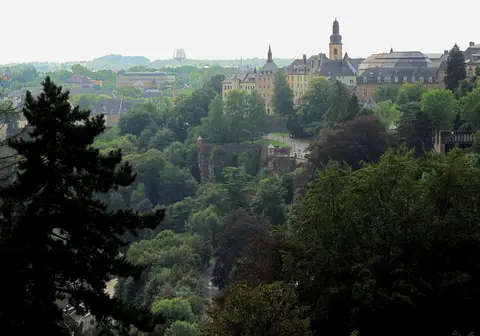
The canton lies in the center of the country on the Luxembourg Sandstone Plateau. The Alzette River and its tributary, the Pétrusse, have carved deep gorges into the rock, and the old town sits high above them. Down in the valleys lie the old suburbs of Grund, Clausen, and Pfaffenthal; up top is the plateau with the Upper Town and the train station district, and to the northeast the Kirchberg Plateau with its modern office buildings. Around the city are communes such as Strassen, Bertrange, Hesperange, Walferdange, and Sandweiler, with residential areas, forests such as the Grünewald, and fields.
Sights in the Capital
The old town and the fortifications have been a UNESCO World Heritage Site since 1994. From the Chemin de la Corniche, often called the "most beautiful balcony in Europe," you look out over the Grund and Neumünster Abbey. The Bock Casemates, a tunnel system hewn into the rock, were once part of one of Europe's strongest fortresses, and parts of them are open to visitors. The Grand Ducal Palace in the Upper Town, Notre-Dame Cathedral, and Place Guillaume II with its market are all close together. A public elevator connects the plateau with Pfaffenthal, and the Red Bridge leads across to Kirchberg, home to the Mudam modern art museum and the Philharmonie. The Musée Dräi Eechelen in Fort Thüngen tells the story of the city's history.
History, Languages, and Everyday Life
The city's history begins in 963 with Count Siegfried's castle on the Bock Rock. Burgundians, Spaniards, French, Austrians, and Prussians expanded the fortress until it was largely demolished after 1867. Today the Court of Justice of the European Union, parts of the European Commission, and the European Investment Bank are based here. Nearly half of the residents do not hold a Luxembourg passport, and tens of thousands of people commute in daily from France, Belgium, and Germany. In everyday life you'll hear Luxembourgish, French, German, Portuguese, and English, often in the same sentence.
Food, Drink, and Festivals
The cuisine combines German heartiness with French finesse. Judd mat Gaardebounen, smoked pork collar with broad beans, is considered the national dish, alongside Gromperekichelcher, crispy potato pancakes, and Bouneschlupp, a bean soup. A Riesling or Crémant from the Moselle goes well with the meal. For something sweet, try Quetschentaart, a damson plum tart, or visit the pastry shops of the Upper Town, known for their pralines and baked goods. The Schueberfouer in late summer is the country's biggest fair, and on June 23 the national holiday is celebrated with fireworks.
Getting There and Best Time to Visit
Findel Airport is only a few kilometers from the center. Direct trains arrive from Trier, Koblenz, Brussels, and Metz, and the TGV runs from Paris. Buses, trams, and trains are free nationwide, which makes day trips to other cantons very easy. The best time to visit is from April to October; in Advent, Christmas markets draw visitors to Place d'Armes and the Knuedler.