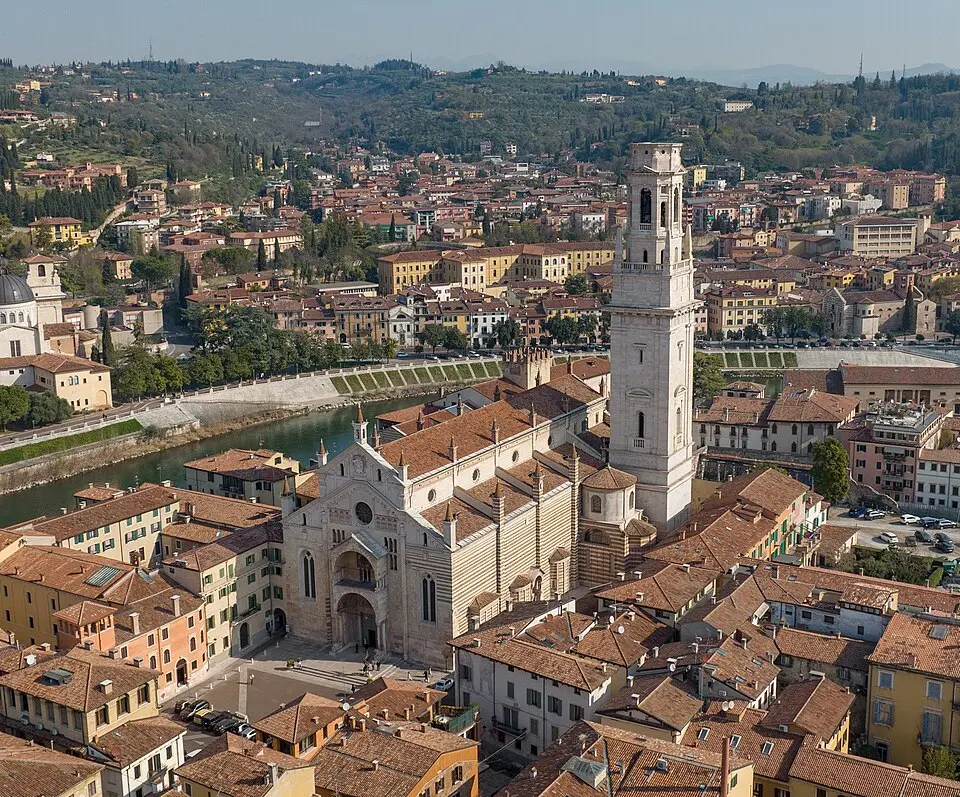
About Duomo di Verona
The cathedral complex of Verona is a significant ensemble within the UNESCO World Heritage site of the Old Town. The main church, also known as Santa Maria Assunta or Santa Maria Matricolare, is the heart of this area, which consists of several historic buildings, including the collegiate church of Sant’ Elena, the Baptistery of San Giovanni in Fonte, the canons' cloister, the Chapter Library, and the Bishop's Palace. The history of the site goes back to the Roman imperial era, when the grounds were occupied by villas with private baths and small temples. The first Christian church buildings appeared as early as the 4th century under Bishop Zeno. After destruction by fire or earthquake, the main church was rebuilt on its present site in the 8th and 9th centuries. A severe earthquake in 1117 devastated the existing structures, after which the cathedral was rebuilt and enlarged in the Romanesque style over the following two decades.
The exterior of the cathedral displays a distinctive mix of tuff blocks and brick arranged in bands. The west facade was remodeled between 1440 and 1520, though the outline of the Romanesque basilica is still recognizable. The main portal, created by Nicolò, is protected by a two-story porch featuring figures of John the Evangelist and John the Baptist. Two large guardian figures flank the entrance, while ten prophets of the Old Testament are depicted on either side. These jamb figures are among the oldest of their kind from the Middle Ages. The tympanum is adorned with a painted relief of the enthroned Madonna and Child. The interior was remodeled in the Late Gothic style in the 15th century, and its red marble clustered piers and wide arcades give it a hall-like feel. Six side chapels, built between 1465 and 1504, are decorated with frescoes and paintings. Especially worth seeing is the Cartolari-Nichesola Chapel, which houses an altarpiece by Titian depicting the Assumption of Mary.
Another highlight of the complex is the Baptistery of San Giovanni in Fonte, built in the 12th century and still largely preserved in its original form. It stands out for its unusually wide central nave, which recalls early Christian basilicas. At its center stands an octagonal baptismal font carved from a single block of marble, considered a masterpiece of Romanesque sculpture. The reliefs on its eight sides show biblical scenes such as the Annunciation to Mary, the Nativity, and the Flight into Egypt. The collegiate church of Sant’ Elena, dedicated to Saint Helena after the earthquake of 1117, now contains excavated remains of the late antique buildings that preceded it. Here you can look down onto mosaic floors and the foundations of the old basilicas, which offers an impressive glimpse into the city's early history.
The canons' cloister, built around 1140, also offers insights into the archaeological past, as mosaic floors and column drums from the earlier church have been made accessible here. The Chapter Library adjoins the west side of the cathedral; it grew out of a 5th-century scriptorium and has been in continuous operation ever since. It houses valuable manuscripts, including the Virgilian Palimpsest and the Veronese Riddle, regarded as the oldest record of the Italian language. The Bishop's Palace, completed in 1502 and featuring a Renaissance facade with Venetian stylistic elements, rounds out the ensemble. Together, these buildings form a fascinating tunnel through time, documenting Verona's religious and cultural development over many centuries.
At a glance
- Category
- Sight › Historic sites
- Rating
- no reviews yet · write a review
- Address
- Piazza Duomo, 21
37121 Verona, Italy - District
- Centro storico
- Phone
- +390458008813
- Website
- www.cattedralediverona.it
- cattedralediverona@cattedralediverona.it
- Coordinates
- 45.44685° N · 10.99686° E
- Data quality
- confidence 0.76
- Identifier
- ID 248c847c-667…
Part of the tour
Verona in a Day: The Classics from the Bra to San Pietro →Location & surroundings
Toggle layersFAQ about Duomo di Verona
quick answersWhat is the Duomo di Verona?
The Duomo di Verona is Verona's main church, also known as Santa Maria Assunta or Santa Maria Matricolare, and the heart of a cathedral complex in the Old Town, which is a UNESCO World Heritage Site. On the outside, the cathedral shows a distinctive mix of tuff blocks and brick in alternating bands. The main portal by Nicolò is flanked by two large guardian figures and ten Old Testament prophets, which are among the oldest jamb figures of the Middle Ages.
What can you see in the Verona cathedral complex?
In the Verona cathedral complex, in addition to the cathedral itself, you can discover the Baptistery of San Giovanni in Fonte, the canons' church of Sant'Elena, the canons' cloister, the Chapter Library, and the Bishop's Palace. In the cathedral's Cartolari-Nichesola Chapel hangs Titian's altarpiece of the Assumption of the Virgin. The 12th-century baptistery holds an octagonal font carved from a single block of marble, with reliefs depicting scenes such as the Annunciation and the Flight into Egypt. In Sant'Elena, you can look down on exposed mosaic floors and the foundations of late antique predecessor buildings.
How old is Verona Cathedral?
The history of the Duomo di Verona goes back to the 4th century, when the first Christian churches were built on the site under Bishop Zeno. In the 8th and 9th centuries, the main church was rebuilt at its present location. After the severe earthquake of 1117, the cathedral was reconstructed in Romanesque style, and the west facade was remodeled between 1440 and 1520. The interior, with its red marble clustered piers, took on its Late Gothic form in the 15th century.
What can you see around the Duomo di Verona?
Around the Duomo di Verona, several museums and historic buildings are within walking distance. travelguide195 lists the Museo Galileiano Scaligero (about 46 m), the Palazzo Vescovile (about 84 m), the Palazzo Emilei Forti (about 207 m), and the Bastione di San Giorgio (about 221 m), among others. A bit farther away are the museum of the Fondazione Miniscalchi Erizzo (about 228 m) and the Chiesa di Sant'Anastasia (about 290 m).
Where is the Duomo di Verona, and are there restaurants nearby?
The Duomo di Verona is located in Verona's Centro storico at Piazza Duomo, 21. travelguide195 lists around 115 restaurants within 500 meters of the cathedral. The cathedral is also part of the tour "Verona in One Day: The Classics from the Bra to San Pietro."
Ratings & comments
none yetNear Duomo di Verona
closest 5 per category · 2 kmSights
Restaurants
Museums
Hotels
More:Historic sites in Verona (95)Sights in Centro storico (86)All sights in Verona (131)
238 places within 2 km loaded.
Don't miss in Verona
All sights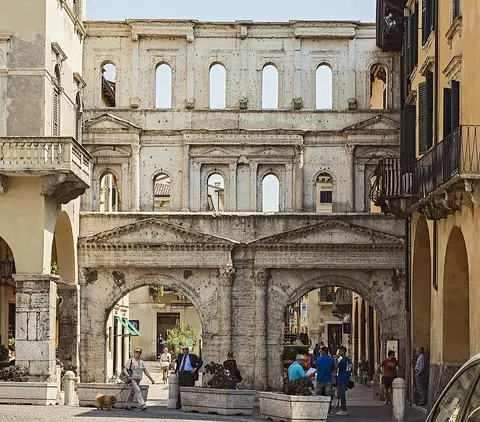 Historic sites01
Porta Borsari
Corso Porta Borsari, 57A · Verona● Website● Phone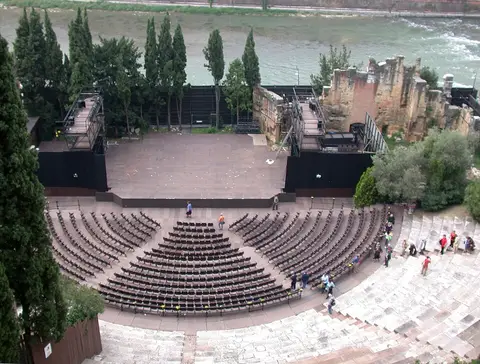 Monuments02
Teatro Romano
Rigaste Redentore, 2 · Verona● Website○ Phone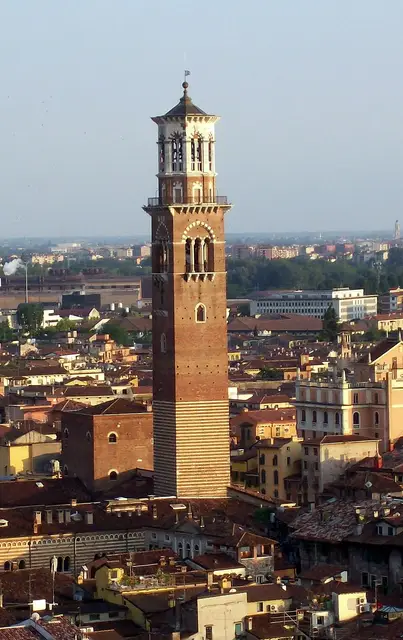 Historic sites03
Torre dei Lamberti
Via della Costa, 2 · Verona● Website● Phone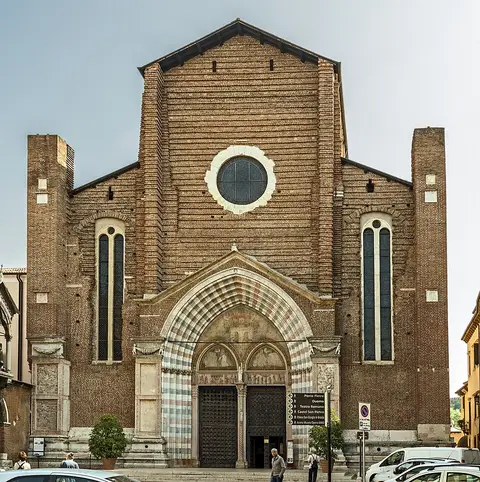 Historic sites04
You need a free account to leave reviews and photos – that keeps comments genuine and lets you edit them later.
It was built to replace an 8th-century church which was destroyed in the earthquake of 1117. Consecrated in 1187, the church features an ornate marble Romanesque façade by the Veronese architect Nicolò; its pillars are supported by two griffins. Stone reliefs around the door include Biblical scenes. The smaller side door is also worth a look - medieval carvings include Jonah being swallowed by a whale. Inside, the nave has many Gothic alterations, and oil paintings around the side chapels include an Assumption by Titian. The Romanesque baptistery adjoining the chapel of Sant'Elena is preserved, with its exquisite marble font and collection of medieval paintings.
Source: Wikivoyage, „Verona“ · authors per page history · CC BY-SA 4.0 · as of 10/3/2019