About Arsenale di Venezia
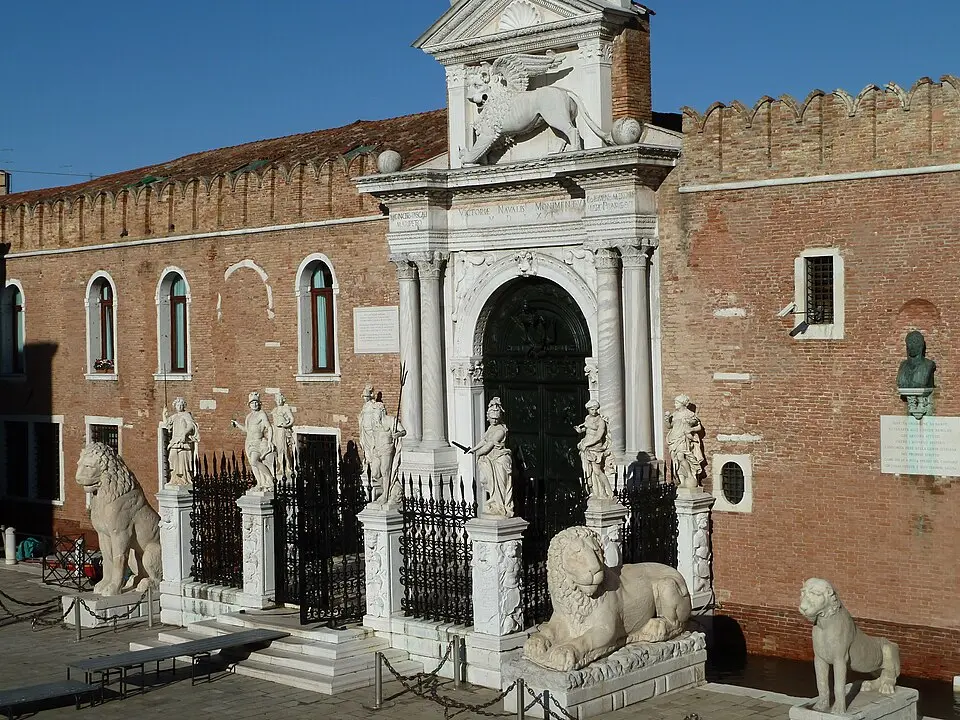
The land gate of the Venetian Arsenal, also known as the Porta da Terra, marks the monumental entrance to the complex where the Republic of Venice built and armed its warships. The gate was completed in 1460 in the style of a classical triumphal arch, with a design modeled directly on the Arch of the Sergii in Pula. The stone facade opens into a large arch, flanked by reused medieval columns with Byzantine capitals. This combination of a Roman arch design and Venetian-Byzantine elements underscores Venice's historical role as heir to Rome and as the "second Byzantium." The great wingless Lion of St. Mark presides over the arch, while the attic was later enriched with additional sculptures.
The gate's historical significance is reflected in its later additions. After the Christian fleet's victory at Lepanto in 1571, winged goddesses of victory and a corresponding inscription were added. In 1578, a colossal statue of St. Justina, the patron saint of Venice, was added to the facade. As part of the celebrations of Francesco Morosini's victories in the Peloponnese, a raised terrace with an iron railing and eight statues was built between 1692 and 1695. These figures, including Justice, Mars, Neptune, and Bellona, are the work of various sculptors and frame the entrance. The original wooden doors were clad in 1694 with copper sheeting decorated with coats of arms and trophies.
In front of the gate stand four ancient Greek sculptures that came to Venice as war trophies. The largest is the Piraeus Lion, about three meters (10 feet) tall, which originally served as a funerary monument and later as a fountain in the harbor of Piraeus. It was seized by the Venetian fleet in 1688 and installed here in 1692. Next to it is an Attic lion from the fourth century B.C. and a lioness from the island of Delos, added in 1716 to commemorate the defense of Corfu. A fourth sculpture, often interpreted as a dog, also comes from Attica. This collection of ancient stone sculptures underscores the military and cultural power of the Venetian Republic.
At a glance
- Category
- Sight › Historic sites
- Rating
- no reviews yet · write a review
- Address
- Campo de la Tana, 2169
30122 Venice, Italy - District
- Castello
- Phone
- +39041041
- Website
- www.arsenaledivenezia.it
- direzione@arsenaledivenezia.it
- Coordinates
- 45.43478° N · 12.34991° E
- Data quality
- confidence 0.97
- Identifier
- ID 9adea326-f3e…
Location & surroundings
Toggle layersRatings & comments
none yetNear Arsenale di Venezia
closest 5 per category · 2 kmSights
Restaurants
Museums
Hotels
More:Historic sites in Venice (244)Sights in Castello (37)All sights in Venice (323)
258 places within 2 km loaded.
Don't miss in Venice
All sights Monuments01
Ponte dei Sospiri
San Marco, Sestiere San Marco, 1 · Venice● Website● Phone Palaces02
Ca' D'Oro
Ca' D'Oro Venezia · Venice● Website● Phone Historic sites03
Venezia Santa Maria Gloriosa Dei Frari
No address · Venice○ Website○ Phone Monuments04
You need a free account to leave reviews and photos – that keeps comments genuine and lets you edit them later.