Le Marche: Adriatic Beaches and Hill Towns
Travel guide · editorialBetween the Apennines and the Adriatic, a rolling landscape of hills unfolds, with a village on every ridge, Renaissance palaces, and long sandy beaches. A vacation in Le Marche is an Italian getaway without the big crowds, with Urbino, the Conero Promontory, and the medieval splendor of Ascoli Piceno.
Landscape and Location
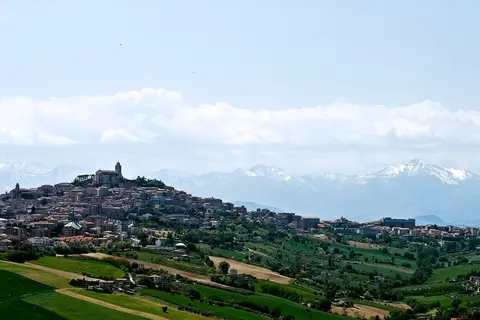
Le Marche lies on the central Adriatic coast between Emilia-Romagna to the north and Abruzzo to the south. Its name recalls the border territories (marches) of the Middle Ages. The land runs like a comb: numerous rivers flow in parallel from the Apennines to the coast, carving out valleys between ridges of hills covered with grain, sunflowers, and vineyards. In the southwest, the Sibillini Mountains rise, with Monte Vettore at over 2,400 meters (7,900 feet), marking the border with Umbria. The coast is mostly flat and sandy; only at Monte Conero near Ancona do white limestone cliffs drop steeply into the sea. The 2016 earthquakes caused severe damage in the south, and towns like Visso and Arquata del Tronto are still recovering today.
Pesaro, Fano, and the North
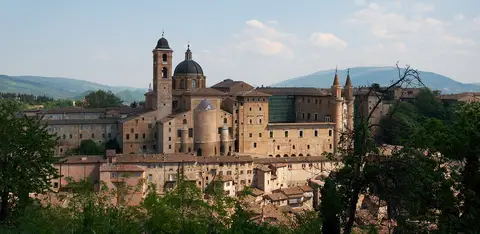
Pesaro is the birthplace of Gioachino Rossini and hosts the Rossini Opera Festival every August; in 2024 it was Italy's Capital of Culture. On the beach stands Arnaldo Pomodoro's bronze Great Sphere. Just a few miles to the south lies Fano, with an Arch of Augustus at the end of the Via Flaminia and a fishing harbor where the fish stew known as brodetto is prepared. Inland, you reach Urbino, whose Palazzo Ducale was turned into a center of the Renaissance by Duke Federico da Montefeltro; the entire old town is a World Heritage Site, and Raphael was born here. Nearby are the fortress towns of Gradara and San Leo.
Ancona and the Conero Riviera
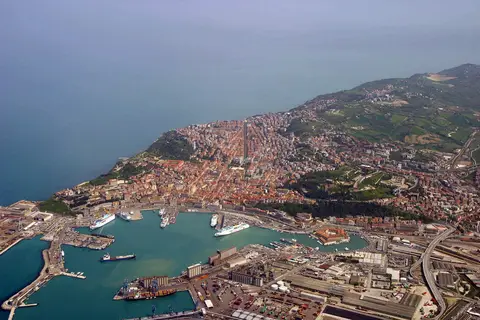
Ancona, the regional capital, is a major port with ferries to Croatia and Greece. The Romanesque Cathedral of San Ciriaco sits on a hill above the sea, and Trajan's Arch recalls the city's Roman past. South of the city, Monte Conero forms a nature park with coves such as Due Sorelle, reachable only by boat, and towns like Sirolo and Numana. North of Ancona lies Senigallia, with its broad Velluto beach, the Rocca Roveresca fortress, and the Summer Jamboree, a festival of 1950s rock 'n' roll. Inland stands the pilgrimage town of Loreto, whose basilica venerates the House of the Virgin Mary.
Sights in Le Marche: the South
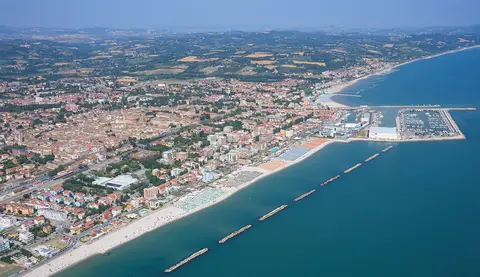
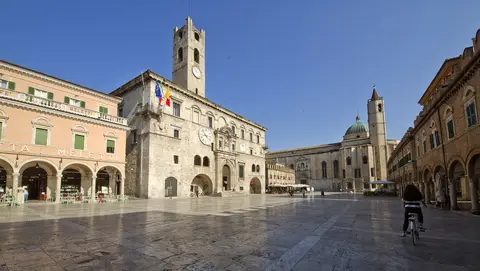
Ascoli Piceno is considered one of Italy's most beautiful small cities. The Piazza del Popolo is paved entirely in travertine and lined with arcades, and at Caffè Meletti you can sip the anise liqueur Anisetta. Fermo rises on a hill with a large piazza and Roman cisterns. On the coast, Civitanova Marche and San Benedetto del Tronto are among the most popular beach destinations in Le Marche, the latter with a promenade lined with thousands of palm trees and a large fishing harbor. In the hinterland, Macerata with its Sferisterio opera arena, Recanati as the home of the poet Leopardi, and the Frasassi Caves near Genga with their enormous stalactite halls are all worth a visit.
Food and Drink
The best-known specialty is olive all'ascolana, large green olives stuffed with meat, breaded, and deep-fried. Vincisgrassi is a rich variation on lasagna with a chicken-liver ragù. On the coast, brodetto is cooked differently from town to town; in Ancona, for example, it contains at least thirteen kinds of fish. The salami ciauscolo comes from Fabriano and is so soft you can spread it. Acqualagna in the north is a center for truffles. The white wine Verdicchio dei Castelli di Jesi and the red Rosso Conero are the best-known wines.
Getting There and Best Time to Visit
Ancona-Falconara Airport is served by only a few airlines; alternatively, you can fly into Bologna or Rimini. The Adriatic railway line connects the coastal towns quickly, and buses run into the interior, though a car is more convenient. The best times to visit are May, June, and September; in July and August the beaches are crowded, but the hills remain quiet. Numerous festivals take place in summer, such as the Quintana jousting tournament in Ascoli. In fall, truffle fairs and the grape harvest are worth planning around.