About Mausoleo di Teodorico
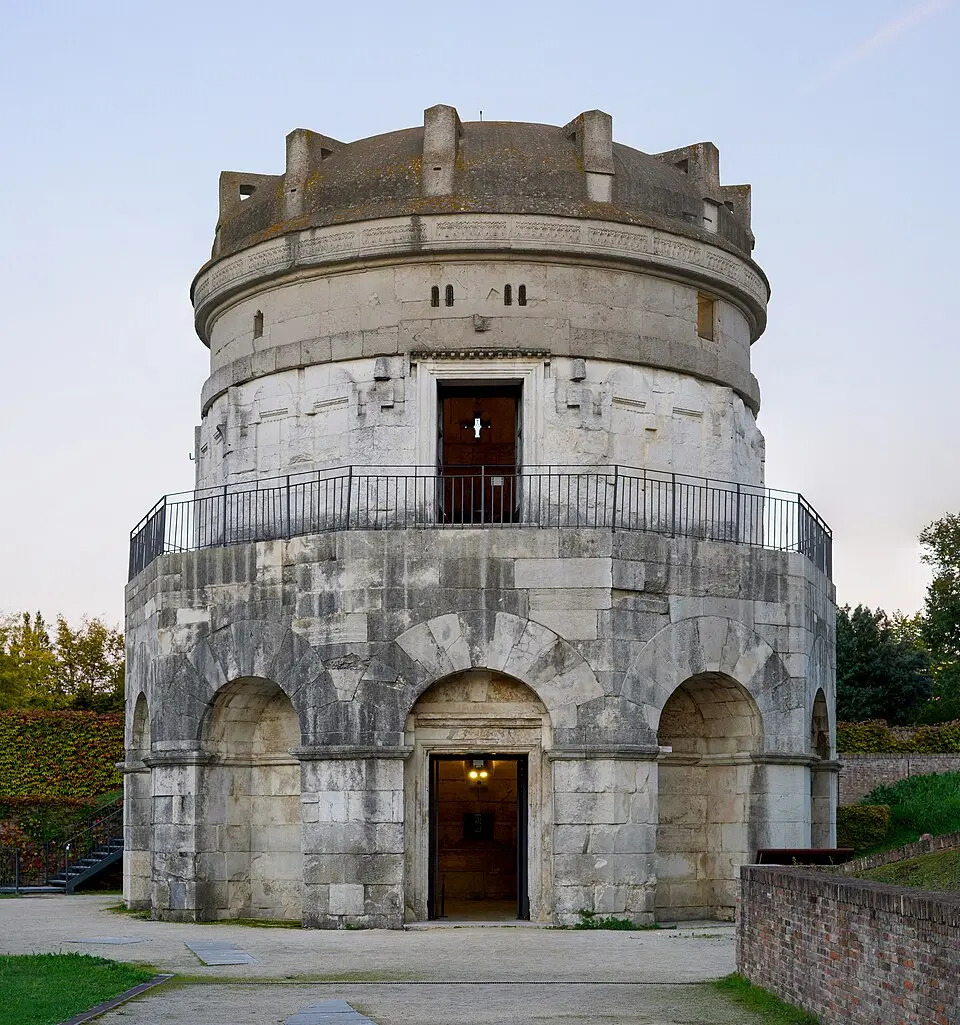
The Mausoleum of Theodoric in Ravenna is the final resting place of the Ostrogothic king Theodoric the Great. This unusual structure, built in the sixth century, is considered the Ostrogoths' most outstanding architectural achievement in Italy. Theodoric likely had the complex built for himself and the closest confidants of his court in the cemetery of the Gothic suburb. The name of the architect in charge has not come down to us in history, but the building clearly follows Roman architectural models. In terms of date, the monument stands at the transition from late antiquity to the pre-Romanesque period and shows parallels to the contemporary early Byzantine architecture that developed in the Exarchate of Ravenna. Despite these influences, the mausoleum represents a significant original achievement by the Ostrogothic settlers and underscores the cultural richness of the region.
The history of the tomb is closely tied to the fate of the Arian king. Theodoric was an Arian by creed, which led to a systematic erasure of his traces after the Byzantines under General Belisarius conquered Ravenna in 540. The Orthodox-Catholic clergy, who now had the upper hand, removed the king's sarcophagus from the mausoleum because it was regarded as that of a heretic. Afterward, the burial chamber was neglected for a long time and was half buried by flooding. It was only in 1918 and 1919 that the chamber was fully uncovered. These excavations also brought to light ancient wall remains and other relics in the immediate surroundings, including a gold-decorated breastplate that offers a glimpse into the material culture of the time.
Architecturally, the mausoleum impresses with its ten-sided, symmetrical floor plan with sides roughly 4.40 meters long. The structure has two stories; the lower level served as the burial chamber and is covered by a groin vault. The interior of this crypt has four niches arranged in a cross shape, none of which holds a sarcophagus today. One of the niches contains the entrance door. The exterior wall of the ground floor is decorated with ten arched niches secured by hook stones. This construction prevents the stones from slipping and assigns each block a specific position. The architecture appears to have been designed so that the people interred here were originally represented by life-size statues in the exterior niches, linking the interior with the outward perception of the monument.
The upper story, which can be reached only by an exterior staircase and a bridge, houses a round chapel. This staircase was not added until 1927 to make access easier. The walkway running around the upper story is about 1.30 meters wide and leads to the entrance door, which sits directly above the door of the lower level. Inside the chapel, an altar niche is set into the east wall. This niche once had a window, which is now walled up. The floor of the upper story was once laid with verde antico, an olive-green stone with characteristic veining that was prized for decoration in antiquity. The building's axis of symmetry runs roughly from west to east but deviates about ten degrees to the north.
The round roof dome, carved from a single block of natural stone, deserves special attention. With a diameter of about eleven meters, a height of 2.5 meters, and a weight of around 230 metric tons, it is a technical masterpiece. Twelve angular stone handles, used to lift the monolith, are integrated into the architectural composition. On the front of eight of these handles, the names of apostles and evangelists are engraved; the handle facing south originally bore the name Peter. At the top of the dome is a conical raised section, which probably served to hold a symbol or sculpture. With its shape and the corbels along the outer edge, the dome looks somewhat like a crown, underscoring the royal significance of the tomb.
Beneath the roof dome, a broad, band-shaped frieze with rectangular ornamental panels runs around the exterior wall. The pattern shows concentric rings and diagonal lines running downward, often described as pincer-shaped. This ornament recalls motifs from Germanic goldsmithing, pointing to a cultural connection. Other interpretations see the rings as possible guide rings for tent walls, emphasizing the resemblance of the building's form to a nomad's tent. The debate over the exact meaning of this frieze reflects the complex cultural identity of the structure, which combines both Roman and Germanic influences.
In the center of the chapel on the upper floor stands a massive porphyry basin. It is about 1.50 meters wide, one meter high, and originally about three meters long. The basin bears reliefs of anchor rings and a lion's head, which may suggest an association with water or a harbor. Although it has all the features of a bathtub and carries no Christian symbols, it has for centuries often been assumed to be Theodoric's sarcophagus. This reputation rests mainly on a ninth-century account. In fact, however, the basin lacks the typical features of a sarcophagus, and its artistic execution is rather plain compared with other surviving pieces from the period. It sits flat on the floor and today serves as the central feature of the room.
The mausoleum also had a later use that extended its significance beyond the Gothic context. Around the year 1000, it became part of a Benedictine monastery dedicated to the Virgin Mary. The monks used the upper story as an oratory. Because a lighthouse had been built onto the mausoleum at that time, the monastery was called S. Maria ad farum. In the Middle Ages, the tomb became a sought-after burial site for important figures, much like the Pantheon in Rome. For a time, the body of Pope Victor II rested in one of the sarcophagi before the remains were lost. The monastery was destroyed in the seventeenth century, and the mausoleum fell into oblivion until the mid-eighteenth century, when cleanup work uncovered it again.
Today the mausoleum is part of a UNESCO World Heritage Site, recognized in 1996 together with several early Christian churches in and around Ravenna. You can view the structure up close and experience the impressive stonework as well as the historical significance of the site. The complex offers insight into the art and architecture of the Migration Period and shows how different cultural currents merged into a unique monument. The combination of Roman building methods, Gothic tradition, and Byzantine influences makes the mausoleum a fascinating destination for travelers interested in history and culture.
The Mausoleum of Theodoric also served as a model for later architectural works. Its floor plan influenced the design of the Bismarck Mausoleum of 1899 and of the Bismarck Tower in Stettin in the early twentieth century. Other Bismarck towers and private mausoleums likewise show stylistic parallels to this tomb. These echoes attest to the enduring fascination the structure holds for architects and artists. It stands not only as a testament to Theodoric's rule but also as a symbol of the cultural diversity and artistic richness of the Ravenna region, which continues to draw visitors from around the world.
At a glance
- Category
- Sight › Monuments
- Rating
- no reviews yet · write a review
- Address
- Via delle Industrie, 14
48122 Ravenna, Italy - Phone
- +39054436136
- Website
- museiitaliani.it
- mn-ra.comunicazione@cultura.gov.it
- Coordinates
- 44.42500° N · 12.20921° E
- Data quality
- confidence 1.00
- Identifier
- ID d3703b68-078…
Part of the tour
Ravenna in One Day: Mosaics, Mausoleums, and Dante's Tomb →Location & surroundings
Toggle layersFAQ about Mausoleo di Teodorico
quick answersWhat is the Mausoleo di Teodorico in Ravenna?
The Mausoleo di Teodorico in Ravenna is the tomb of the Ostrogothic king Theodoric the Great and was built in the sixth century. It is considered the Ostrogoths' most outstanding architectural achievement in Italy and stands at the transition from late antiquity to the pre-Romanesque period. Theodoric probably had it built for himself and his closest confidants in the cemetery of the Gothic suburb. You'll find the mausoleum at Via delle Industrie, 14.
Why is there no longer a sarcophagus in the Mausoleum of Theodoric in Ravenna?
Theodoric's sarcophagus was removed by the Orthodox-Catholic clergy because the king was an Arian and was regarded as a heretic. After the Byzantines under General Belisarius conquered Ravenna in 540, traces of him were systematically eliminated. The tomb was then neglected for a long time and half buried by floods until it was completely uncovered in 1918 and 1919. During these excavations, finds in the surrounding area included ancient wall remains and a gold-decorated breastplate.
How is the Mausoleo di Teodorico in Ravenna constructed?
The Mausoleo di Teodorico in Ravenna has a symmetrical, decagonal floor plan with sides of about 4.40 meters and consists of two stories. The lower story served as the burial chamber, is covered by a groin vault, and has four niches arranged in the shape of a cross; on the outside, it is decorated with ten arched niches whose stones are secured by clamp stones. You reach the upper story, with its round chapel space, via an exterior staircase and a bridge, although the staircase wasn't added until 1927. From there, a passage about 1.30 meters wide leads to the entrance door, which sits directly above the door of the lower story.
What can you see around the Mausoleo di Teodorico in Ravenna?
Around the Mausoleo di Teodorico in Ravenna, there are several historic sites less than a kilometer away. travelguide195 lists, among others, the Parco Pubblico Rocca Brancaleone about 400 meters away, the Porta Serrata about 660 meters away, and the Basilica dello Spirito Santo about 850 meters away. Within a 500-meter radius, travelguide195 also lists around 10 restaurants.
Are there tours that include the Mausoleo di Teodorico in Ravenna?
Yes, the Mausoleo di Teodorico in Ravenna is part of the tour "Ravenna in One Day: Mosaics, Mausoleums and Dante's Tomb." This tour combines the tomb of the Ostrogothic king Theodoric with other stops in Ravenna focused on mosaics, mausoleums, and Dante's tomb.
Ratings & comments
none yetNear Mausoleo di Teodorico
closest 5 per category · 2 kmSights
Restaurants
Museums
Hotels
More:All sights in Ravenna (65)
184 places within 2 km loaded.
Don't miss in Ravenna
All sights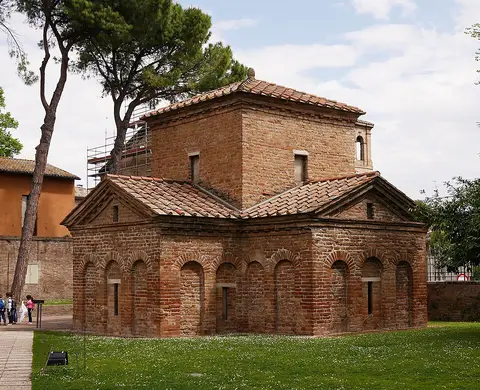 Historic sites01
Mausoleo di Galla Placidia
Via San Vitale, 17 · Ravenna● Website● Phone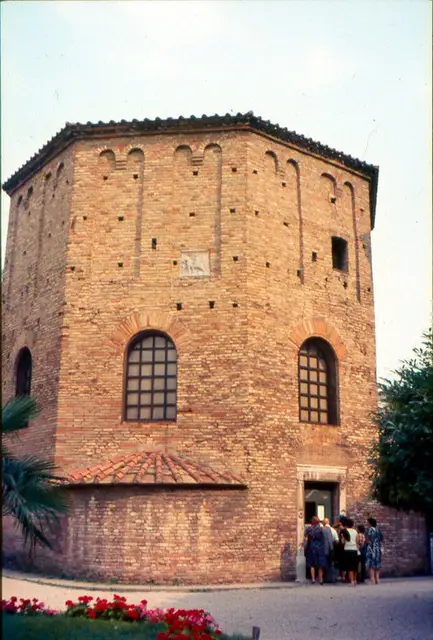 Historic sites02
Battistero Neoniano
P.za Arcivescovado, 1 · Ravenna● Website● Phone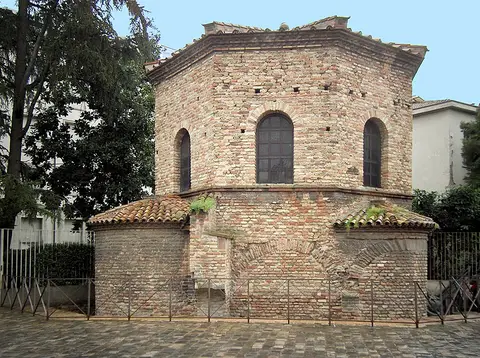 Historic sites03
Battistero degli Ariani
Piazzetta degli Ariani · Ravenna● Website● Phone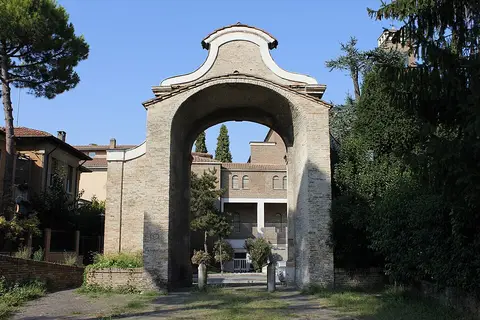 Historic sites04
You need a free account to leave reviews and photos – that keeps comments genuine and lets you edit them later.
Built in the 6th century for the powerful king of Ostrogoths. The monument is also included in UNESCO World Heritage list.
Source: Wikivoyage, „Ravenna“ · authors per page history · CC BY-SA 4.0 · as of 4/19/2016