About San Giovanni a Carbonara
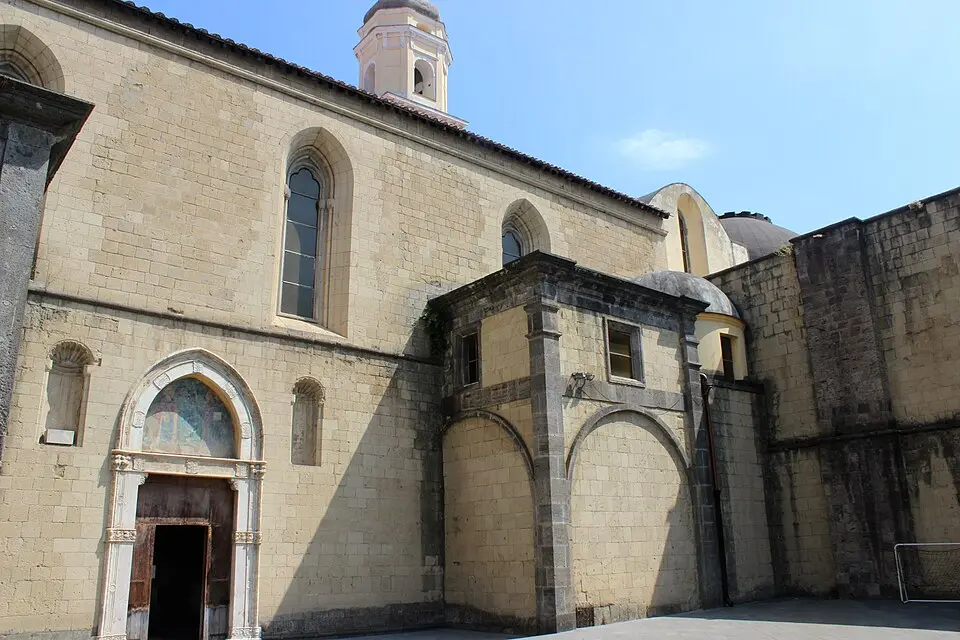
San Giovanni a Carbonara is a major religious complex in Naples, located at the end of Via Carbonara. The name comes from the site's historical use: in the Middle Ages, trash was burned here and tournaments were held. Construction began in 1343 on the initiative of the nobleman Gualtiero Galeota, who donated land to monks so they could build a place of worship for John the Baptist. In the early 15th century, King Ladislao had the complex expanded and chose the church as his burial place. This era also saw the creation of the large cloister, where famous humanists such as Giovanni Pontano and Jacopo Sannazaro used to meet. Later, the monastery was supported by various branches of the Caracciolo family, which led to the construction of imposing funerary chapels. After the devastating earthquake of 1688 and heavy damage from bombing in World War II, the complex was restored several times.
The exterior of this intricate ensemble is dominated by a monumental double staircase of piperno stone, built in the early 1700s. It leads up to a facade that actually belongs to the Santa Monica chapel, while the real entrance to the church of San Giovanni is through a Gothic portal in a courtyard. This portal is adorned with the coats of arms of the Anjou dynasty and the Caracciolo del Sole family. Inside, the church is laid out as a Latin cross with a wooden roof truss. Here you can admire numerous works of art, including the Miroballo altar with its allegorical figures and the magnificent Cappella di Somma, whose walls and vaults are entirely decorated with frescoes and white marble.
The highlight of any visit is the tomb monument of King Ladislao in the apse. This work, usually attributed to Andrea da Firenze, combines Gothic forms with elements of the early Renaissance. The sarcophagus rests on four allegorical caryatids representing virtues such as strength and temperance. Above them are seated figures of the kings and the archangel, topped by an equestrian statue of the king. Passing through the caryatids, you reach the circular Cappella Caracciolo del Sole, which is decorated with valuable majolica tiles and 15th-century frescoes. The tomb of Sergianni Caracciolo is also here. Other areas worth seeing include the Cappella Caracciolo di Vico, a High Renaissance masterpiece with marble columns and a coffered ceiling, as well as the three historic cloisters that surround the complex.
At a glance
- Category
- Sight › Historic sites
- Rating
- no reviews yet · write a review
- Address
- Via Carbonara, 4
80139 Naples, Italy - District
- Municipalità 4
- Phone
- +39081295873
- Website
- www.muddnapoli.it
- —
- Coordinates
- 40.85604° N · 14.26027° E
- Data quality
- confidence 0.98
- Identifier
- ID 74a3b800-ae4…
Part of the tour
The Old Town on Foot: From the Decumano to Pizzofalcone →Location & surroundings
Toggle layersFAQ about San Giovanni a Carbonara
quick answersWhat is San Giovanni a Carbonara in Naples?
San Giovanni a Carbonara is a major religious complex in Naples dedicated to John the Baptist. Construction began in 1343, after the nobleman Gualtiero Galeota donated the land to monks. In the early 15th century, King Ladislao had the complex expanded and chose the church as his burial place. After the earthquake of 1688 and severe bomb damage in World War II, the complex was restored several times.
How did San Giovanni a Carbonara get its name?
The name of San Giovanni a Carbonara in Naples goes back to the earlier use of the site. In the Middle Ages, trash was burned there, and tournaments were also held on the grounds. The "San Giovanni" part of the name refers to John the Baptist, to whom the sanctuary is dedicated.
What are the highlights inside San Giovanni a Carbonara?
The highlight of San Giovanni a Carbonara in Naples is the tomb monument of King Ladislao in the apse, usually attributed to Andrea da Firenze and combining Gothic forms with the early Renaissance. The sarcophagus rests on four caryatids representing virtues such as strength and temperance, and is crowned by an equestrian statue of the king. Passing through the caryatids, you reach the round Cappella Caracciolo del Sole, with majolica tiles, 15th-century frescoes, and the tomb of Sergianni Caracciolo. Also worth seeing are the Miroballo altar, the Cappella di Somma decorated with frescoes and white marble, the High Renaissance Cappella Caracciolo di Vico, and the three historic cloisters.
Where is San Giovanni a Carbonara, and where is the church entrance?
San Giovanni a Carbonara is located at the end of Via Carbonara (address: Via Carbonara, 4) in Naples' Municipality 4 district. From the outside, the monumental double staircase of piperno stone from the early 1700s stands out. However, it leads to the facade of the Santa Monica chapel; to reach the actual entrance to the church of San Giovanni, you go through a Gothic portal in a courtyard, decorated with the coats of arms of the Anjou and the Caracciolo del Sole family.
What can you see around San Giovanni a Carbonara in Naples?
Near San Giovanni a Carbonara in Naples is the Museo Madre of contemporary art, about 165 meters away. The church is also part of the tour "Old Town on Foot: From the Decumano to Pizzofalcone." For a break, travelguide195 lists around 95 restaurants within 500 meters.
Ratings & comments
none yetNear San Giovanni a Carbonara
closest 5 per category · 2 kmSights
Restaurants
Museums
Hotels
More:Historic sites in Naples (304)Sights in Municipalità 4 (61)All sights in Naples (377)
296 places within 2 km loaded.

You need a free account to leave reviews and photos – that keeps comments genuine and lets you edit them later.