About S. Martino
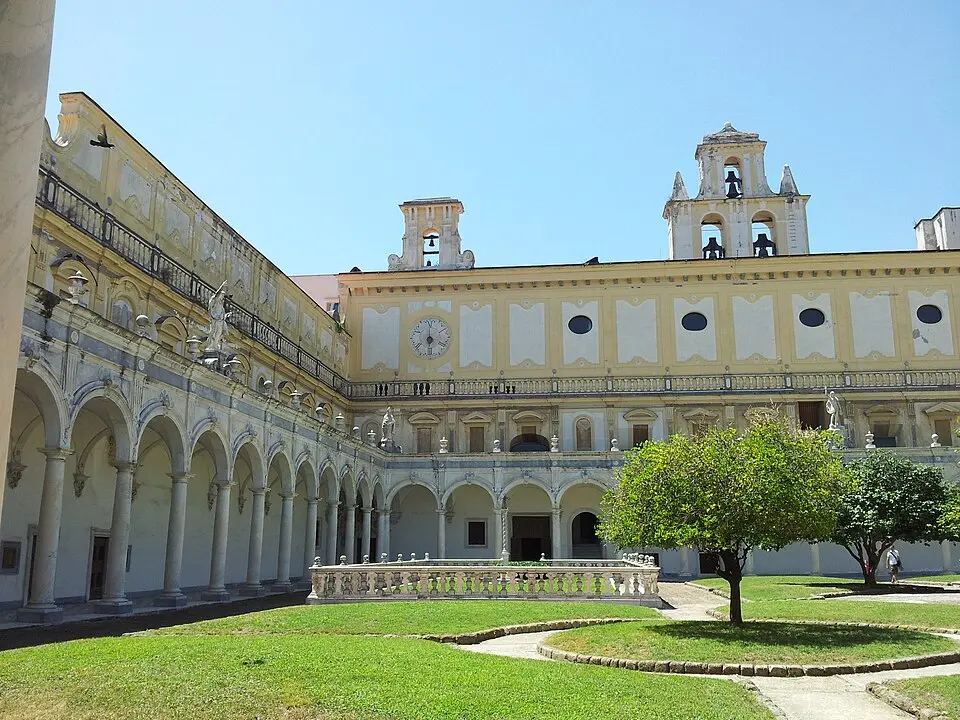
The Chiostri di San Martino form the heart of the monumental Certosa di San Martino complex in Naples. The history of this site goes back to the 14th century, when the first and, at the time, only cloister was built on the initiative of Robert of Anjou and his son Charles. The complex was originally defined by a large, square courtyard with seventeen arches on each side, while the area now known as the Chiostro dei Procuratori served as a garden for self-sufficiency and the cultivation of medicinal herbs. Not until the late 16th century, starting in 1578, did a comprehensive transformation begin under Giovanni Antonio Dosio. During this phase, the existing cloister was expanded into the Chiostro Grande and two further courtyards were created, establishing the monastery's present-day architectural structure.
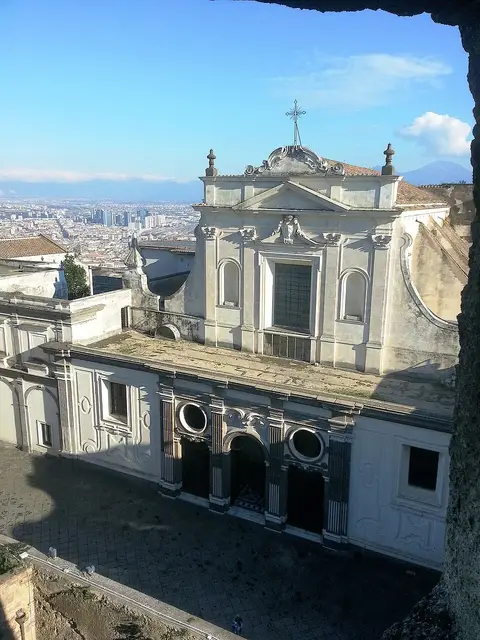
The Chiostro Grande is especially impressive, and its exact authorship is still debated today, as various architects, such as Cosimo Fanzago and Dosio, are considered possibilities. The courtyard stands out for its materials of gray and white marble and piperno, as well as an artful floor, completed between 1629 and 1643, that creates a play of light and shadow. The balustrade is decorated with Carrara marble spheres and white bowls, while eight life-size statues by artists such as Fanzago and Perasco adorn the upper level. In contrast, busts set in niches commemorate the holy founders and martyrs. Around the cloister are the former cells of the Carthusian monks, which offer sweeping views over the city.
Another highlight is the spectacular Mannerist-era cistern, a masterpiece of hydraulic engineering dug fifty meters deep into the rock. It can be reached via a tuff step and has a floating balcony with a balustrade of gray tuff. The water once flowed through small windows into the depths, where two keys are located, one of them set into the mouth of a marble statue. Northeast of the great cloister lies the Carthusian cemetery, another example of Fanzago's work, notable for decorative elements such as skulls and bones bound with ribbons. Here you will also find an Angevin marble cross commemorating the prior Pedro Villa Mayna.
At a glance
- Category
- Sight › Historic sites
- Rating
- no reviews yet · write a review
- Address
- Via Bondenese 107
44041 Naples, Italy - District
- Municipalità 5
- Phone
- +390516842219
- Website
- —
- —
- Coordinates
- 40.84400° N · 14.24043° E
- Data quality
- confidence 0.34
- Identifier
- ID d61b4fc2-685…
Location & surroundings
Toggle layersRatings & comments
none yetNear S. Martino
closest 5 per category · 2 kmSights
Restaurants
Museums
Hotels
More:Historic sites in Naples (304)Sights in Municipalità 5 (26)All sights in Naples (377)
300 places within 2 km loaded.


You need a free account to leave reviews and photos – that keeps comments genuine and lets you edit them later.