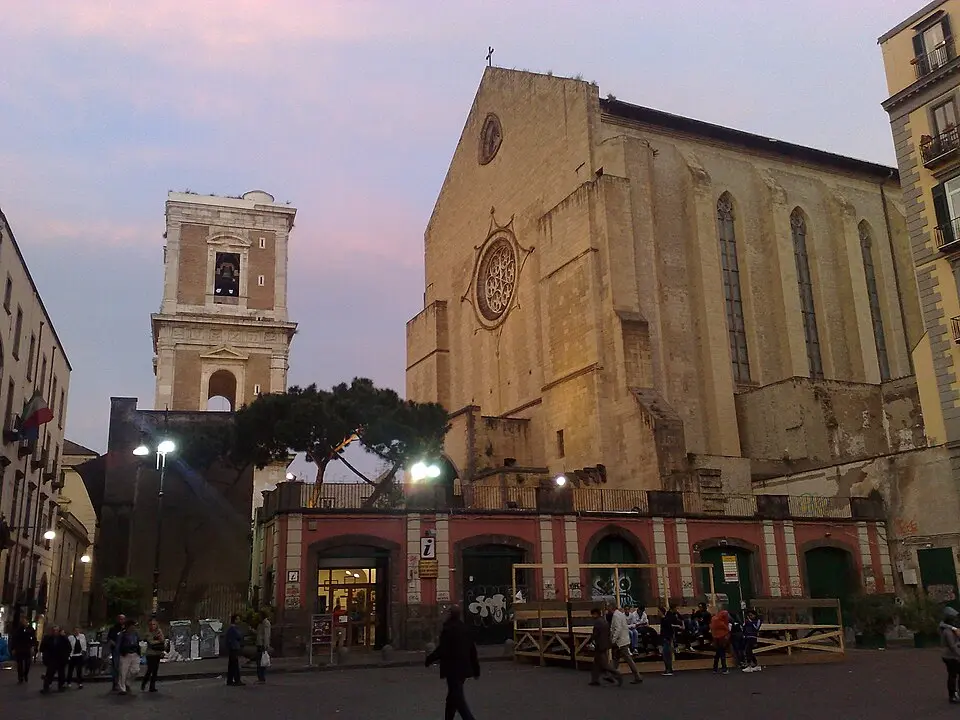
About Museo di Santa Chiara
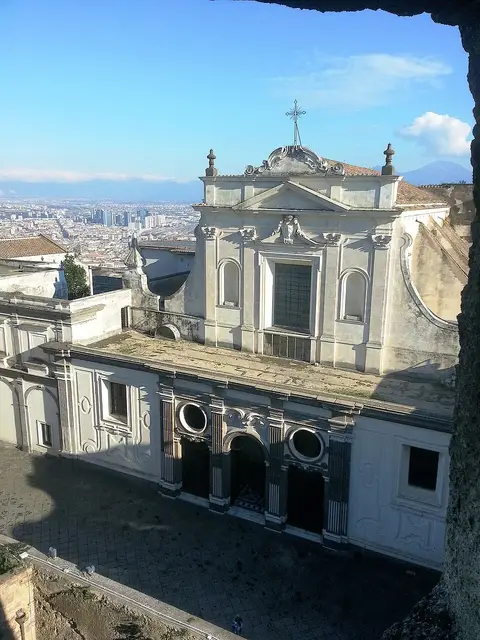
Santa Chiara in Naples is a historic complex made up of a former Poor Clares church, an adjoining monastery, and an archaeological museum. The original church was built between 1310 and 1340 under Robert of Anjou in the Provençal Gothic style. Famous artists such as Giotto and his workshop decorated the interior with frescoes, though only fragments of them survive today. In the 18th century the building underwent a thorough Baroque makeover, before it was almost completely destroyed in the Allied air raids of 1943. Reconstruction, which began in 1953, followed the idea of a so-called de-restoration, an approach that goes back to the architectural theorist Roberto Pane. The Baroque additions were removed and the building was rebuilt in the Gothic style, which means its present appearance is an architectural interpretation of the 20th century.
One particular highlight for visitors is the cloister, considered one of the most beautiful in Campania. It was laid out in the 14th century and later converted into a courtyard with a central cross-shaped pathway. Especially striking are the boundary walls, supports, and benches, which are completely covered with ornamental and figurative majolica tiles. These tiles were made by the artists Donato and Giuseppe Massa, who were pupils of Francesco del Grue. The church also houses an organ built in 1962, which sits in two cases to the left and right of the altar.
The basilica is also known as the burial place of Neapolitan kings. Four kings of the House of Bourbon-Two Sicilies, including Ferdinand I and Francis II, rest beneath the altar. Along the altar wall you will find the tombs of members of the House of Anjou, including the large monument to Robert of Anjou, created by Florentine sculptors. In one of the side chapels lie the remains of 44 other members of the royal dynasties, making this a place of great importance for remembering the history of Naples.
At a glance
- Category
- Museum › Museums (general)
- Rating
- no reviews yet · write a review
- Address
- Via Santa Chiara, 49/c
80026 Naples, Italy - District
- Municipalità 2
- Phone
- +390810606976
- Website
- www.monasterodisantachiara.eu
- info@monasterodisantachiara.eu
- Coordinates
- 40.84697° N · 14.25292° E
- Data quality
- confidence 0.97
- Identifier
- ID 5ec2bdae-63d…
Part of the tour
Naples in a Day: From Antiquity to the Gulf →Location & surroundings
Toggle layersRatings & comments
none yetNear Museo di Santa Chiara
closest 5 per category · 2 kmSights
Restaurants
Museums
Hotels
More:Museums in Municipalità 2 (30)All museums in Naples (128)
300 places within 2 km loaded.
You need a free account to leave reviews and photos – that keeps comments genuine and lets you edit them later.
A religious complex which includes the Church of Santa Chiara, a monastery, tombs, and an archaeological museum. The double monastic complex was built in 1313-1340 by Queen Sancha of Majorca and her husband King Robert of Naples. The original church was in traditional Provençal-Gothic style, but was decorated in the 1744 century in Baroque style by Domenico Antonio Vaccaro. Santa Chiara was the largest Clarissan church ever built, and it was the first Clarissan church built where the nuns in their choir would have been able to view the performance of Mass. The bell tower, separated from the main edifice, was begun in 1328 but was completed only in Renaissance times. The simple interior houses the tomb of King Robert and, in the side chapels, those of the Bourbon king of Naples, Francis II and his consort Maria Sophie of Bavaria, as well as of Queen Maria Christina of Savoy and of the national hero Salvo d'Acquisto (a carabiniere who sacrificed his own life to save the lives of 22 civilian hostages at the time of the Nazi occupation). Famous is the cloister of the Clarisses, transformed in 1742 by Vaccaro with the addition of precious majolica tiles in Rococò style. The Nuns' Choir houses fragments of frescoes by Giotto.
Source: Wikivoyage, „Naples“ · authors per page history · CC BY-SA 4.0