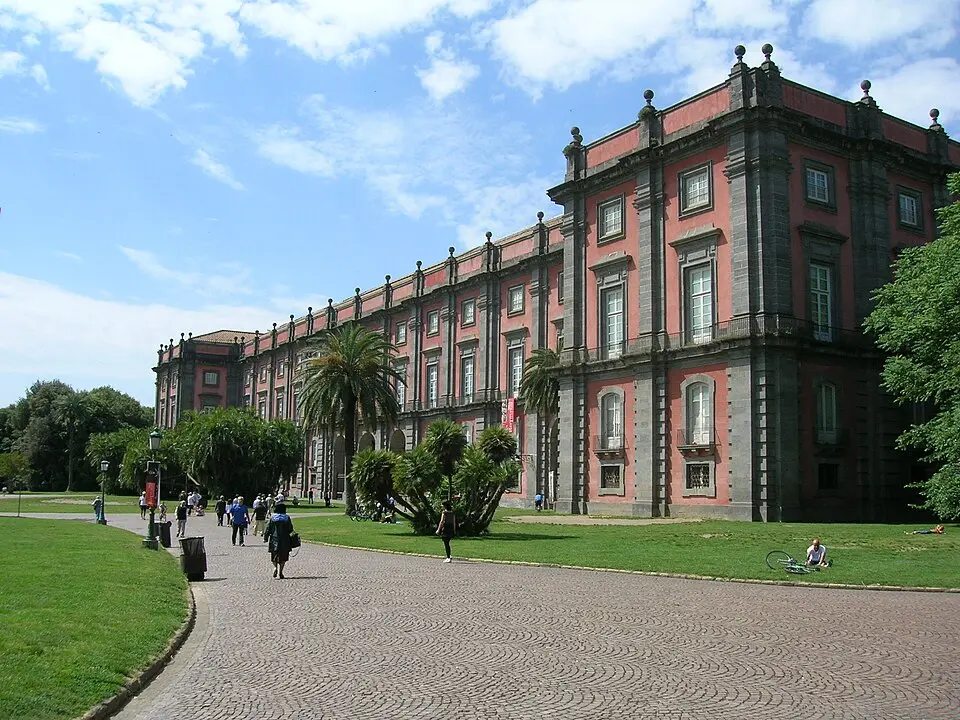
About Kapodimontės Muziejus
The Museo e Galerie Nazionali di Capodimonte in Naples is one of the city's most important cultural institutions and houses one of the most comprehensive painting galleries in Italy. Set in the Reggia di Capodimonte, a magnificent palace on a hill with sweeping views over the bay, the museum brings together artworks from the 13th to the 19th century. It displays not only European masterpieces but also a wide selection of exhibits from Neapolitan cultural heritage, including weapons, ceramics, and royal apartments. The complex is surrounded by a park of the same name, which offers visitors a peaceful setting in which to enjoy the art.
The history of the site is closely tied to the Bourbon dynasty. King Charles of Bourbon, who ascended the throne of Naples in 1734, was looking for a worthy home for the art treasures he had inherited from his mother, Elisabetta Farnese. This collection had been founded by Pope Paul III in the 16th century and had grown over generations. Because the royal palace in the city lacked suitable space and its proximity to the sea threatened the preservation of the works, Charles decided to have a new palace built on the hill of Capodimonte. Construction began in 1738, and by 1758 the first paintings were already on display in twelve large halls arranged by artist and school of painting.
Among the earliest visitors to the museum, which was still under construction at the time, were prominent figures such as Goethe, Winckelmann, and Canova. In 1787, Goethe watched an eruption of Vesuvius from the top floor, an experience he recorded in his Italian Journey. Despite this early significance, the palace temporarily lost its museum function in the 19th century. After the French occupation and the proclamation of the Parthenopean Republic in 1799, numerous works were looted or sold. During the ten years of French rule beginning in 1806, Capodimonte served primarily as a royal residence, and the collections were moved to other buildings.
After the Bourbons returned in 1815, the palace remained the residence of the royal family. Only with the unification of Italy and the appointment of Annibale Sacco as director of the palace did the museum function gradually return. Sacco and his staff began reuniting the scattered collections and arranging them chronologically. In the 20th century, the museum went through further turbulence. During World War II, many artworks were evacuated, and some masterpieces by Titian and Parmigianino fell into the hands of the German Wehrmacht. They were found after the war in a tunnel near Salzburg and returned to Naples in 1947.
The museum's definitive redesign took place in the 1950s. After the Dukes of Aosta moved out in 1946, the collections were permanently transferred to the Capodimonte Palace. The renovation work, funded by the Cassa del Mezzogiorno, was overseen by a team of art historians and architects. The museographic design, praised for its modernity and functionality, long served as a model for other museums. The museum officially opened in 1957 and initially presented the works by historical collection, later by chronology and school of painting, complemented by modern lighting technology.
The first floor of the palace houses the famous Farnese Gallery, which forms the core of the European painting collection. The collection is arranged by region of origin and in chronological order. Here you can admire works by Raphael, Titian, Parmigianino, Bruegel the Elder, El Greco, and the Carracci brothers. Particularly noteworthy is the extensive Titian collection, regarded as one of the most important in the world. In Room 14, the so-called Gallery of Rarities, precious objects such as amber, bronze, rock crystal, and majolica are on display, which were once housed in the cabinet of curiosities of the Dukes of Parma.
Besides the Farnese Gallery, the first floor holds the royal apartments. These rooms, some of which have retained their original appearance, show the lifestyle of the Bourbon kings. One highlight is the Porcelain Salon, which consists of more than three thousand pieces of porcelain and was originally made for Queen Maria Amalia of Saxony. The bedroom of Francis I is also worth seeing, with wall decoration reminiscent of the frescoes of Pompeii. The Farnese and Bourbon armory and the De Ciccio collection of applied arts round out the offerings on the first floor.
The second floor is home to the Neapolitan Gallery, which brings together works from the region. Here you can see masterpieces by Simone Martini, Caravaggio, Ribera, Luca Giordano, and Francesco Solimena. This collection documents the development of Neapolitan painting over the centuries. The same area also contains the d'Avalos collection with tapestries and the contemporary art department, which continues on the third floor. The 19th-century gallery is also housed there, showing works by artists of the Posillipo School and of Realism.
The mezzanine houses the Cabinet of Drawings and Prints, which comprises about 2,500 sheets and 25,000 prints. Highlights include drawings by Annibale Carracci, Guido Reni, and Giovanni Lanfranco, as well as works by Pontormo, Tintoretto, and Jusepe de Ribera. The collection of Count Karl Firmian, which contains more than 20,000 prints by Albrecht Dürer and Rembrandt, is also displayed here. The ground floor and lower level hold the visitor center, an auditorium for conferences and concerts, and rooms for temporary exhibitions.
The Borgia Collection, acquired in 1817, is housed in Room 7. It includes artworks from the Orient and the colonies that Cardinal Borgia collected in the 18th century. The collection is divided into sacred, Arab-Cypriot, and Indo-Christian sections and offers insight into the cultural exchange of the time. Capodimonte is thus not only a place of European art history but also a window onto Naples' global cultural connections.
With more than 260,000 visitors in 2017, the Museo e Galerie Nazionali di Capodimonte is one of Italy's most visited state museums. It offers a unique combination of historic architecture, royal splendor, and one of the richest painting galleries in Europe. The careful curation and modern presentation make a visit an impressive experience that underscores the cultural importance of Naples as a historic metropolis.
At a glance
- Category
- Museum › Art museums
- Rating
- no reviews yet · write a review
- Address
- —
Naples, Italy - District
- Municipalità 3
- Phone
- —
- Website
- www.museo-capodimonte.it
- —
- Coordinates
- 40.86701° N · 14.25053° E
- Data quality
- confidence 0.80
- Identifier
- ID 9ecba38e-5ad…
Location & surroundings
Toggle layersRatings & comments
none yetNear Kapodimontės Muziejus
closest 5 per category · 2 kmSights
Restaurants
Museums
Hotels
More:Art museums in Naples (31)Museums in Municipalità 3 (21)All museums in Naples (128)
261 places within 2 km loaded.
You need a free account to leave reviews and photos – that keeps comments genuine and lets you edit them later.