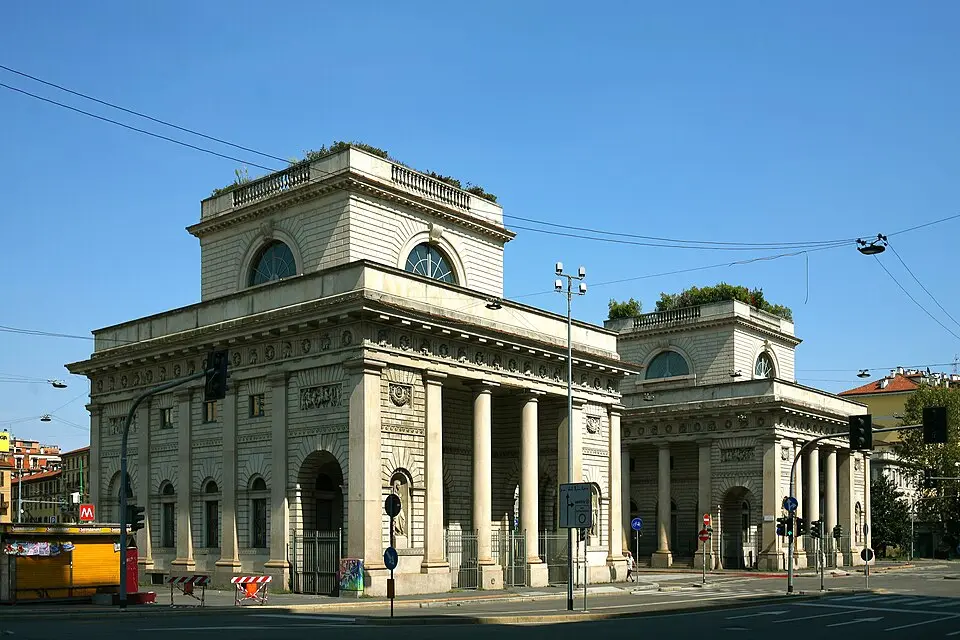
About Porta Venezia
Porta Venezia, also known as Porta Orientale until 1860, is one of Milan's historic city gates and was given a monumental redesign in the 19th century. Its development began as early as the late 18th century, when the Habsburg government turned the city walls into a recreation area and laid out the adjoining public gardens. Originally, the ring of walls served mainly to collect the municipal consumption tax. Following an unrealized design by Giuseppe Piermarini, his student Luigi Cagnola created a temporary triumphal arch in 1806 for the entry of Viceroy Eugène Beauharnais. The final Neoclassical form was built starting in 1825, on the occasion of Emperor Francis I's visit. The flanking side buildings, which served as customs offices, were designed by Rodolfo Vantini and completed in 1827 and 1828, respectively. With the addition of statues and reliefs in 1831, the gate acquired the monumental appearance it has today.
At a glance
- Category
- Sight › Historic sites
- Rating
- no reviews yet · write a review
- Address
- Bastioni di Porta Venezia, 1
20121 Milan, Italy - District
- 1
- Phone
- +390220245255
- Website
- www.portaveneziaindesign.com
- info@portaveneziaindesign.com
- Coordinates
- 45.47433° N · 9.20522° E
- Data quality
- confidence 0.99
- Identifier
- ID 7c8557df-ac6…
Location & surroundings
Toggle layersFAQ about Porta Venezia
quick answersWhat is the Porta Venezia in Milan?
The Porta Venezia is one of Milan's historic city gates, which was given a monumental Neoclassical makeover in the 19th century. Until 1860, the gate was also known as the Porta Orientale. You'll find the Porta Venezia at Bastioni di Porta Venezia, 1, right next to the public gardens, which were laid out in the late 18th century under Habsburg rule.
How did the Porta Venezia in Milan come about?
The Porta Venezia in Milan as you see it today took shape gradually between 1806 and 1831. The ring of walls originally served mainly to collect the municipal consumption tax, until the Habsburg government turned the city walls into a recreational area in the late 18th century. In 1806, Luigi Cagnola, a student of Giuseppe Piermarini, created a temporary triumphal arch for the entry of Viceroy Eugène de Beauharnais. Starting in 1825, the final Neoclassical design followed on the occasion of Emperor Francis I's visit, and with statues and reliefs the gate acquired its present appearance in 1831.
Who designed the side buildings of the Porta Venezia?
The two side buildings of the Porta Venezia in Milan were designed by Rodolfo Vantini. They served as toll offices and were completed in 1827 and 1828, respectively. Together with the central gate, they form the monumental ensemble at the edge of the public gardens.
What can you see around the Porta Venezia in Milan?
Around the Porta Venezia in Milan, several historic buildings and a museum are within walking distance. The Albergo Diurno is only about 29 meters away, the Palazzo e Torre Rasini about 88 meters, and the Palazzo Luraschi about 95 meters. In about 132 meters you reach the Fondazione Luigi Rovati art museum, and the Casa Galimberti (about 149 meters) and the Monumento a Ruggiero Giuseppe Boscovich (about 156 meters) are also nearby.
Are there restaurants and tours near the Porta Venezia in Milan?
Yes, the area around the Porta Venezia in Milan offers a wide range of dining options. travelguide195 lists around 258 restaurants within 500 meters of the city gate. The Porta Venezia is also part of the tour "Milan for Food Lovers: From Mozzarella Lunch to Cocktail Night in the Ticinese."
Ratings & comments
none yetNear Porta Venezia
closest 5 per category · 2 kmSights
Restaurants
Museums
Hotels
More:Historic sites in Milan (455)Sights in 1 (254)All sights in Milan (573)
300 places within 2 km loaded.
You need a free account to leave reviews and photos – that keeps comments genuine and lets you edit them later.
Known by its current name since 1862, this gate has origins that can be traced back to the Roman Empire. The current rather massive gate structure consists of two buildings and was completed in 1828.
Source: Wikivoyage, „Milan/North“ · authors per page history · CC BY-SA 4.0