Museum · Art museums
La Última Cena de Leonardo da Vinci
Santa Maria delle Grazie, Via Giuseppe Antonio Sassi, 3, 20123 Milan
About La Última Cena de Leonardo da Vinci
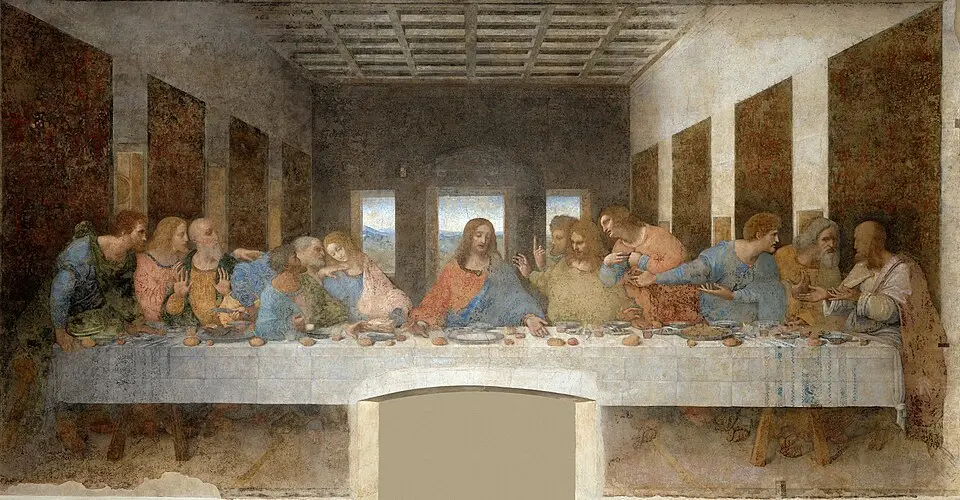
In the refectory of the Dominican convent of Santa Maria delle Grazie in Milan hangs one of the most famous works of art in world history: The Last Supper by Leonardo da Vinci. This monumental mural, which takes up almost the entire north end wall of the dining hall, shows Jesus Christ and his twelve apostles at the moment he announces that one of them will betray him. The work was painted between 1495 and 1497 on commission from Ludovico Sforza, Duke of Milan, who had the convent expanded to serve as his family's future burial place. Although the painting began to deteriorate shortly after its completion because of the unsuitable technique Leonardo chose, it quickly became famous and came to epitomize Renaissance art.
The composition deliberately breaks with the conventional depictions of the Last Supper that came before it. Rather than showing the figures in static groups, Leonardo captures the emotional shock of the apostles immediately after Jesus says that one of them will betray him. The disciples are rendered in dynamic, agitated gestures that send a wave of astonishment and dismay through the scene. Jesus himself sits in the calm center, his hands pointing to the bread and wine, which also symbolizes the institution of the sacrament of the Eucharist. Strikingly, there are no halos, and no chalice or host in the traditional sense, which brings the scene closer to the human realm.
Leonardo arranges the apostles in groups of three to show their differing reactions to the announcement of the betrayal. At the far left, Bartholomew, James the Less, and Andrew show their surprise. Next to them, Peter leans toward John, while Judas Iscariot, recognizable by the small bag of money he holds, sits apart, gazing into the distance. To the right of Jesus, James the Greater spreads his arms wide, forming a barrier to the questioning gestures of Thomas and Philip. The entire arrangement is held together by a precise central perspective whose vanishing point lies at the temple of the figure of Christ. This perspective construction creates the impression that the room behind the table extends in three dimensions into the distance, an effect underscored by two windows and a doorway opening onto a landscape.
Particularly interesting is the painting technique Leonardo used, a secco painting applied to dry plaster. Instead of the usual fresco technique, he tried to achieve the effects of oil painting on a wall by using a rich egg tempera over a chalk ground. This experimental method proved disastrous for the durability of the work. Fine cracks appeared even during Leonardo's lifetime, and over the centuries paint flaked off across large areas. A door was also later cut into the wall, which destroyed the feet of the figure of Christ. Despite this damage, the painting has been restored several times, including during the Napoleonic occupation, when the refectory served as a horse stable, and after a bombing raid in 1943, when the friars successfully protected the painting with sandbags.
The last major restoration, led by restorer Giuseppina Brambilla Barcilon and completed in 1999, was of enormous importance. Using modern techniques, the team managed to halt further deterioration, remove later overpainting, and conserve Leonardo's original passages. Today, access to the work is strictly regulated. Visitors can view The Last Supper only in small groups and at fixed times, since the air in the room must be kept stable by special climate control to protect the fragile painting. The ideal viewing position is roughly four to four and a half meters (about 13 to 15 feet) above the floor, which shows off the painting's perspective effect to best advantage.
Over the centuries, The Last Supper has been received in many different ways. Already in Leonardo's lifetime it was highly praised by contemporaries such as Matteo Bandello and Giorgio Vasari, and numerous copies were made that give an impression of its original condition. In the 20th century, the church and the painting together were designated a UNESCO World Heritage Site. The painting continues to inspire artists, filmmakers, and writers. From adaptations in the visual arts, such as the work of Salvador Dalí or Andy Warhol, to cinematic references in works like "The Da Vinci Code" or "M*A*S*H," the enduring cultural relevance of this masterpiece is evident. It remains a place where history, art, and spirituality merge in fascinating ways.
At a glance
- Category
- Museum › Art museums
- Rating
- no reviews yet · write a review
- Address
- Santa Maria delle Grazie, Via Giuseppe Antonio Sassi, 3
20123 Milan, Italy - District
- 1
- Phone
- —
- Website
- www.laultimacenademilan.com
- —
- Coordinates
- 45.46596° N · 9.17042° E
- Data quality
- confidence 0.59
- Identifier
- ID 181d1707-d9f…
Part of the tour
Milan in One Day: Leonardo, Poldi Pezzoli and 20th-Century Art →Location & surroundings
Toggle layersRatings & comments
none yetNear La Última Cena de Leonardo da Vinci
closest 5 per category · 2 kmSights
Restaurants
Museums
Hotels
More:Art museums in Milan (69)Museums in 1 (110)All museums in Milan (209)
300 places within 2 km loaded.
You need a free account to leave reviews and photos – that keeps comments genuine and lets you edit them later.