County Galway: City of Music and Connemara
Travel guide · editorialWest of Galway, the roads seem to run out and Connemara begins: bog, granite, stone walls, and the light of the Atlantic. A vacation in County Galway combines a young, musical city with one of Ireland's most unspoiled landscapes and the Aran Islands just off the coast. Here in the Gaeltacht, Irish is still spoken in everyday life.
Landscape Between Lough Corrib and the Atlantic
The large lake of Lough Corrib divides the county into two worlds. To the east lie flat, fertile pastures with towns like Tuam and Ballinasloe; to the west lies rocky Connemara, with the mountain ranges of the Twelve Bens and the Maumturks. The coastline is ragged, full of bays and islands. In Galway Bay lie the three Aran Islands of Inis Mór, Inis Meáin, and Inis Oírr, whose limestone belongs geologically to the Burren.
Galway City
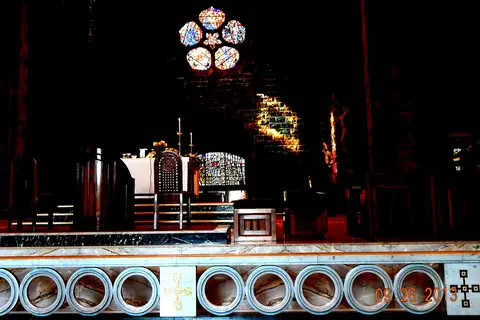
Galway is a university town, and that shapes the mood: street musicians on Shop Street, packed pubs in the Latin Quarter, theaters, and festivals. The Spanish Arch recalls trade with Spain, while Lynch's Castle and the cathedral recall the history of the fourteen merchant families known as the "Tribes of Galway." In July the Galway International Arts Festival draws artists from around the world, followed at the end of July by the horse races. The Salthill promenade is the place for a stroll, and locals jump into the sea here all year round.
Sights in County Galway
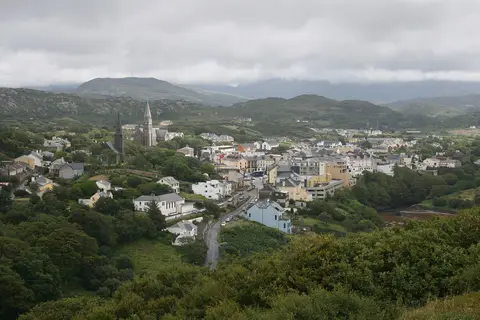
The best way to explore Connemara is by car or bike: Kylemore Abbey sits mirrored in the lake, and Connemara National Park near Letterfrack offers trails up Diamond Hill. Clifden, the unofficial capital of Connemara, is the starting point for the Sky Road, with views over the islands. On Inis Mór, the prehistoric fort of Dún Aonghasa sits high above steep cliffs; you can rent bikes right at the harbor. In the east, the monastery ruins of Clonfert and Dunguaire Castle near Kinvara are worth a visit.
Gaeltacht and Island Life
West of the city, along the coastal road through Spiddal and Carraroe, begins the largest Irish-speaking area in the country. Place-name signs here are in Irish only, and the radio station Raidió na Gaeltachta and the TV channel TG4 are based in the area. Small workshops produce Aran sweaters, whose knitting patterns were once assigned to particular families. On the Aran Islands, dry-stone walls, tiny fields, and limestone slabs define the scenery; many residents speak Irish as their first language. The smallest island, Inis Oírr, is best explored on foot or by pony and trap, past the wreck of the Plassy, which has lain on the beach since 1960.
Food, Getting There, and Best Time to Visit
Galway is famous for oysters, celebrated in September at the Oyster Festival, as well as for Connemara lamb and smoked salmon. Galway has no scheduled-service airport of its own; Shannon and Dublin are the usual arrival points, and trains and buses run regularly to Galway. Ferries to the Aran Islands depart from Rossaveal, and small planes from Inverin. The best time to visit is between May and September, though July books up early because of the festivals. In fall and winter, Connemara is quieter, the colors of the bog and mountains grow richer, and in the pubs of Clifden and Roundstone it is mostly locals who sit by the peat fire.