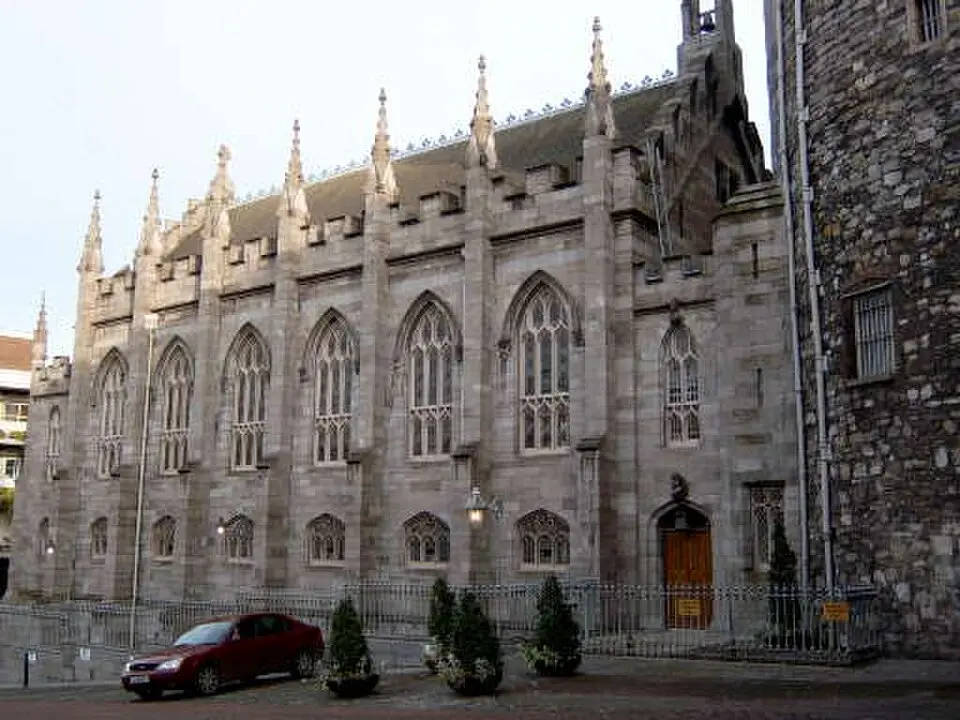
About The Chapel Royal
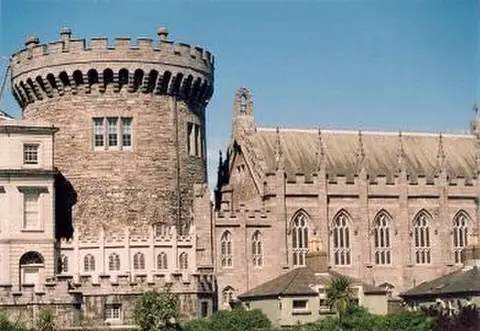
The Chapel Royal at Dublin Castle is an outstanding example of 19th-century Gothic Revival architecture. Designed by Francis Johnston, Ireland's leading architect at the start of the 19th century, it replaced a dilapidated earlier church that had been built on soft ground near the old castle moat. To overcome the structural challenges of the site, the building was constructed on a lightweight timber framework. Construction began in 1807 and took seven years, with the chapel opening on Christmas Day 1814. Its interior is considered one of the most magnificent of its kind in Ireland. The large stained-glass window above the altar was donated by Lord Whitworth, while the ceiling decoration was created by George Stapleton and the larger figures by the sculptors Edward and John Smyth. Above the chancel window are life-size depictions of Faith, Hope, and Charity, while a special paint finish gives the timber vaults the appearance of stone.
Historically, from 1814 until the founding of the Irish Free State in 1922, the chapel served as the official Church of Ireland church for the household of the Lord Lieutenant of Ireland. Behind the galleries, a passage led to the bedrooms of the State Apartments, used by the viceroy and his entourage. The coats of arms of successive office-holders were carved into the galleries or, when space ran short, set into the windows. Notably, the last available window was taken by Viscount FitzAlan of Derwent, who served as the last Lord Lieutenant and was himself a Catholic. The organ case dates from 1857 and at various times housed instruments by William Telford and later by Gray and Davison; the instrument is no longer playable today.
After the office of Lord Lieutenant was abolished, the chapel was reconsecrated in 1943 as a Catholic garrison church and renamed the Church of the Most Holy Trinity. The Stations of the Cross were donated in 1946 by monks of Glenstal Abbey. Because of structural problems, the building was closed in the early 1980s and restored in the early 1990s. No regular services have been held here since 1983, but the space is occasionally used for concerts and other cultural events. The historical significance of the site was also picked up by the television series The Tudors, which filmed scenes here, such as the trial of Thomas More.
At a glance
- Category
- Sight › Historic sites
- Rating
- no reviews yet · write a review
- Address
- Dublin Castle, Castle St
D02 K540 Dublin, Ireland - Phone
- +35316458813
- Website
- ca.wikipedia.org
- —
- Coordinates
- 53.34311° N · -6.26623° E
- Data quality
- confidence 0.89
- Identifier
- ID 65816933-c6d…
Part of the tour
Dublin in One Day: The Classics for Your First Visit →Location & surroundings
Toggle layersRatings & comments
none yetNear The Chapel Royal
closest 5 per category · 2 kmSights
Museums
Hotels
More:Historic sites in Dublin (346)All sights in Dublin (393)
296 places within 2 km loaded.
You need a free account to leave reviews and photos – that keeps comments genuine and lets you edit them later.